
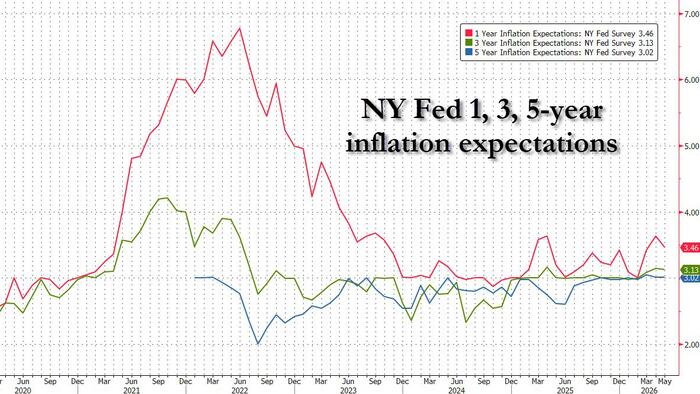
Ahead of Wednesday’s CPI report which is expected to show a substantial rise in consumer prices, moments ago we got an early look into how consumers view inflation after the NY Fed’s latest monthly survey of consumer expectations reported that inflation expectations at the one-year horizon dipped to 3.46% in May from 3.64% in April, easing from the highest print since September 2023. Inflation expectations were unchanged at 3.1% for the three-year-ahead horizon and also unchanged at 3.0% at the five-year-ahead horizon in May.
Median inflation uncertainty, or the uncertainty expressed regarding future inflation outcomes, increased at the one-year and three-year-ahead horizons and decreased at the five-year-ahead horizon.
The drop in year-ahead expectations took place as 1-year gas inflation expectations extended its recent decline, sliding to 4.96% in May from 5.11% in April and from 9.42% in March, which had been the highest reading since March 2022.

Among other prices, home price growth expectations increased to highest since July 2022.

Food and rent price outlooks also increased while medical care and college eased (good luck).

Turning to the labor market, sentiment continued to deteriorate with job-loss fears rising and probability of quitting at a three-year high despite unemployment rate seen edging lower and expected earnings growth steady.
Respondents said the mean perceived probability of finding a job if one’s current job was lost decreased by 2.3% to 43.7%, remaining below its 12-month trailing average of 46.8% and marking the lowest reading since December 2025.

The mean perceived probability of losing one’s job in the next twelve months increased by 0.5% to 15.1%, above the series’ 12-month trailing average of 14.4%. Despite that, the expected quit rate – the probability of leaving one’s job voluntarily in the next year, usually a sign of confidence in the labor market – rose in May to the highest since February of 2023. The increase was broad-based across age, education and income groups, the report said.

The report followed an unexpectedly strong employment report for May with job gains beating expectations. For Fed officials, the report put to rest for now concerns that the US labor market remained fragile and stoked worries over inflation. Policymakers’ preferred measure of inflation hit 3.8% in April, amid a spike in energy prices.
The New York Fed survey also reinforced other reports showing consumer sentiment is at record lows: the share of households who said their financial situation was worse than last year reached its highest level since January of 2023. More consumers also expected a deterioration in their finances in the year ahead.

Household finances outlook fell to lowest since Oct. 2022, with spending growth expected to moderate amid worsening credit access and delinquencies

The perceived probability of missing a minimum debt payment over the next three months rose by 1.2% points to 12.6%, staying below its 12-month trailing average of 12.9%. This increase was mostly driven by those with at most a high school degree and with annual household incomes below $100,000.

Here are some more details from the report:
Inflation
- Median home price growth expectations increased by 0.5% point to 3.5%. This is the highest reading since July 2022. The increase was most pronounced for the West and Midwest Census regions.
- Median year-ahead gas price growth expectations dropped by 0.1% point to 5.0%. Other commodity price change expectations increased by 0.6 percentage point for food to 5.8% and by 1.4 percentage points for rent to 7.4%, while they decreased by 0.7 percentage point for the cost of medical care to 8.9% and by 0.8 percentage point for the cost of a college education to 8.0%.
Labor Market
- Median one-year-ahead earnings growth expectations remained stable at 7% in May, remaining slightly above their 12-month trailing average of 2.6%.
- Mean unemployment expectations—or the mean probability that the U.S. unemployment rate will be higher one year from now—decreased by 0.4 percentage point to 43.2%, remaining above their 12-month trailing average of 41.1%.
- The mean perceived probability of losing one’s job in the next 12 months increased by 0.5 percentage point to 15.1%, above the series’ 12-month trailing average of 14.4%. The mean probability of leaving one’s job voluntarily, or the expected quit rate, in the next 12 months increased by 2.6 percentage points to 20.8%, its highest level since February 2023. The increase was broad-based across age, education, and income groups.
- The mean perceived probability of finding a job if one’s current job was lost decreased by 2.3 percentage points to 43.7%, remaining below its 12-month trailing average of 46.8% and marking the lowest reading since December 2025.
Household Finance
- The median expected growth in household income remained unchanged at 2.8% in May 2026.
- Median one-year-ahead nominal household spending growth expectations decreased by 0.4 percentage point to 5.0%, standing slightly above their trailing 12-month average of 4.9%. The decline was driven by respondents above age 60 and those with at most a high school degree and annual household incomes less than $50,000.
- Perceptions of credit access compared to a year ago remained largely unchanged, with a greater share of households reporting that credit availability was equally easy or difficult. Expectations for future credit availability deteriorated, with a lower share of respondents expecting it will be easier to obtain credit in the year ahead.
- The average perceived probability of missing a minimum debt payment over the next three months rose by 1.2 percentage points to 12.6%, staying below its 12-month trailing average of 12.9%. This increase was mostly driven by those with at most a high school degree and with annual household incomes below $100,000.
- The median expectation regarding a year-ahead change in taxes at current income level decreased by 0.3 percentage point to 3.1%.
- Median year-ahead expected growth in government debt decreased by 0.1 percentage point to 9.9%.
- The mean perceived probability that the average interest rate on savings accounts will be higher in 12 months decreased by 2.1 percentage points to 24.6%.
- Perceptions about households’ current financial situation compared to a year ago deteriorated, with a larger share of households reporting a worse financial situation, marking the highest reading since January 2023, and a slightly smaller share of households reporting a better financial situation. Year-ahead expectations about households’ financial situation also deteriorated, with an increase in the net share of households expecting a worse financial situation. The net share of households expecting a better versus worse financial situation in one year is at its lowest level since October 2022.
- The mean perceived probability that U.S. stock prices will be higher 12 months from now increased by 0.4 percentage points to 38.0%.
Source: NY Fed