
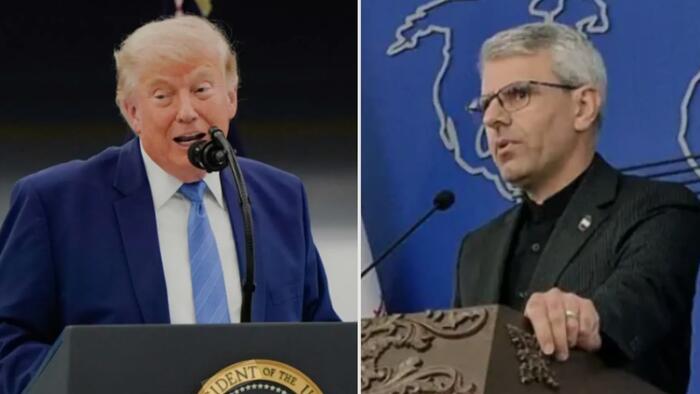
President Trump now says new talks with Iran will begin Monday afternoon after he called off a planned “massive attack” – following high level Saudi intervention, and also likely White House advisors and Pentagon leadership failing to agree on a strategic vision.
“The Saudis expressed concern and asked for clarity about the plan of action,” one US official told Axios over the weekend, with another saying that crown prince Mohammed bin Salman urged Trump to de-escalate and refrain from launching the strikes. Trump aknowledged all of this to reporters aboard Air Force One while returning from Bedminster, New Jersey, to Joint Base Andrews. He claimed the canceled attack would have been “the biggest attack since World War II” and could have been “disastrous” for Iran.
“I was asked to by Saudi Arabia, the UAE, by Qatar, and by Iran to hold off strikes,” Trump said. “It would have been a massive attack.” He added: “When the allies asked to call it off, you gotta say, Well, let’s see.”
.@POTUS “We had an attack that would have been the biggest attack since WORLD WAR II.
It would have been DISASTROUS FOR THEM.” pic.twitter.com/HnVYxw0EsV
— DOW Rapid Response (@DOWResponse) August 2, 2026
“I asked the Crown Prince of Saudi Arabia, ‘What would you rather have us do?'” Trump said. “He said, ‘We would prefer a deal rather than an attack.'” And more: “Allies think there is a deal,” Trump explained. “There is a deal on Hormuz, and it will be a deal on the nuclear.”
Iranian officials said there are currently no negotiations with the United States and that Tehran is not planning to send or host any delegations “these days.”
However, Iran has confirmed that it is deep into negotiations over managing the Strait of Hormuz with Oman, and that it desires to get more ships moving through the vital transit waterway. According to Bloomberg on Monday:
Iran suggested negotiations to get more ships moving through the Strait of Hormuz are making progress, after President Donald Trump called off what he said was a major attack on the Islamic Republic.
Oil fell on Monday, with Brent crude down about 4.5% to just over $83 a barrel, after Iran’s foreign minister, Abbas Araghchi, said discussions between Tehran and Oman over management of the strait are in the final stages.
While Tehran officials acknowledged that negotiations with Oman are ongoing and that progress has been made toward securing a temporary passage through the Strait of Hormuz, they stressed that reaching an agreement with Oman alone would not be enough to reopen the waterway, warning that the situation will remain unchanged as long as US “aggression” continues.
Iranian Foreign Ministry spokesman Esmail Baghaei conveyed also that China is concerned about “the escalation of conflict and insecurity in the region” and is working to prevent the situation from worsening. He described that there is no new mediator involved in contacts with Washington, with Pakistan and Qatar continuing to carry out that role.
On the broader conflict, Baghaei argued that the US-Israeli war on Iran is not merely a war against one country, but “a war against the entire region.” He laid out that Iran once again rejected attempts to tie developments in Yemen to the conflict with Iran, calling such claims “a form of evasion of responsibility.”
“We currently do not have negotiations with America,” and Iran had no plans to host foreign delegations or send negotiators abroad in the coming days, Foreign Ministry spokesperson Esmaeil Baghaei told reporters.
🔴 Iranian Foreign Ministry spokesman Esmaeil Baghaei says there are no talks with the US currently, adding that there are talks with Oman over Strait of Hormuz
🔴 Baghaei says working with Oman on a temporary safe route through Strait of Hormuz
🔴 Baghaei says reaching an… pic.twitter.com/9nd1T4lgNT
— Al Arabiya English (@AlArabiya_Eng) August 3, 2026
Meanwhile, the on-again, off-again style of escalation and de-escalation pattern we are witnessing is likely only helping Tehran’s side in terms of leverage, as the conflict grinds on and potentially becomes more politically costly for the White House.
Referring to the Iranians, Reuters writes in new analysis, “They see an opportunity in what they regard as President Donald Trump’s reluctance to become deeply entangled in another Middle East conflict ahead of November’s midterm elections.”
“The Iranians…believe that by widening the war and increasing the pressure, he will eventually give in,” a Gulf source is cited in the report as saying. “Trump thinks he can hit the Iranians hard and bring them to the negotiating table, but they won’t bend.” That much should be obvious by now, as Trump Tacos once again.
According to more from Reuters: “Iran is betting it can outlast Washington by turning the Middle East’s trade routes, shipping lanes and energy infrastructure into pressure points that steadily raise the cost of confrontation, according to Gulf officials and analysts.”
Who can outlast? This is currently month #6 of the war…
“Rather than seeking a decisive military victory, Tehran is pursuing a strategy of calibrated escalation aimed at widening the conflict without triggering full-scale war,” the report continues. But that much should have been obvious and anticipated from week one of the war, and clearly the US side underestimated things.
More Latest Developments
via Newsquawk
- US President Trump said the US is locked and loaded and ready to go against Iran, but they “have just been asked by Iran, and other Middle Eastern Countries, to hold off any attack in that the perimeters of a deal have been agreed to. This would include the Immediate, Complete, and Total OPENING OF THE HORMUZ STRAIT, and an end to Iran’s nuclear threat. Based on this request, I have agreed, for the future benefit of the WORLD and, likewise, the survival of a successful and prosperous Iran, to cancel the attack, subject to being able to rapidly make a DEAL.”
- In further comments, US President Trump said the Iran attack would have been a massive one if not paused, adding there’s a deal on Hormuz and there will be a deal on denuclearisation. He added that he was asked very strongly by Iran to hold off the attack. On negotiations, he said they will begin tomorrow afternoon.
- US CENTCOM was reported on Friday to have prepared a large-scale operation in the form of a decisive two-week bombing campaign should President Trump choose escalation to break the deadlock in the Middle East, according to The Hill reports, citing sources.
- US Central Command intelligence official wrote in an email that they are seeking new and unconventional ways to increase pressure on and punish Iran, according to an internal message circulated among military analysts, according to CNN
- Iran’s Foreign Ministry spokesperson said negotiations with Oman are progressing, with the two sides holding constructive talks on a new framework and exchanging maps over the past seven to eight days for review, IRNA reported.
- Iran’s Foreign Ministry spokesman Baghaei said Iran is working with Oman to establish a temporary security corridor in the Strait of Hormuz, adding that Tehran is not currently in dialogue with the US and is holding talks with Oman on the waterway. Baghaei added that issues with the US should be addressed at a later stage and that there are no plans to receive a US delegation or send an Iranian delegation in the coming days.
- Iranian Foreign Minister Araghchi told a cabinet meeting on Sunday that the negotiations with Oman to manage shipping through the Strait of Hormuz “were in the final stages”, according to FT. It was separately reported that Araghchi held phone calls with Saudi, Pakistan and Iraqi counterparts and exchanged views on the latest developments in the region, while he warned on Saturday against any adventurous action by the US and stressed Iran’s readiness to respond decisively to any aggression.
- Iranian lawmaker Qashqawi said there are no discussions with the US or talks on the nuclear issue, adding that US sanctions amount to war; lasting peace can only be pursued once the military, economic and media conflict ends, SNN reported.
- Iran’s Mehr News Agency rejected US President Trump’s claim that he halted attacks at the request of Iran and Middle East countries, while it called it “a new lie” and emphasised that Iran’s forces are on full alert.
- UKMTO said on Saturday it received a report of an incident 21 nautical miles northeast of Oman’s Khasab, where the master of the tanker saw a large splash and explosion in close proximity to the vessel, although no damage to the vessel was reported.
- Israel told the White House it has significant security concerns over a proposed Hamas disarmament agreement, saying intelligence suggests Hamas intends to rebuild its military capabilities rather than genuinely disarm. Israel added that it will not withdraw from most of Gaza until Hamas has fully completed the disarmament process.
- Palestinian civil defence said Israeli drone and airstrikes hit multiple locations across the Gaza Strip, killing at least 18 people, including two women and four children, with residential apartments, tents sheltering displaced people and civilian areas among the reported targets.
- Kpler shipping data showed 18 vessels passed through the Bab al-Mandeb on Sunday, compared to the 27 vessels on Saturday.