
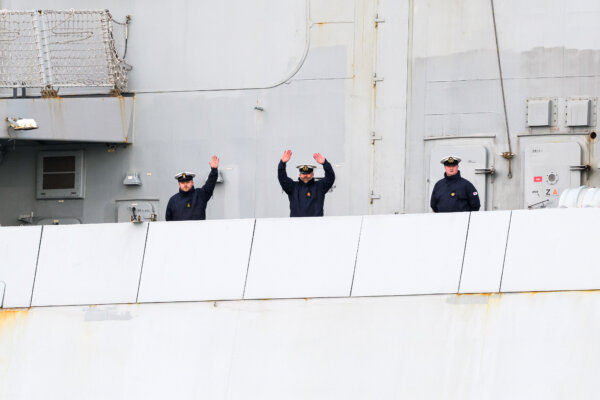
 Iran has warned France and the UK that deployment of warships near Hormuz will be met with a military response.
Iran’s deputy foreign minister for legal and international affairs, Kazem Gharibabadi, in a May 10 post on X, said that any deployment and stationing of destroyers around the Strait of Hormuz “will be met with a decisive and immediate response from the armed forces of the Islamic Republic of Iran.”
The UK and France will host the first meeting of the Strait of Hormuz coalition of defense ministers on May 12.
On May 11, the British Royal Navy released a statement saying that the warship HMS Dragon is heading to the Middle East ahead of a potential multinational Strait of Hormuz mission.
It said that the Type 45 destroyer “will forward deploy to ensure the UK can contribute to a future multinational mission to secure the critical waterway and safeguard freedom of navigation, following a sustainable ceasefire.”
The Royal Navy said that HMS Dragon “can use her Sea Viper missile system to help safeguard UK assets and interests—assisted by Wildcats from 815 Naval Air Squadron equipped with Marlet missiles able to deal with the aerial drone threat.”
On May 6, the French Armed Forces said the carrier strike group centered on its nuclear-powered aircraft carrier Charles de Gaulle had been deployed to the Red Sea and Gulf of Aden.
“The reason why we must make a renewed effort today is simply that the blockade of Hormuz continues, the damage to the world’s economy is therefore becoming more and more pronounced, and the risk of a prolongation of hostilities is too serious for us to accept it,” a French presidency official told reporters in a briefing after the army announced the strike group’s deployment.
“What we are proposing is that Iran gains passage for its ships through the Strait and in return commits to negotiating with the Americans on issues of nuclear materials, missiles, and the region, and we propose that the Americans, for their part, lift their blockade of the Strait of Hormuz and, in return, obtain Iran’s commitment to negotiations.”
Gharibabadi said that the Strait of Hormuz is “not the common property of extra-regional powers; it is a sensitive waterway adjacent to coastal states, and the exercise of sovereignty by the Islamic Republic of Iran over this strait and the determination of its legal arrangements is Iran’s right as a coastal state.”
“Any deployment and stationing of extra-regional destroyers around the Strait of Hormuz, under the pretext of ‘protecting shipping,’ is nothing but an escalation of the crisis, the militarization of a vital waterway, and an attempt to cover up the true root of insecurity in the region,” he said.
“I have just read the response from Iran’s so-called ‘Representatives.’ I don’t like it—totally unacceptable!” Trump wrote in a Truth Social post on May 10.
The Islamic Republic News Agency, the Iranian regime’s state-run news agency, said that current negotiations should focus exclusively on the cessation of hostilities in the region and that other issues, including Iran’s nuclear program, should be discussed later.
Iran’s response is focused on efforts to end the aggression on all fronts, including Israeli attacks on Lebanon, and to guarantee the security of shipping in the Persian Gulf, according to Iranian state TV.
A significant point of disagreement remains over the control of shipping through the Strait of Hormuz. Iranian state TV said the strait has been under Iranian control since the early days of the war.
It also said that the country has indicated that it is ready to reopen the strait if the war ends permanently and the United States lifts its sanctions and naval blockade.
The first phase of peace negotiations “must concentrate on shipping and sanctions, while signaling they are ready to discuss the country’s nuclear program in later stages of the talks with the U.S.,” Iran said, according to the Islamic Republic News Agency.