
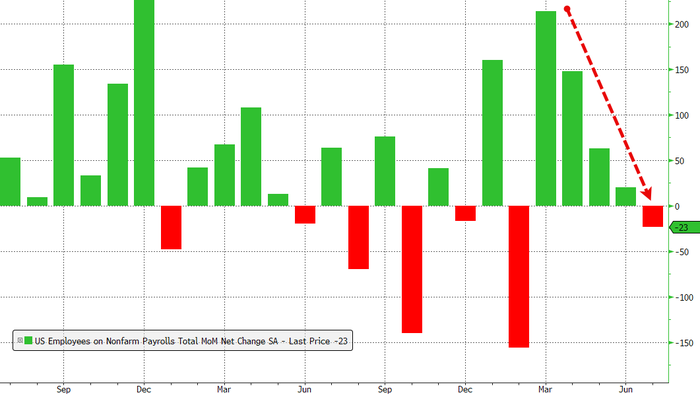
Ahead of today’s jobs report, in our payrolls preview we warned that “July Has Emerged As A Very Poor Month For Jobs” and boy were we right: moments ago the BLS reported that in July, the US labor force shrank by a whopping 23K, sharply lower from a downward revised 20K in June (from 57K), and the worst print since the negative 156K in February.
As noted above, the -23K print was below all estimates…

… and was a 5-sigma miss to estimates…

… as the 80K median estimate was missed by more than 100K.

And here come the Biden admin tricks of massive prior revisions: the change in total nonfarm payroll employment for May was revised down by 66,000, from +129,000 to +63,000, and the change for June was revised down by 37,000, from +57,000 to +20,000. With these revisions, employment in May and June combined is 103,000 lower than previously reported

Yet despite the dismal Establishment Survey print, the unemployment rate actually declined from 4.2% to 4.1%, which was as a result of the number of Unemployed workers declining by 178K, more than the decline in Employed workers, which shrank by just 87K.
Among the major worker groups, the unemployment rates for teenagers (12.1%) and people who are Hispanic (4.6%) declined in July. The jobless rates for adult men (3.9 percent), adult women (3.7 percent), and people who are White (3.6 percent), Black (6.3 percent), or Asian (4.0 percent) showed little change over the month.

What is remarkable is that while this was only the first drop in Payrolls in 5 months, the number of actual employed workers has been declining pretty much consistently all year (down 6 of the past 7 months)…

… and in July was the lowest US employment going back almost two years.

Part and parcel with the sudden chill in the labor market was the big miss in average hourly earnings, which rose just 0.1% MoM (below estimates of 0.3% and below last month’s 0.3% increase), which in turn translated into a 3.2% annual increase, also far below the 3.5% median estimate.

Some more details on the composition of the labor market from the latest jobs report:
- Among the unemployed, the number of people on temporary layoff increased by 153,000 to 921,000 in July. The number of permanent job losers changed little at 1.7 million.
- In July, the number of people jobless less than 5 weeks edged down to 2.0 million and is down by 344,000 over the year. The number of long-term unemployed (those jobless for 27 weeks or more) edged down over the month to 1.8 million but changed little over the year. The long-term unemployed accounted for 25.5 percent of all unemployed people in July.
- Both the labor force participation rate, at 61.4 percent, and the employment-population ratio, at 58.9 percent, changed little in July. Since January, the labor force participation rate declined by 0.7 percentage point, and the employment-population ratio decreased by 0.5 percentage point.
- The number of people employed part time for economic reasons changed little at 4.8 million in July. These individuals would have preferred full-time employment but were working part time because their hours had been reduced or they were unable to find full-time jobs.
- In July, the number of people not in the labor force who currently want a job changed little at 5.9 million. These individuals were not counted as unemployed because they were not actively looking for work during the 4 weeks preceding the survey or were unavailable to take a job.
- Among those not in the labor force who wanted a job, the number of people marginally attached to the labor force changed little at 1.8 million in July. These individuals wanted and were available for work and had looked for a job sometime in the prior 12 months but had not looked for work in the 4 weeks preceding the survey. The number of discouraged workers, a subset of the marginally attached who believed that no jobs were available for them, was essentially unchanged in July at 476,000.
And another disappointing fact when looking below the surface: the number of part-time jobs rose by 138K and is once again approaching a record high, while full-time jobs dropped again by 106K, and is down 6 of the past 7 months.

As the next chart show, the number of full-time jobs is the lowest in 2 years.

Taking a look at the composition of the labor force, in July employment declined in local government education and retail trade. Employment continued to trend up in health care. Some more details:
- Employment in local government education declined by 50,000 in July, after showing little net change over the prior 12 months.
- Retail trade lost 19,000 jobs in July. Employment declined in warehouse clubs, supercenters, and other general merchandise retailers (-21,000) and in gasoline stations and fuel dealers (-5,000). Sporting goods, hobby, musical instrument, book, and miscellaneous retailers added 10,000 jobs. Retail trade employment had shown little net change over the prior 12 months.
- Employment in financial activities continued to trend down in July (-14,000), reflecting losses in credit intermediation and related activities (-9,000) and insurance carriers and related activities (-7,000). Financial activities employment is down by 121,000 since a recent peak in May 2025.
- In July, employment in health care continued its upward trend (+22,000) but at a slower pace than the average monthly gain over the prior 12 months (+36,000). Employment in ambulatory health care services continued to trend up over the month (+18,000).
In other words, there were two key drivers for today’s big jobs drop:
- Leisure and Hospitality jobs -40K (of which -26.1K restaurant workers and -16.1K performing arts, sports, amusement and recreation) which was mostly World Cup driven
- Local government jobs, entirely due to education (-50K), i.e. vacation.
And visually:

Commenting on the report, WSJ Nick Timiraos concludes that it was a “messy one“, to wit:
The July employment report will be a messy one for the Federal Reserve to read. New evidence the labor market is not reaccelerating could take some of the edge off the case for raising rates next month, but this is all still subject to better inflation data.
Officials held rates steady last week but three of 12 officials voted for a rate increase. A declining unemployment rate will continue to keep the focus on inflation data.
Whether price pressures are building or fading will determine whether more officials conclude that they can no longer maintain their forecast for inflation to return to their target with rates remaining at the current setting. A mild inflation report would reinforce the case for holding (because two cool months in a row start to look like a trend rather than noise). A firm one would put the forecast back in doubt and give the dissenters a fourth vote to look for.
To summarize, this was a mostly disappointing report, yet one driven by one-time factors (teachers, world cup) while the unemployment rate dropped due to a quirk in the calculation. Does this mean that no Fed hikes are coming? While the market is suddenly much more confident that a September rate hike is out of the picture, it is likely that Warsh will simply wait for a less noisy report before making a decision.