
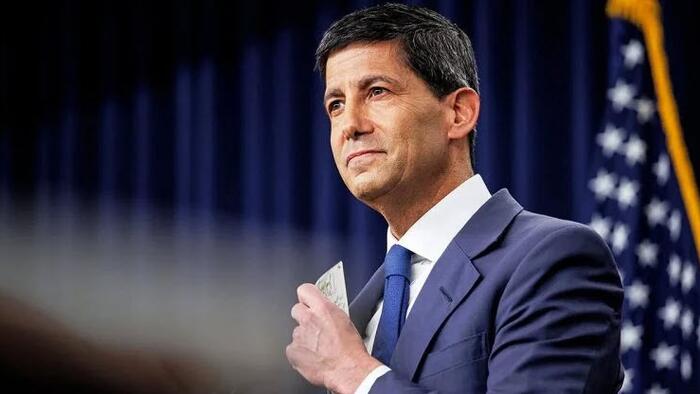
As we start a new weeks, the upward pressure on long-end bond yields from last week has shown initial signs of easing. Indeed, the 30yr Treasury yield is down -5bps overnight to 5.22%, whilst the 10yr yield is down by the same amount to 4.69%. That’s been supported by an announcement by the Treasury to CNBC that some/all of the cash in the Treasury General Account may be used to fund buybacks (bringin the US ever closer to Yield Curve Control and a new QE, much to Kevin Warsh’s horror) and by a pullback in oil prices, with Brent crude oil finally reversing course after a run of 6 consecutive gains to trade at $93.10/bbl.
That pullback in Treasury yields this morning follows last week’s surprise announcement that the US Treasury will increase its buyback operations for longer-dated Treasuries. That briefly eased the pressure on yields when it was announced, with the 30yr yield down -9.2bps on Wednesday to 5.19%, after reaching a post-2007 high of 5.31% last Monday. But even with that intervention, yields then crept back up into the weekend, with the 30yr yield closing at 5.27% on Friday, less than 4bps beneath its closing peak earlier in the week. Moreover, investor concern about wider financial repression led to clear effects in other asset classes, with the dollar index down -0.87% last week, whilst gold rose +5.18%. And this morning, gold is up another +0.72% to a 3-month high of $4,636/oz.
One reason why yields moved higher into the weekend was the ongoing rise in oil prices last week, which added to fears about inflation. Indeed, if we look at the oil futures curve, it’s clear that markets are starting to price in a longer closure of the Strait of Hormuz again. For instance, the 12-month Brent future hit a 2-month high of $79.16/bbl on Friday, which isn’t far off its peak in the Iran conflict of $83.58/bbl back in May. So those expectations of higher oil prices put upward pressure on yields as well, and the weekend newsflow hasn’t shown any sign of progress towards a US-Iran deal either.
The conflict is set to stay in the headlines this week, as US Treasury Secretary Bessent has said that he’ll be holding a press conference today to outline what he described as “the greatest coordinated economic isolation in the history of the world”. That follows President Trump’s post last week that “ANY country that allows its financial institutions, businesses, airports, or government entities to provide any type of lifeline to Iran will itself face TREMENDOUS Economic Consequences.” Bessent also wrote an article in the FT overnight, in which he referred to an “economic D-Day”.
Elsewhere, tariffs were also back in the headlines over the weekend, after the trade talks between the US and Canada broke down. Canadian PM Mark Carney said they were “walking away from a bad deal”, and would now “match Washington’s new tariffs dollar for dollar”. So that means Canada will now face 50% tariffs on around $20bn worth of goods, and Carney said that their own retaliatory tariffs would take effect on September 8. Meanwhile on the US side, President Trump posted that “Canada wants the benefits of being a State, without being one!!! They have also charged our great farmers, for many years, massive amounts of Tariffs. No more!!!” There’s already been a market reaction this morning to the breakdown of the talks, with the Canadian dollar weakening against every other G10 currency, including a -0.26% fall against the US Dollar. Otherwise, Bloomberg also reported overnight that Canada saw little chance of the talks resuming before the midterm elections.
So with all that in mind, as we look forward, the week ahead has several other events, with a big one set to be Fed Chair Warsh’s speech at Jackson Hole on Friday. This is a speech that’s often used by Fed Chairs to make big announcements or send policy signals, and last year saw former Chair Powell acknowledge that policy might need adjusting, shortly before they cut rates again the following month. We’ll have to see what Warsh discusses this time, but he said at the July press conference that he hadn’t yet decided “whether it’s going to be a big-picture speech or whether it’s going to be a more traditional set up for all the action we’re going to have between September and December”.
We did a preview of the event (link here), where we note that the prevailing view is that if Warsh goes for the “big-picture” speech, then his options include a discussion of the Fed’s taskforces he set up, or possibly a speech on AI’s impact on the economy and his thinking. Alternatively, if he goes for the “more traditional” speech, they think Warsh could do a “cleanup” of the July press conference, and he may wish to counter one market narrative that Fed policy actions could be delayed until the task forces have completed their work. Otherwise, he might also discuss how officials are viewing inflation dynamics, or how the FOMC views the monetary policy implications of evolving financial conditions and recent volatility in long-term interest rates. But whatever he decides, market pricing is still very much in the balance for the next meeting in 3 weeks’ time, with futures currently pricing in a 39% chance of a hike. So investors are keeping an eye out for anything that could shift this in either direction.
Elsewhere this week, earnings season is winding down, but we do have a few releases left including the perhaps the most improtant of all – Nvidia – on Wednesday. In the last few years, Nvidia’s earnings have often been a big macro event in their own right, with reactions on a par with US jobs reports and CPI prints. But in the most recent quarters, the positive earnings surprises haven’t been as big as we saw in 2023-24, and after each of the last 4 earnings reports, Nvidia’s share price actually fell the next day. Speaking of Nvidia, Bloomberg also reported over the weekend that some of their biggest customers had been told about price hikes for servers containing its AI chips. So that adds to the signs that AI is having inflationary consequences, and isn’t a straightforward positive supply shock.
Otherwise, the data calendar is fairly light next week, with a few inflation reports likely to be the main focus. That includes the US PCE reading for July on Wednesday, which is the Fed’s target measure, for which our US economists expect core PCE at a monthly 0.18%. Then in Europe, we’ll start to get some of the flash CPI prints for August, including from France and Spain on Friday, ahead of the Euro Area-wide number next week.
Courtesy of DB, here is a day-by-day calendar of key global events this week
Monday August 24
- Data: US July Chicago Fed national activity index
Tuesday August 25
- Data: US August Conference Board consumer confidence index, Philadelphia Fed non-manufacturing activity, Richmond Fed manufacturing index, business conditions, July new home sales, June FHFA house price index, Germany August Ifo survey, France August consumer confidence
- Central Banks: Fed’s Barkin speaks
- Earnings: Intuit
- Auctions: US 2-yr Notes ($69bn)
Wednesday August 26
- Data: US July PCE, personal income, personal spending, durable goods orders, Japan July PPI services, Australia July CPI
- Central banks: ECB’s Cipollone and Fed’s Barkin speak
- Earnings: NVIDIA, Crowdstrike, Salesforce
- Auctions: US 2-yr FRN (reopening, $28bn), 5-yr Notes ($70bn)
Thursday August 27
- Data: US July advance goods trade balance, wholesale inventories, August Kansas City Fed manufacturing activity, initial jobless claims, Germany September GfK consumer confidence, France July PPI, Eurozone July M3, Canada Q2 current account balance, China July industrial profits, Norway Q2 GDP
- Central banks: Jackson Hole symposium (through August 29), BoJ’s Himino speaks, ECB’s account of the July meeting
- Earnings: Marvell, Toronto-Dominion Bank, Autodesk, Workday, Dollar Tree, Pernod Ricard
- Auctions: US 7-yr Notes ($44bn)
Friday August 28
- Data: US August MNI Chicago PMI, Kansas City Fed services activity, Japan August Tokyo CPI, July jobless rate, job-to-applicant ratio, Germany July import price index, August unemployment claims rate, France August CPI, July consumer spending, Q2 total payrolls, Italy June industrial sales, August consumer confidence index, economic sentiment, manufacturing confidence, Eurozone August economic confidence, Canada Q2 GDP, Sweden Q2 GDP
- Central banks: Fed Chair Warsh speaks at Jackson Hole symposium, ECB’s Schnabel speaks
Looking at just the US, the key economic data releases this week are the Durables report and the core PCE inflation report on Wednesday. There are a few speaking engagements by Fed officials scheduled this week, including events with President Barkin and remarks from Chairman Warsh at the 2026 Jackson Hole Economic Policy Symposium. Several other FOMC officials are likely to speak in currently unscheduled television interviews on the sidelines of the symposium.
Monday, August 24
- There are no major economic data releases scheduled.
Tuesday, August 25
- 08:00 AM Richmond Fed President Barkin (FOMC non-voter) speaks: Richmond Fed President Tom Barkin will speak at a Chamber of Commerce event. Speech text and Q&A are expected. On August 13, Barkin said, “There’s an argument to be made that the inflation we see today is already headed to the right path… And the current level of interest rates, many think, is still restrictive enough to bring inflation down.” But he added, “There’s a counterargument, however, that says the elevated inflation we see today is more embedded… [and] If true, this argument suggests help is needed to bring inflation all the way back down to target.”
- 09:00 AM S&P Case-Shiller home price index, June (GS +0.2%, consensus +0.1%, last +0.15%)
- 10:00 AM New home sales, July (GS -2.3%, consensus -1.3%, last +1.6%)
- 10:00 AM Conference Board consumer confidence, August (GS 91.0, consensus 90.2, last 90.8)
- 04:00 PM Richmond Fed President Barkin (FOMC non-voter) speaks: Richmond Fed President Tom Barkin will speak to the Charlotte Regional Business Alliance. Speech text and Q&A are expected.
Wednesday, August 26
- 08:30 AM Personal income, July (GS +0.3%, consensus +0.2%, last +0.2%); Personal spending, July (GS +0.1%, consensus +0.1%, last +0.3%); Core PCE price index, July (GS +0.20%, consensus +0.2%, last +0.1%); Core PCE price index (YoY), July (GS +3.24%, consensus +3.3%, last +3.3%); PCE price index, July (GS +0.12%, consensus +0.1%, last -0.1%); PCE price index (YoY), July (GS +3.61%, consensus +3.6%, last +3.7%): We estimate that personal income and spending increased by 0.3% and 0.1%, respectively, in July. We estimate that the core PCE price index rose 0.20% in July, corresponding to a year-over-year rate of +3.24%. Additionally, we expect that the headline PCE price index increased 0.12% and increased 3.61% from a year earlier.
- 08:30 AM GDP, Q2 second release (GS +1.6%, consensus +1.5%, last +1.5%); Personal consumption, Q2 second release (GS +3.4%, consensus +3.2%, last +3.2%)
- Core PCE inflation, Q2 second release (GS +3.42%, consensus +3.4%, last +3.4%); We estimate a 0.1pp upward revision to Q2 GDP growth to +1.6% (quarter-over-quarter annualized). Our forecast reflects an upward revision to consumer spending growth (+0.2pp to +3.4%) but a downward revision to business fixed investment growth based on stronger personal care and healthcare spending but softer software spending details in the quarterly services survey (QSS).
- 08:30 AM Durable goods orders, July preliminary (GS +1.0%, consensus +0.5%, last +0.5%); Durable goods orders ex-transportation, July preliminary (GS +0.6%, consensus +0.5%, last +0.7%); Core capital goods orders, July preliminary (GS +0.6%, consensus +0.7%, last +1.2%); Core capital goods shipments, July preliminary (GS +1.0%, consensus +0.8%, last +2.0%): We estimate that durable goods orders increased 1.0% in the preliminary July report (month-over-month, seasonally adjusted) based on our tracking of commercial aircraft orders. We forecast a 0.6% increase in core capital goods orders—reflecting strength in the new orders components of manufacturing surveys in July—and a 1.0% increase in core capital goods shipments—reflecting the continued increase in core capital goods orders in recent months.
- 11:45 AM Richmond Fed President Barkin (FOMC non-voter) speaks: Richmond Fed President Tom Barkin will participate in a panel discussion at a Greensboro Chamber event.
Thursday, August 27
- 08:30 AM Advanced goods trade balance, July (GS -$103.0bn, consensus -$100.2bn, last -$101.4bn); We forecast that the goods trade deficit weighed slightly in July, reflecting a continued decline in oil exports.
- 08:30 AM Initial jobless claims, week ended August 22 (GS 210k, consensus 208k, last 206k); Continuing jobless claims, week ended August 15 (consensus 1,800k, last 1,799k)
- 08:00 PM Jackson Hole agenda and paper titles likely released: The Jackson Hole program is expected to be posted to the event’s website, with the paper titles or panel topics and speaker names. Full text of the papers and speeches will be posted to the website at the time each event is scheduled to begin. This year’s topic is “Financial Innovation: Implications for Payments and Policy.”
Friday, August 28
- 10:00 AM BLS releases preliminary annual payrolls benchmark revision: The Bureau of Labor Statistics (BLS) will publish a preliminary estimate of the benchmark revision to the level of nonfarm payrolls for March 2026. The final benchmark revision will be issued and incorporated into nonfarm payrolls alongside the January 2027 employment report in February 2027. Based on the Quarterly Census of Employment and Wages (QCEW)—the key source data for the annual benchmark revision—an upward revision seems likely; we estimate on the order of 50-450k (or a 5-40k upward revision to monthly payroll growth over April 2025-March 2026). We believe that difficulties accounting for unauthorized immigrants caused the QCEW to understate job growth and likely contributed to the deeply negative benchmark revisions of the last three years. Undercounting of unauthorized workers in the benchmark should be less of an issue for this year’s benchmark and going forward, reflecting the sharp slowdown in immigration.
- 10:00 AM University of Michigan consumer sentiment, August final (GS 51.0, consensus 51.0, last 51.0): University of Michigan 5-10-year inflation expectations, August final (GS 3.3%, last 3.3%)
- 10:00 AM Fed Chairman Warsh speaks: Fed Chairman Kevin Warsh will deliver keynote remarks at the 2026 Jackson Hole Economic Policy Symposium. Speech text is expected.
d