
(Photo Derek VanBuskirk)
I saw the volcano before I saw the prison.
Guards lined the tropical road beneath the active San Vicente, where we had already been stopped and frisked before our van was allowed to continue.
Soon, we arrived at El Salvador’s Terrorism Confinement Center, or CECOT, the massive prison built in 2023 to house the country’s worst of the worst: thousands of convicted murderers from the gangs that had terrorized the nation for decades.
Upon seeing the 57 acres of concrete walls that made up the prison’s exterior, my mind immediately turned to Edmund Burke’s notion of the sublime: the often-overlooked cousin of beauty that, rather than delighting the viewer, evokes an immediate sense of awe, power and dread—a feeling usually reserved for vast, immovable forces of nature or realities so immense that they force us to confront the limits of our own existence.
Inside, our bodies were thoroughly searched before we stepped into a scanner capable of seeing through our clothing for contraband, leaving nothing private or sacred.
After touring the dormitory and armory, we boarded a bus that carried us across the compound to the northeasternmost of CECOT’s eight cell blocks.
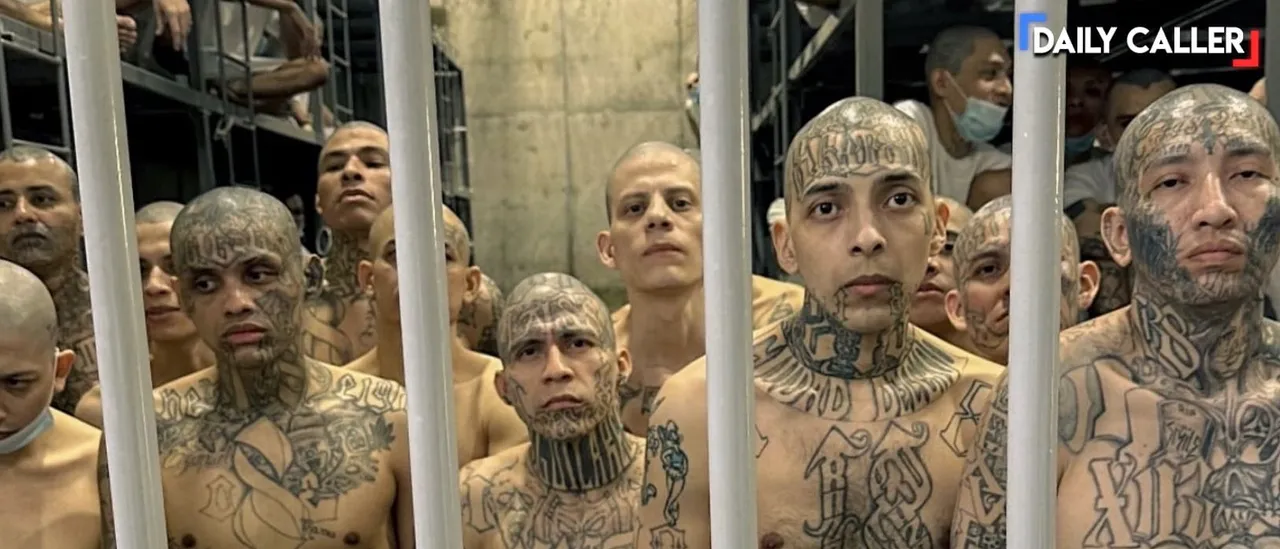
Walking in, the block felt empty. It resembled a vacant airplane hangar, except for a line of guards in SWAT uniforms standing shoulder to shoulder along yellow lines, staring through the metal grates.
Only when I followed their gaze did I see them.
Sixty-four murderers stared back.
Each had a shaved head. Many had tattoos covering their bodies. They all wore the same uniform: white shirts, white pants, and Crocs, with many also wearing medical masks.
They sat perched on bare metal bunk beds stacked four high in rows of four, watching me from behind their masks as though I were the most entertaining thing that had happened to them in a long time. My guess is that I probably was.
The block contained 32 of these mass-confinement cells, enough for me to estimate an approximate 2,048 prisoners housed there, with every one of them focused on me.
🧵6/7 The prisoner said the eerie silence that filled the room, packed with hundreds of some of the world’s most dangerous men, was normal. With little talking and no access to books or possessions, I asked if he spent his days lost in thought. His answer surprised me. He said… pic.twitter.com/iJsIj6YxyR
— Derek VanBuskirk (@DerekVBK) November 8, 2025
CECOT Director Belarmino García explained that the lights remain on around the clock and that prisoners spend 23½ hours each day inside their cells, leaving only to go to the middle of the block for brief supervised exercise or short daily seminars focused on spiritual and life guidance.
🧵5/7 CECOT prisoners spend more than 22 hours a day locked in their cells. They’re only let out in small groups for supervised exercise, a mandatory non-denominational Christian message, and medical appointments. pic.twitter.com/QQa20QSkZO
— Derek VanBuskirk (@DerekVBK) November 8, 2025
He also showed us where prisoners’ medical records are kept, the rooms where inmates meet attorneys or appear in court by video as in-person visitors are prohibited, and the solitary confinement unit known as “the island,” where a ventilation hole carved into a concrete slab provides the prisoners’ only source of air and light for up to 14 days.
We were then introduced to three gang members who removed their shirts to display tattoos identifying them as MS-13 members. Some referenced the gang’s birthplace of Los Angeles. Others displayed occult imagery, including devil horns tattooed above one prisoner’s temples.
I couldn’t help but think how skinny the inmates looked, especially compared with videos showing their arrival at CECOT.
One of the three stood out. As he held his shirt above his head, guards read through a rap sheet that had earned him a prison sentence of more than 1,000 years. Within seconds, what remained of the once-feared gang member began trembling under the strain of simply keeping his arms raised.
I was then taken to the head of the cell block to meet the prisoner I would interview.
After attaching a microphone to the collar of Marvin Ernesto Medrano Vázquez, an MS-13 member and founder of the Crazy Crime clique, I shared pleasantries with a man I would learn had murdered more than 30 people—and had no regrets.
Vázquez entered from one side of the room and sat in a chair. I entered from the other end and squatted so we could speak eye to eye through the bars separating us.
I had only 10 minutes.
My local interpreter, overwhelmed by fear, chose to remain outside the room, volunteering to film through the gate instead while wearing a medical mask to conceal his identity.
I couldn’t blame him.
“This, this is a maximum security prison. This, according to what I’ve heard… nobody leaves this facility,” Vázquez told me after showing me the large “MS” tattoo across his stomach. “We can only speak of the past, because there’s no future here.”
🧵2/7 I asked what it was like sharing a cell with gang members whose friends he’d murdered. He said it isn’t a problem—there’s no reason to fight anymore. All possessions have been stripped away, and as he put it, they used to kill each other because the other gang would kill… pic.twitter.com/JiDnfTbOre
— Derek VanBuskirk (@DerekVBK) November 8, 2025
Vázquez had lived in the United States for 15 years before fleeing to El Salvador after killing another gang member.
“Look, I’ve lived my whole life in gangs, ever since I was in the United States. Just as I committed crimes there, I came here to commit crimes,” the murderer said. “I’ve always lived like this, for my life is to kill. Why? Because I was seeking revenge.”
Vázquez said vengeance fueled both gangs, describing it as the “norm of Gang coexistence.” He said members of the rival Barrio 18 gang had intended to kill his mother.
“We’re going to kill them and anyone who messes with us,” the hardened criminal promised.
Living alongside rival gang members is among the hardest parts of prison, he said.
“It’s difficult, because one day we were killing each other, but today we have no other option but to just spend time together,” he said, explaining that the eerie silence throughout the cell block was normal, as there is nothing to say to the men who killed your brothers.
Looking over my shoulder, I saw my translator doing everything he could to avoid making eye contact with the incarcerated killer before I used my broken Spanish to ask Vázquez how he would respond to human rights organizations that have alleged prisoners have been starved or abused.
“Look, here they’ve never hit me, they’ve never disrespected me,” Vázquez said, adding, “Mealtimes are regular, water is plentiful, but I have to live with my enemies.”
He also pointed to the constant medical attention provided, saying, “It’s a joy to leave that cell.”
Vázquez said he is treated “humanely,” despite believing he doesn’t deserve it.
“In short, we don’t deserve it, because when someone asked you for forgiveness, pleading ‘don’t kill me,’ we killed them, we didn’t forgive, and here they forgive us for our lives,” the head of the clique said.
🧵1/7 My day in CECOT
I sat down with an MS-13 member at CECOT on Thursday. He told me he’s murdered 30+ people, including while as an illegal alien in the U.S.
When asked about claims from civil rights groups that prisoners are mistreated, he denied it, saying he isn’t… pic.twitter.com/dtWRvMqPyX
— Derek VanBuskirk (@DerekVBK) November 8, 2025
Vázquez said he and his cellmates are “beyond recovery” and that society is better off with them inside CECOT.
“I believe that the Salvadoran population has benefited, because those who once terrorized the people out there, killed people out there, are all imprisoned today,” Vázquez said. “What I tell the youth is to take advantage of the opportunity that the president has given them.”
“I’ve lost everything. Well, what am I supposed to do at night? Cry. Why? Because we’re gone. There’s no other option. What else can we do? That’s what we’ve been dealt. Why? Because we chose this life and there’s no way out,” the killer lamented. “We’re not going to change, because we’ve already have our norms. Our duty is simply to maintain them until the day arrives that we are going to have to give an account.”
For perhaps the first time in my life, I offered a short prayer for mercy on a mass murderer.