
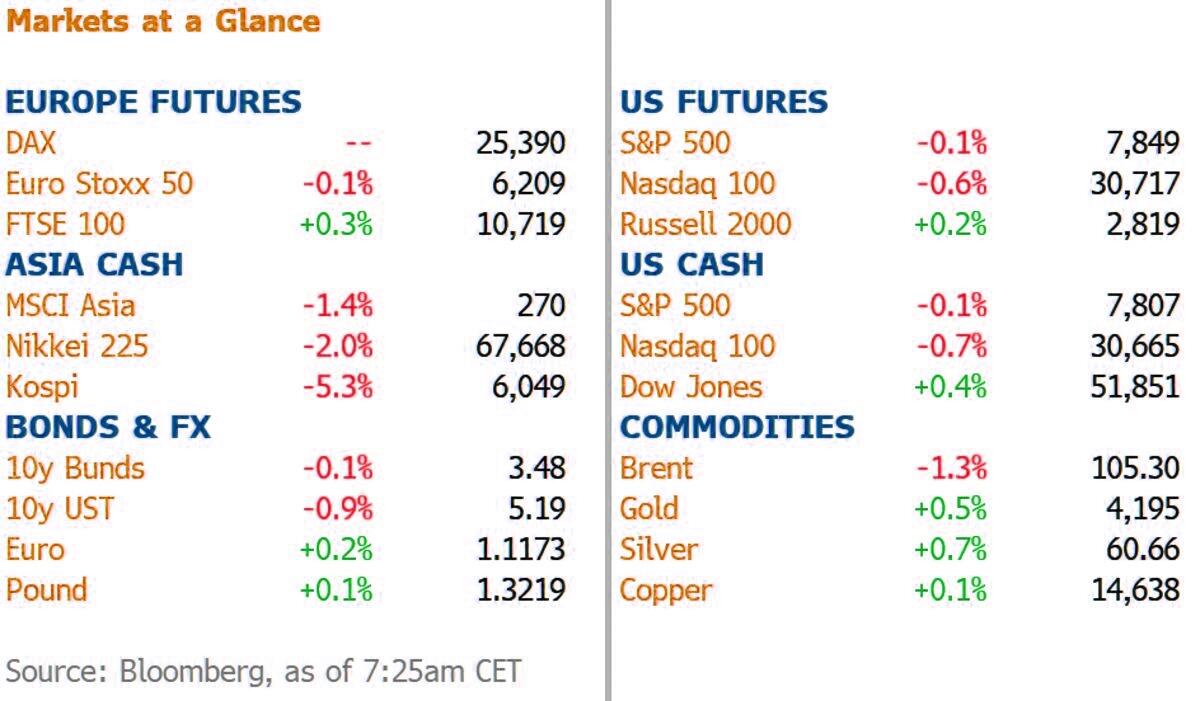
US futures are mixed with the Nasdaq lagging as the AI rout that started on Wall Street on Monday ricocheted through Asia, where the Kospi crashed as much as 7% after Broadcom’s Hock Tan likened AI investing to a casino and China’s CXMT touted a denser memory chip design, while Q3 bank earnings kicked off with a FICC trading miss at JPMorgan; as a result, a flight to safety sent 10Y yields 5bps lower to 5.19% as cash Treasuries reopened after the holiday, while Brent slid back toward $105. As of 8:00am ET, S&P futures are down 0.1% around 7,850 while Nasdaq futures slide 0.7%, Dow futures are up 0.7% and Russell 2000 futures rise 0.3%. That follows a session in which the S&P dipped 0.1% and the Nasdaq 100 fell 0.7% on what was the lowest volume session in 23 years, with the SOX down 2.7% for its fourth straight decline even as two-thirds of S&P members rose. In premarket trading, memory names are getting hammered again (Western Digital -4.5%, Seagate -4.1%, Sandisk -3.7%, Micron -2.8%) and Nvidia is the worst of the Mag 7, down 0.9%, while JPMorgan is flat after FICC revenue of $5.37BN missed the $6BN estimate but the company guided NII higher; UnitedHealth rises 2.8% after raising its guidance. The day’s driver is AI angst (again): Hock Tan’s warning that financing the buildout, not chip supply, is the problem (as we discussed yesterday) was the spark, while CXMT’s progress on new DRAM architecture did the rest in Seoul, where Samsung and SK Hynix lost around 8% and 10%. Treasuries rallied, with yields down 2-5bps led by the 10Y, after Fed Governor Waller said the surge in long-term yields is doing some of the work of tighter policy, while bunds and gilts gained as lower energy prices eased inflation worries. The BBG dollar index is down 0.2%, snapping a four-session winning streak, and the yen leads G10 after a report that the BOJ is leaning against a back-to-back hike in October. In commodities, WTI is down about 1.5% near $92.3 and Brent is 1.7% lower to $104.6; gold rises 0.3% to around $4,190, silver is up 0.4% near $60.5 and copper is flat. Bitcoin regains $83,000. US economic data slate includes September NFIB small business optimism (already out: 97.9 vs est. 98.2), ADP weekly employment change (8:15am), September existing home sales (10am) and the September federal budget balance (2pm). Fed speaker slate includes Goolsbee (7am and 10am), Barkin (1pm) and Collins (4pm). The Treasury sells $95BN of 13-week and $82BN of 26-week bills at 11:30am and $95BN of 6-week bills at 1pm.
In premarket trading, Magnificent Seven stocks are mixed: Apple (AAPL) +0.7%, Microsoft (MSFT) +0.4%, Alphabet (GOOGL) +0.2%, Amazon (AMZN) -0.4%, Meta Platforms (META) -1.2%, Tesla (TSLA) -0.8%, Nvidia (NVDA) -0.7%
- Chemours Co. (CC) slips 1.6% after RBC Capital Markets cut its recommendation on the chemicals company to sector perform on lower demand.
- Domino’s Pizza (DPZ) drops 1.5% after the restaurant chain reported total domestic stores comp sales growth for the third quarter that missed the average analyst estimate.
- Enerflex’s US-listed shares (EFXT) rises 7% after the natural gas and petroleum producer said it received a contract award to design and assemble over one gigawatt of low emission behind-the-meter natural gas-fired power generation units for a large-scale North American data center.
- Johnson & Johnson (JNJ) slips 2% after the maker of pharmaceuticals and medical devices posted mixed sales for the third quarter. Revenue from the firm’s MedTech unit for the quarter fell short of the average analyst estimate.
- JPMorgan Chase (JPM) gains 1%, erasing an earlier loss, after the bank boosted its net interest income forecast for the full year. It also reported FICC sales & trading revenue that missed expectations.
- Syndax Pharmaceuticals (SNDX) plunges 10% after the biotech said a phase 2 trial of axatilimab failed to meet its primary endpoint of annualized rate of decline in forced vital capacity in a rare lung disease.
- UnitedHealth (UNH) rises 2% after the health insurer boosted its adjusted profit for the full year, following third-quarter results that were ahead of the average analyst estimate. Analysts view results as better than expected and are on watch for commentary on 2027 growth outlook during the earnings call.
- VF Corp. (VFC) is up 3% after Piper Sandler and Truist Securities upgrade the retailer to buy-equivalent ratings, noting the company’s Vans brand is at an inflection point.
- Viking Holdings (VIK) gains 3% as Barclays upgrades to overweight, noting that European river levels are back in recovery mode.
In other corporate news, JPMorgan kicked off bank earnings season with a miss where it hurts most in a volatile quarter: third-quarter FICC sales & trading revenue came in at $5.37 billion versus the $6 billion estimate, though the bank now sees full-year net interest income of about $106.2 billion, above the $105.28 billion estimate. JPMorgan and Goldman Sachs have taken a rare move to limit exposure on a $5 billion loan sale for AI startup Volta Infrastructure as investors demand higher yields for risky debt tied to the AI boom (good thing nobody is worried about AI financing). UnitedHealth raised its full-year adjusted EPS forecast to at least $20.50. Meta Platforms released its long-awaited Muse Wonder AI model, which its leadership says is on a par with OpenAI’s ChatGPT and Anthropic’s Claude on some functions. Microsoft is gearing up to install the latest version of its own chips in data centers, and Applied Materials expects to double revenue over the next few years without a commensurate rise in hiring. SentinelOne plans to offer $1.25 billion in convertible senior notes due 2031. Jio Platforms is said to have drawn more than $20 billion in bids for its IPO. In Europe, LVMH’s fashion and leather goods sales fell 5% organically, Crédit Agricole agreed to buy IKB Deutsche Industriebank from Lone Star, Nokia agreed to sell its Enterprise Campus Edge business to Aurelius, Monte Paschi rejected Intesa Sanpaolo’s improved takeover offer as not financially satisfactory, and UBS transferred £1.7 billion of UK pension assets to Legal & General.
The AI trade is unwinding again from the Nasdaq 100 to Seoul: a global slide in semiconductor stocks deepened overnight, sending the Kospi down more than 7% at one point as concerns about AI overheating and Chinese competition intensified. The trigger was Broadcom chief Hock Tan likening AI investing to a casino and warning that financing the buildout, not chip supply, is the problem, just days after Nvidia-backed Firmus’s offering collapsed; a report of progress at China’s CXMT on a new memory architecture did the rest. The AI trade is splitting into model makers and the capex chain: Meta rose after releasing Muse Wonder even as the Philly semi index fell for a fourth straight session. US futures are attempting to shrug it off — S&P contracts recovered to roughly flat by 5:45am — and the next inflection point comes via the busy slate of pre-market bank earnings, with the KBW bank index down around 12% from its August peak (we previewed the big bank prints here).
“Memory names are under pressure from a rise in Chinese competition and an increasing number of voices in the industry warning of a bubble,” said Bank J Safra Sarasin’s von Rotberg. “The volatility in the tech trade makes a confirmation of hyperscaler capex guidance ever more important.”
Still, markets keep doing what they’re not supposed to: the S&P sits within a whisker of its record high on the lowest volume in 23 years, while underneath the surface Goldman finds an extraordinary flight to quality not seen since Covid, and the median S&P stock trades 15% below its 52-week high. And while the AI financing angst grows (Oracle is now trucking natural gas to its data centers), JPMorgan and Goldman are capping their exposure on a $5 billion AI infrastructure loan.
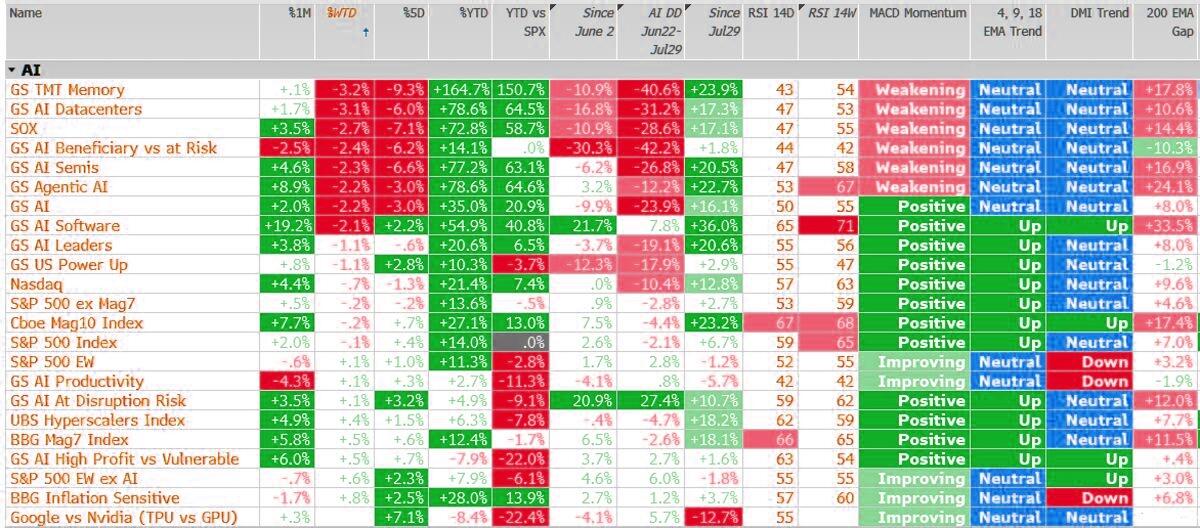
Goldman’s Bobby Molavi writes that the past two to three months have felt like “everyone has been sprinting to standstill.” Deals are being pulled, and with more than $500 billion of debt issued this year for the infrastructure buildout, “we are seeing a lot of future AI revenue being spent up front,” per Bloomberg.
The rotation remains the story for Goldman’s Rich Privorotsky, who argues “the market got itself incredibly long one corner and effectively short everything else,” listing four AI stories that hit at once: CXMT, Microsoft’s Maia 300 moving to TSMC 2nm, Hock Tan’s comments (“taken wildly out of context”) and Meta’s Muse Wonder. In Japan, he notes, five stocks effectively account for the entire Nikkei decline while the TOPIX is up. On energy: “So much for the Russia/Ukraine energy ceasefire… couldn’t survive a news cycle,” and “If energy takes out the highs with velocity, markets will struggle in a much more correlated fashion.” His silver lining: “Financials could reinforce the rotation, with the bar relatively low given de-rating ahead of numbers.”
Over on the GS TMT desk, Sean Johnstone sees “a lot of nervousness ahead of an Anthropic S1,” notes Meta’s Muse Wonder reportedly ranks behind only Claude Opus 5.5 on Artificial Analysis’ Intelligence Index, and concludes that “Capital (and the cost of capital) is becoming the bigger constraint.” Tony Pasquariello, meanwhile, points out that net exposure across GS’s global PB book sits in just the 10th percentile of the past year, with the US market net sold for three straight weeks: “I’m not sure that I can remember a time when a market that was on the highs was attracting so little chase.” Yesterday’s floor was a 2 on a 1-10 activity scale, per the GS US desk, which thinks S&P upside is cheap into month-end, with the next one-week implied move at ~96bps, one of the lowest in about six years.
JPM’s Market Intel desk stays Tactically Bullish heading into earnings, noting breadth was supportive yesterday with over 60% of S&P stocks higher and the rotation/broadening continuing premarket. Tech specialist Joshua Meyers says the most proximate trigger was Hock Tan’s DBS conference panel, where he warned financing could become a bigger bottleneck than component shortages and compared “many investors” to casino gamblers, while a weekend sell-side note re-ignited power concerns (powered-shell shortages of as much as 19GW next year), all of which hit on a low-liquidity holiday as investors sit on their hands ahead of an expected private frontier lab investor meeting on Wednesday. JPM’s Manish flags meaningful risk of a Quality reversal around the CPI release and the Fed meeting if the Fed turns dovish, noting semiconductor sentiment is above the 99th percentile. On earnings, FactSet consensus has Q3 at 29.6% EPS growth on 12.4% revenue growth, with all 11 sectors expected to post positive revenue and earnings growth for only the second time in history.
Big US bank stocks, meanwhile, are in correction territory as the latest earnings from Wall Street roll in. The KBW Bank Index has dropped around 12% from an August peak, exceeding the 10% threshold for a technical correction.
“Loan book quality, capital markets activity and trading will be very much in focus, as all three may have weakened,” said Wolf von Rotberg at Bank J Safra Sarasin. “They need to show that lending growth remains strong and net interest income continues to rise.”
On the geopolitical front, President Trump’s Russian diesel deal has opened a rift with Republican senators, European leaders and Ukraine, while running into a 2022 law barring most Russian energy purchases. Even if it goes ahead, it will deliver a first release of 2.25 million barrels in October, less than a single day of US consumption. Brent is still more than 50% higher than when the Iran war began, with Houthi strikes on Saudi Arabia’s main airport keeping the supply risk alive; Goldman estimates the Brent risk premium at $24/bbl.
In Europe, the Franco-German 10Y spread closed Monday at a post-2012 high of 142bps, per DB, albeit with less fanfare than when those levels were first breached ten days ago; Blackstone’s Jon Gray warned that fiscal strains in France, the UK and elsewhere in Europe pose a more pressing risk than in the US, and the IMF told UK Chancellor Healey to use cost-of-living support “sparingly” ahead of his Oct. 28 budget.
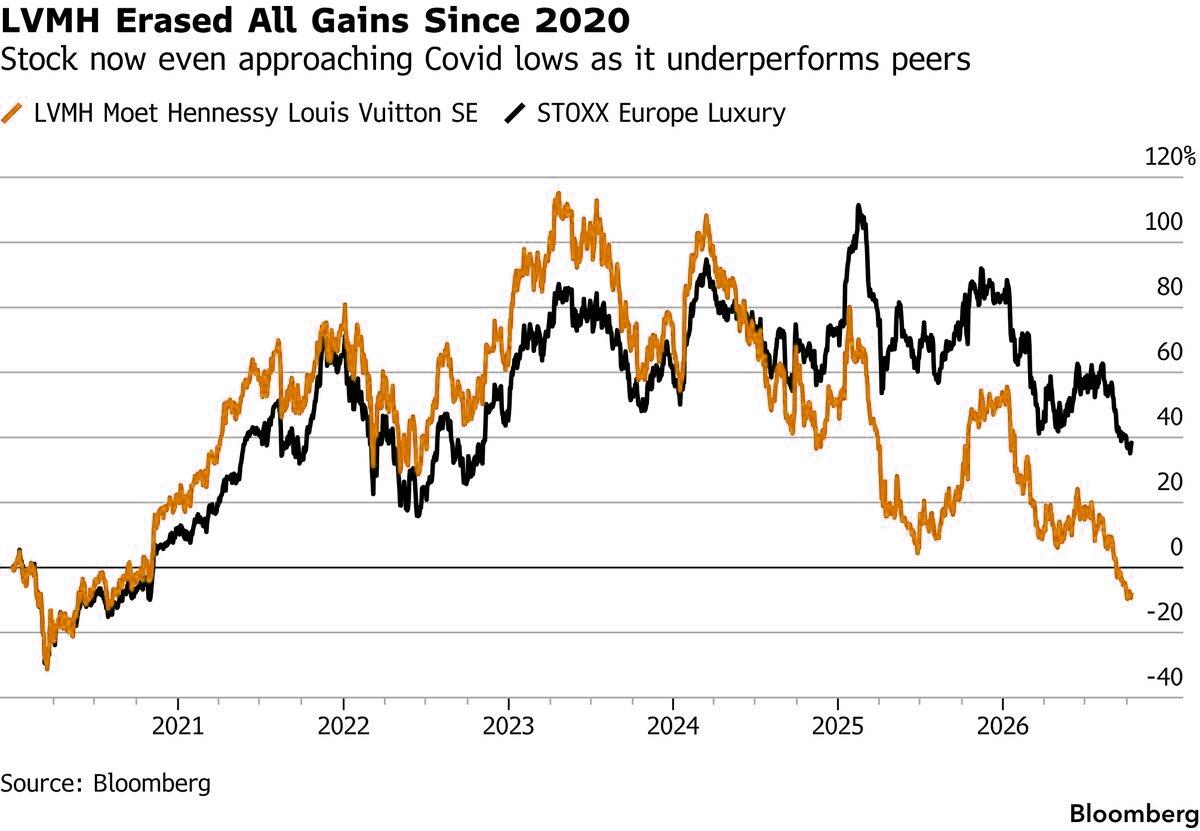
Turning to European stocks, the Stoxx 600 rises 0.6% to 639.73 with 471 members up, as positive earnings news counters renewed concerns about the AI trade, which prompted investors to rotate out of semiconductor and AI-linked names globally. Chemicals and healthcare are the best performers, with real estate helped by the pullback in Brent sending yields lower across European curves; tech, consumer products and basic resources lag. JPM’s desk notes defensives and rate-sensitive baskets are outperforming while semis and luxury lag, with LVMH a clear drag after its worse-than-expected numbers on weak Chinese demand — the stock is already down more than 40% this year. Here are the biggest European movers:
- BP shares gain as much as 1.6% after the British oil major’s 3Q trading statement guided for a fall in net debt to $13.5b-$14.5b, compared to $22.3b in the previous quarter.
- Whitbread shares gain as much as 3.6% after the hotel operator reported strong first-half results, including a beat on profit before tax.
- Givaudan shares rise as much as 8.1% after the maker of fragrances and flavors reported like-for-like growth that was well ahead of expectations in the third quarter.
- Greencore shares rise as much as 6.8% after the food manufacturer said annual adjusted operating profit will come in higher than previously expected, following a strong finish to the year.
- Ypsomed shares rise as much as 3.1% after Berenberg initiates coverage of the stock with a buy rating, citing the growing market for self-injection systems for drugs, resilient margins and a supportive valuation.
- Oxford Instruments gains as much as 4.9% as JPMorgan says the scientific instruments specialist’s first-half trading update was strong “on all fronts.”
- Sulzer rises as much as 5.4% after the Swiss pump maker positively surprises on orders in the third quarter.
- Bellway shares rise as much as 3.9% after analysts at Jefferies said the downbeat outlook for FY27 does not look as bad as feared, as the company warned of lower completions and tighter margins.
- LVMH shares fall as much as 2.3% after the French luxury-goods giant reported third-quarter organic revenue that missed estimates, with its biggest division — fashion and leather-goods — posting a slump in sales.
- European semiconductor stocks slide, tracking a selloff across Asia and US peers, after Broadcom CEO Hock Tan warned of overheating market sentiment.
- Schaeffler shares fall as much as 5.4% after the German car parts maker posted disappointing preliminary third-quarter results.
- Befesa shares slip as much as 4.9% after Jefferies reduced its full-year earnings estimates for the waste recycling services firm and trimmed its price target in anticipation of softer third-quarter results.
Asian stocks declined as the global AI trade came under renewed pressure, with the MSCI Asia Pacific Index falling as much as 2.1% to the lowest level since Aug. 4. The Kospi slumped 5.46% after breaking its 200-day moving average — at one point down 7.4% before finding support near 6,000 — and Seoul briefly halted program trading for the first time since August; foreigners sold a net $3.4 billion, $3.2 billion of it in tech, per Goldman, which also notes Samsung’s buyback has ended and SK Hynix’s is nearly complete. The Nikkei 225 fell 1.82% on its return from a long weekend, but the TOPIX rose 0.14%: TEL (-7.2%), SoftBank (-8.5%), Advantest (-2.9%), Kioxia (-13.3%) and Ibiden (-7.8%) accounted for all of the Nikkei’s losses, while Japanese banks rose 2.1% ahead of US bank earnings. Taiwan’s Taiex fell 1.95% and the Taiwan dollar posted its biggest drop since June 2025. The ASX 200 outperformed as energy, financials and defensives offset tech and miners. The Hang Seng (+0.31%) and CSI 300 (-0.29%) reversed early weakness, though Chinese automakers fell across the board after the Ministry of Finance cut the VAT export rebate on new-energy vehicles to 9% from 13%. India’s Nifty rose 0.76% on IT services. “Rotation into financials, defensives and software cushioned losses elsewhere,” Goldman’s Asia desk wrote.
In FX, the Bloomberg Dollar Spot Index is down 0.2% after rising 0.6% over the past four sessions, with the DXY in a 102.30-102.57 range as yields and energy ease. The yen outperforms, with USD/JPY down 0.3% around 158.1, after Bloomberg reported BOJ officials are leaning against a rare back-to-back hike this month while still eyeing December; EUR/USD rises 0.3% to 1.1189 and cable edges up to 1.3230. USD/KRW rose 0.5% to 1,341.60 as the Kospi tumbled, while the Taiwan dollar fell as much as 1% to 32.215.
In rates, Treasuries rallied as cash trading reopened after Monday’s holiday, with yields down 2-5bps led by the 10Y, which slipped 5bps to 5.19%; USTs are firmer by around 10 ticks, at the upper end of a 104-18 to 104-30+ range. Fed Governor Waller said higher long-term yields could help the Fed cool demand in rate-sensitive sectors such as housing and autos, doing some of the work of tighter policy (finally, a use for the bond rout). Bunds rose as much as 49 ticks and gilts gained more than 50 ticks as energy prices eased, with the UK 10Y opening 7bps lower at 5.37%; Germany’s 5-year auction drew a weak 1.1x bid-to-cover. Big investors are snapping up Treasuries to lock in the highest yields in decades, with almost $14 billion injected into US government bond funds since the start of October, per the FT. Positioning may add fuel: CFTC data show speculators have rebuilt sizeable net shorts in 10-year futures while sharply cutting 2-year shorts, leaving the 2s10s curve exposed to an initial bull flattening if Wednesday’s CPI is soft. Goldman’s Kaplan points out that “bond funds are underweight duration at an extreme that has historically skewed to lower yields over the next 1–2 quarters.” Goldman expects a 0.24% increase in September core CPI (vs. +0.2% consensus) and a 0.59% rise in headline CPI (vs. +0.6% consensus), reflecting higher energy prices; the GS US desk warns “A 10bp downside surprise on core would be meaningful for rates.”
As money markets price in at least one more US rate hike by December, Federal Reserve Governor Christopher Waller said the surge in long-term Treasury yields is helping curb demand in rate-sensitive sectors.
“When yields go up, is that going to impact interest-sensitive sectors like housing and autos and other things? Yeah, of course it is,” Waller said at Bloomberg’s New Economy Forum in New Delhi on Tuesday. While that isn’t the Fed’s intention, higher yields are “doing a little bit of the work,” he said.
In commodities, WTI Nov and Brent Dec futures are softer, extending their pullback from yesterday’s gains as Trump reiterated the Iran war will end “very soon”: WTI fell to a $91.81 low from a $93.49 peak and Brent to $104.71 from $106.14, though Houthi attacks on Saudi Arabia and US Gulf production shut-ins remain supportive. Goldman estimates the Brent risk premium at $24/bbl and notes its average global crude freight rate is now $30/bbl vs. $4 a year ago. Dutch TTF is firmer, climbing to €86.40/MWh on colder weather and Middle East supply concerns, after European gas hit a post-2022 high on Monday. Spot gold rose from a $4,151 low to $4,201 and silver trades in a $59.58-60.73 range. LME copper is little changed within a $14,549.68-14,667.00/t range.
US economic data slate includes September NFIB small business optimism (97.9 vs est. 98.2, prior 98.7), ADP weekly employment change (8:15am), September existing home sales (10am) and the September federal budget balance (2pm). Fed speaker slate includes Goolsbee (7am, 10am), Barkin (1pm) and Collins (4pm). Corporate events: SEMICON West runs through Thursday; Workday and BGC hold investor days.
Market Snapshot
Top Overnight News
- Iran is fortifying its defenses, rallying loyalists, and hinting that their forces could conduct land incursions into neighboring countries as it threatens a wider, harsher response against the U.S. and its Gulf allies as it prepares for potential American attacks after the midterms and seeks to deter them. WSJ
- Saudi Arabia intercepted ballistic missiles launched by Yemen’s Houthis, targeting Riyadh and Khamis Mushait. Donald Trump dismissed concerns that Russia and China might be helping Iran. Oil slipped after three days of gains. BBG
- A global slide in semiconductor stocks deepened, sending South Korea’s chip-heavy equity benchmark down more than 7% at one point, as concerns about AI overheating and Chinese competition intensified. Investor angst over the AI trade increased after Broadcom Inc.’s chief executive likened market sentiment to a casino and warned that financing the buildout will become a key problem. BBG
- JPMorgan and Goldman Sachs have taken a rare move to limit exposure on a $5 billion loan sale for AI startup Volta Infrastructure as investors demand higher yields for risky debt tied to the AI boom. BBG
- JPMorgan 3Q FICC sales & trading revenue $5.37B, est. $6B; sees FY net interest income about $106.2B, est. $105.28B. BBG
- Nvidia’s share of China’s market for data-center AI chips fell to 34% in the first half of 2026, as US export controls restricted supplies of its products and domestic rivals led by Huawei gained ground. RTRS
- Volumes in options tied to individual stocks have recently reached levels seen during the meme-stock mania of 2021, about $700 billion of notional volume a day. WSJ
- BoJ officials are leaning against a rare back-to-back interest rate increase this month while still eyeing the possibility of another move as soon as December, according to people familiar with the matter. BBG
- Federal Reserve Governor Christopher Waller said the surge in long-term US Treasury yields is helping to curb demand in interest-rate-sensitive sectors such as housing and automobiles, doing some of the work of tighter monetary policy. BBG
- Big investors are snapping up US Treasuries, seeking to lock in the highest yields in decades as they bet borrowing costs can only climb so much further before a months-long sell-off abates. Investors have injected almost $14bn into US government bond funds since the start of October, after net inflows in the third quarter reached a record $59.3bn. FT
- Russia will be able to return diesel exports to levels above those US President Donald Trump has outlined under a deal with Moscow which has been criticised by Ukraine and some US lawmakers, Deputy Prime Minister Alexander Novak said on Monday. RTRS
- Iran and the US remain divided over the sequencing of a diplomatic agreement: Al-Akhbar. Tehran is demanding an end to the war, removal of the naval blockade and oil sanctions, and release of frozen assets before reopening the Strait of Hormuz and discussing nuclear issues, while Washington is insisting on nuclear concessions first. Newsquawk
- IMF raised 2026 Global Real GDP growth forecast to 3.1% (prev. 3.0%), citing AI investment tempering energy price shock in key economies, while it maintains 2027 global growth view at 3.4%. Maintained US 2026 growth forecast at 2.3% and raises 2027 forecast to 2.3% (prev. 2.2%), lowered China 2026 GDP forecast to 4.5% (prev. 4.6%) and cut 2027 forecast to 4.0% (prev. 4.1%). Newsquawk
- Surging bond yields are the top risk to the financial system, the IMF says. BBG
- US Sept. NFIB small business optimism falls to 97.9, est. 98.2. BBG
- UK Chancellor Healey is reportedly rejecting calls to equalise capital gains tax and income tax rates: FT
- Black Sea strikes threaten Bulgarian refinery supply, the Bulgarian premier says; a merchant ship was sunk off Bulgaria’s Black Sea coast. BBG/Newsquawk
- JPM Market Intel stays Tactically Bullish into earnings but flags meaningful risk of a Quality factor reversal around CPI and the Oct. 28 Fed meeting. JPM
A more detailed look at global markets courtesy of Newsquawk
APAC stocks mostly declined amid a tech sell-off following the mixed handover from Wall Street, where the Nasdaq underperformed as chip and memory names were pressured by China competition concerns after CXMT announced technological progress on a denser memory chip design. ASX 200 outperformed its regional peers with price action range-bound as the downside in tech and miners was offset by strength in energy, financials and defensive sectors. Nikkei 225 suffered from the tech-related pressure as participants returned from the long weekend. KOSPI slumped alongside the tech sell-off, with a sidecar triggered early on due to heavy losses. Hang Seng and Shanghai Comp conformed to the tech-led declines across the region, with weakness in autonames after reports that China will cut the VAT export tax rebate rate on new energy vehicles to 9% from 13%.
Top Asian News
- China smartphone shipments fell 15.4% in Q3, according to IDC.
- India’s PM Modi said today’s technology and data and knowledge and innovation are powers, adding that tech should help new opportunities for millions.
European bourses (STOXX 600 +0.6%) have moved higher throughout the session. There was earlier underperformance in the tech–heavy AEX (+0.1%), but it has since climbed into the green. Initial pressure stemmed from the slump in tech behemoths in Asia and throughout the US trading session on Monday. The drivers seem to be two-fold: 1) increased competition after CXMT said they made progress on new memory architecture, as they plan to roll out a new server-memory product by year-end, according to SCMP, 2) Broadcom CEO likens market sentiment to a casino and highlights concerns about AI buildout financing. Tech continues to be in favour for fund managers, with a BofA survey showing that the proportion of managers overweight tech has risen to 37% (prev. 30%). Sectors highlight the positive bias. Chemicals top the sector pile, with Health Care and Real Estate following closely behind. The sector laggards include Tech, Consumer Products & Services and Basic Resources. LVMH (-1.5%) reported Q3 sales after the close on Monday. Headline revenue beat estimates; however, the widely watched Fashion & Leather Goods fell 5% (exp. -1.57%). As expected, struggles in China were highlighted as a major challenge, while the CFO added that short-term cost-cutting will not increase sales. US equity futures are mixed, with underperformance in the NQ. Outside of the tech story, focus will be on banking earnings, with JPM, GS and C set to report.
Top European News
- UK Chancellor Healey is reportedly rejecting calls to equalise capital gains tax and income tax rates, the FT reported citing sources. The report added that the Treasury could still decide to raise CGT by a small amount and also said the Treasury is working on CGT relief to encourage entrepreneurs who sell their business to reinvest back in the UK.
- Retail bosses are to warn UK Chancellor Healey that a tax raid on shops will push up prices and worsen the cost of living crisis, according to Telegraph.
- UK grocery price inflation accelerates to 2.5% in the four weeks to October 4th (vs 2.3% in the 4 weeks to Sep), according to Worldpanel.
- German Chancellor Merz said Germany needs to increase its long-term growth potential. Merz added that he wants a comprehensive pension reform and that there will be temporarily higher contributions paid by workers and employers into the pension system.
FX
- Snapshot: DXY is under pressure this morning, owing to easing yields and a pullback in energy benchmarks. The downside in oil does not have a specific catalyst, and it appears to be more of a pullback from yesterday’s advances. Overall, the geopolitical situation remains tense with Saudi striking Houthi targets overnight; elsewhere, a merchant ship was sunk off Bulgaria’s Black Sea coast. Given the USD pressure, G10s are stronger, albeit to varying degrees; the JPY outperforms, whilst the CAD posts only mild gains.
- DXY holds within a 102.30 to 102.57 range. As mentioned, pressure comes alongside easing yields/energy, with domestic newsflow focused on the Fed’s Waller. He mentioned that recent high yields are somewhat attributed to the AI buildout. Interestingly, he noted that recent yield levels are doing some of the Fed’s work on demand. No reaction was seen on the comments, but remarks are not too dissimilar from those seen in the ECB Minutes.
- JPY outperforms vs peers, following reports in Bloomberg, citing sources, which suggested that the BoJ is leaning back against back-to-back hikes in October. Instead, the Bank may change the language surrounding its 2% target to signal that it is “approximately” at the level, rather than “approaching” it. This essentially corroborates a Reuters source report from earlier in the month, but still managed to spur a hawkish reaction in the JPY. MUFG (following the Reuters piece) suggested that the language change will back its case for a December hike.
Central Banks
- Fed’s Waller (Voter, Dovish) said the US remains the dominant country in building AI models and that AI could contribute to widening GDP per capita. If AI investment falls off, it will put a check on prices and that hyperscalers are still planning on spending trillions of dollars over the next three years. On the bond market and yields, Waller said the AI build-out is definitely having an impact on yields and that real yields reflect the impact of real growth. Waller went on to say that higher yields could do some of the Fed’s work on demand and that inflation expectations are well anchored.
- Fed’s Hammack (2026 voter) reiterated that more restriction is needed, but she is keeping an open mind on pace of rate hikes and noted that policy restriction will need to hit demand, either through capital spending or consumption. Furthermore, she said inflation pressures are broadening out from AI, with other firms all doing well and ready to invest, while she doesn’t want to discourage growth but stated that they may need to ‘pull it back a little bit’.
- The BoJ is reportedly to lean back against back-to-back hikes in October, Bloomberg reported citing sources. The source added that the BoJ could adjust language on the 2% inflation target from “approaching 2%”, to “approximately 2%”, while also suggesting that December is still in play.
- BoJ Governor Ueda reiterated the BoJ’s stance that market determines long-term interest rates and will continue to closely monitor bond markets, adding that long-term interest rates are determined in the markets and reflecting various factors. Ueda said core inflation is gradually nearing 2% and that it is important to anchor inflation around 2% now.
- RBA Minutes from the September Meeting stated the Board was concerned excess demand in the economy was greater than previously assumed and it saw an increased risk of persistently elevated inflation, while it reiterated it will increase rates further if needed. All board members had agreed that a 25bps rate hike was necessary, and the Board briefly weighed the case for keeping rates unchanged, including a decline in house prices. Furthermore, it discussed upside inflation risks and factors that could sustain higher inflation, as well as noted that some upside inflation risks had already emerged or intensified since August, and the Board highlighted the need to adjust rates in a timely manner to keep inflation expectations anchored.
- BoE’s Greene (hawkish dissenter) said a bigger risk is not being proactive enough in tackling inflation than raising rates too soon, while she warned if they wait until second-round effects materialise, it will be too late. Greene noted concern about successive supply shocks and stated they must be proactive in leaning against second-round effects, as well as stated that UK monetary policy is not that restrictive.
- ECB’s Elderson said the heatwave in Europe may have imposed costs equivalent to the area’s projected 2026 economic output, underscoring a potentially material macroeconomic risk.
Fixed Income
- The bullish APAC performance remains, but has not extended, in the European morning thus far. Despite a number of potential catalysts occurring, nothing has fundamentally shifted the dial from a FTQ on the tech sell-off and energy downside, as the Middle East backdrop has not escalated.
- USTs firmer by around 10 ticks as things stand, but only a tick or two above the APAC peak. No move at the time to Fed’s Waller, but his comment that higher yields are doing some of their work is notable, though in-fitting with his dovish-bias. At the upper-end of 104-18 to 104-30+ parameters.
- Bunds followed suit overnight, and have extended by a few ticks to a 121.44 peak this morning, higher by 49 ticks at best. Specifics for the space light, no move to the unrevised German final inflation print and weak Bobl auction. Regional focus remains on familiar factors for the bloc and Germany specifically.
- Gilts gapped higher by just over 10 ticks, before climbing to an 84.47 peak in short order, and since then have held just off that but still with gains in excess of 50 ticks. Aside from the above points and the usual, relatively speaking, larger move seen on energy action, Gilts react to a few factors today. A UK court ruling which significantly increases the odds of the Treasury keeping c. GBP 4bln in seized crypto holdings; a windfall for Chancellor Healey. Additionally, a FT source report suggests that CGT will not be equalised to Income Tax, though it could still see an increase; a reported view taken by the, unsurprising, view that such an increase would increase capital outflows from the UK.
- Italy sells EUR 7bln vs Exp. EUR 5.5-7bln 3.00% 2029, 3.35% 2033 and 3.95% 2041 BTP.
- The UK sells GBP 500mln 4.00% 2063 Gilt via Tender: b/c 3.98x (prev. 3.51x), average yield 5.802% (prev. 5.722%).
- Australia sells AUD 300mln 3.00% March 2047 bonds: b/c 3.60x, avg. yield 5.6818%.
Commodities
- WTI Nov and Brent Dec futures are softer, extending their pullback from yesterday’s gains as Trump reiterated that the Iran war will end very soon, while talks between Washington and Tehran continue through intermediaries. Nonetheless, diplomatic progress remains limited, with reports this morning suggesting the two sides remain divided over the sequencing of an agreement, although Iranian FM Araghchi reiterated that Tehran is seriously pursuing diplomatic efforts. Meanwhile, Iran continues to insist on its conditions for reopening Hormuz, while Houthi attacks on Saudi Arabia and the US Gulf production shut-ins remain supportive for the complex. WTI has fallen to a USD 91.81/bbl low from a USD 93.49/bbl peak, while Brent has declined to USD 104.71/bbl from USD 106.14/bbl highs.
- Dutch TTF is firmer amid upcoming colder weather in the Western Hemisphere alongside continued Middle Eastern supply concerns. TTF has climbed from a EUR 83.90/MWh low to EUR 86.40/MWh highs.
- Precious metals are firmer, with spot gold benefiting from lower global yields and a softer DXY amid softer oil prices, although expectations of further Fed tightening keep upside capped. Spot gold has risen from a USD 4,151/oz low to USD 4,201/oz while spot silver has gained within a USD 59.58-60.73/oz range.
- Base metals are mixed, with copper flat amid the broader risk-off tone across the tech sector. 3M LME copper has risen within a USD 14,549.68-14,667.00/t range, while COMEX copper is firmer within a USD 6.7030-6.7725/lb range.
- Maersk (MAERSKB DC) and Hapag-Lloyd (HLAG GY) will re-launch the FM1 service on the route between Asia and the Middle East.
- Kuwait lowered November crude prices for November, according to the pricing document.
Trade/Tariffs
- Western auto executives warned the EU’s deal with Beijing to restrict hybrid vehicle imports into the bloc will offer only “temporary” protection, as Chinese rivals push ahead with their ambitions to expand sales across the continent, according to FT.
- China proposes civil aviation dual-use export rules to facilitate compliant exports for aviation enterprises.
Geopolitics: Middle East
- US President Trump said the Houthis are misbehaving very badly and that he spoke with Saudi Crown Prince MBS about attacks, while he also stated that oil will drop when the war with Iran ends very soon and that the Midterm elections will have no impact on his decisions regarding Iran.
- US President Trump said Iran will never get nuclear weapons and that this war will end very soon, with gas prices to go down as soon as the war ends, while Trump said he had to change the course a little bit on Iran because they couldn’t let Iran get a nuclear weapon.
- US President Trump posted, “I see so many comments from the Radical Left Morons and Lunatics that China and Russia are helping the “wonderful” Islamic Republic of Iran. If they are, it’s at a very low level, but I don’t believe they are at all. They have too much to lose, and we would know about it, and know about it very fast!”
- Iran’s Foreign Minister Araghchi said that the Foreign Ministry is seriously pursuing the use of diplomatic capabilities to secure national interests, IRIB reported.
- IRGC commander-in-chief said no extra-regional power has the right to threaten and maintain a hegemonic presence or interfere in the Strait of Hormuz and the Persian Gulf.
- Iran and the US remain divided over the sequencing of a diplomatic agreement, Al-Akhbar reported citing sources. The source said that Tehran is demanding an end to the war, removal of the naval blockade and oil sanctions, and release of frozen assets before reopening the Strait of Hormuz and discussing nuclear issues while Washington is insisting on nuclear concessions first.
- Iran is fortifying defences, rallying loyalists and threatening a wider, harsher response against the US and its Gulf allies as it prepares for a potential resumption of attacks after the Midterms and seeks to deter them, according to WSJ.
- Yemen’s Houthis said they targeted Riyadh Airport with ballistic missiles on Monday, while the group also carried out an operation targeting Khamis Mushait Air Base with a drone. Furthermore, it was reported that air traffic at King Fahd International Airport in Dammam was temporarily halted.
Geopolitics: Ukraine
- US President Trump said Ukrainian President Zelensky and Russian President Putin have to get together and end the war, while he added that they both don’t know how to make a deal, but he thinks they support the energy ceasefire. Furthermore, Trump said he thinks Putin wants to make a deal more than Zelensky, and that Zelensky has to focus on making a deal, not talk.
Geopolitics: Other
- North Korea confirmed it test-fired a tactical ballistic missile, while North Korean leader Kim said North Korean weaponry will be developed and completed more strenuously, according to KCNA.
- US President Trump said he may meet with North Korean leader Kim and it would be exciting, while he also said that he is considering firing the US ambassador to Greece.
- Belize’s Foreign Ministry rejected China’s sanctions and said measures against Belize’s Foreign Minister are unwarranted.
Crypto
- Bitcoin rebounds from Monday’s losses and has regained the USD 83k handle after falling to a trough of USD 80.93k.
US Event Calendar
- 6:00am: Sept. NFIB Small Business Optimism, est. 98.2, prior 98.7 (actual 97.9)
- 8:15am: Sept. 26 ADP Weekly Employment Change, prior 23.750k
- 10:00am: Sept. Existing Home Sales, est. 3.95m, prior 3.98m
- 10:00am: Sept. Existing Home Sales MoM, est. -0.8%, prior -2.0%
- 11:30am: US to sell $95BN 13-week bills and $82BN 26-week bills
- 1:00pm: US to sell $95BN 6-week bills
- 2:00pm: Sept. Federal Budget Balance, est. -$30.0b, prior $197.9b
Central Bank Speakers
- 7:00am: Fed’s Goolsbee Speaks in Semafor Podcast Interview
- 10:00am: Fed’s Goolsbee Speaks in Kyla’s Newsletter Podcast Interview
- 1:00pm: Fed’s Barkin Speaks in Moderated Discussion
- 4:00pm: Fed’s Collins Speaks at Banking Conference
DB’s Jim Reid concludes the overnight wrap
Superintelligence may yet wipe out the Reid family as in celebrating my wife’s birthday yesterday I discovered via the card he delivered that one of my 9-year-old twins spells mummy with one “m”. Meanwhile, despite being on the planet for 52 years, I still can’t wrap presents. Every present I give looks as if I don’t care at all about the recipient because of the chaotic state of the wrapping. There is nothing I can do about it. It might explain why it took until my late 30s to get married though.
After a quiet start to the week with US bond markets closed yesterday, this morning we’ve seen a major Asian tech sell-off and later today we’ll see the start of the US Q3 earnings season barrage. JPMorgan, Goldman Sachs, Wells Fargo and Citigroup all report today, followed by Bank of America, Morgan Stanley and BlackRock tomorrow. Financials are actually expected to be one of the sectors with the weakest YoY growth so be aware of that as you digest today’s results. Overall, our US equity strategists expect S&P 500 earnings growth to remain at a record 34% YoY in Q3, versus consensus at 27%. Their view is that consensus is again embedding too much of a slowdown, leaving scope for another quarter of above-average beats. See their piece here for more. In Europe, the season really kicks off next week and our equity strategists expect earnings growth to reach 25% in Q3, 5 pp above consensus (their full preview is here). So it should be a very strong earnings season on both sides of the Atlantic and indeed across the globe.
Ahead of the onslaught there has been a big sell-off in tech overnight, seemingly on concerns over Chinese AI competition. The sell-off, which began this time yesterday has continued to weigh on the KOSPI (-6.30%), leaving the tech-heavy index with its largest two-day drop (-9.79%) since July, back when a reassessment of the AI trade was the key theme in equities. The Nikkei 225 has also come back from a long weekend in Japan with a -2.21% loss.
The catalyst for the latest AI-driven sell-off came after the South China Morning Post reported yesterday morning that China’s CXMT memory chipmaker had made good progress on new DRAM architecture that would boost memory density. So that led to a fall in several memory makers, including the likes of Micron (-3.88%) yesterday, and South Korea’s Samsung (-7.98%) and SK Hynix (-8.72%) this morning. In fact, the Philly semiconductor index fell for a 4th consecutive session yesterday, which is the first time that’s happened since July. Nasdaq (-0.79%) futures are lower this morning with both the S&P and Stoxx equivalents down a more measured -0.19%. 10yr US yields are down -4.6bps after being closed yesterday.
Turning to the rest of yesterday’s developments now, it was a relatively different picture, with most equities advancing despite a rise in oil and gas prices. That came as markets digested the weekend news that the Houthi militants had bombed Riyadh’s airport, along with lingering uncertainties around some kind of energy ceasefire between Russia and Ukraine. Yet despite all that, the S&P 500 (-0.06%) ended the session only a little below flat, whilst the STOXX 600 (+0.65%) saw bigger gains. US equity gains were ultimately reversed by the continued selloff in chip stocks, with the Philly semiconductor index down -2.67%. That said, two-thirds of the index were higher with the Mag-7 closing up +0.47%.
In terms of that rise in oil prices, Brent crude (+1.84%) closed up to $106/bbl, whilst European natural gas futures (+3.58%) hit a post-2022 high of €84.24/MWh. The risk-off in Asia has helped Brent fall back -1.12% this morning.
While US bond markets were closed for a holiday, the latest rise in energy prices led to a repricing across European rates yesterday. Indeed, higher inflation expectations were clear, as the Euro 1yr inflation swaps rose +4.7bps to 3.52%, which pushed front-end yields higher across Europe, as it revived fears about more persistent inflation over the months ahead. Indeed, the sense was that things were still deteriorating, particularly with gas prices hitting a new high. All that came as doubt was cast on the energy ceasefire between Russia and Ukraine, with Ukrainian President Zelenskyy saying that Ukraine would respond if Russia didn’t agree to the ceasefire. So that added to energy supply concerns, particularly with investors already nervous about a wider Middle East escalation after the attacks on Saudi Arabia.
So that meant front-end yields moved up across Europe, with the Franco-German 10yr spread (+5.1bps) closing at a post-2012 high of 142bps, albeit with less fanfare and market stress than when 2012 levels were previously breached 10 days ago. The 2yr yield moved higher in Germany (+2.4bps), France (+1.5bps) and Italy (+2.3bps). So it was interesting that French bonds were not the worst performing at the front end, perhaps suggesting that much of the sizeable summer front end carry positions had now been squared.
Before the late US equity dip and the overnight Asia sell-off, all the major European indices ended higher on the day even with gas prices notably higher. That included the Stoxx 600 (+0.65%) and the DAX (+0.76%), whilst France’s CAC 40 (+0.38%) still saw a rise, even though it underperformed.
To the day ahead now, and as discussed near the top, earnings releases include JPMorgan, Wells Fargo, Goldman Sachs and Citigroup. Data releases from the US include the NFIB’s small business optimism index for September, along with existing home sales. Finally, the Fed’s Waller, Barkin and Collins will speak today.