
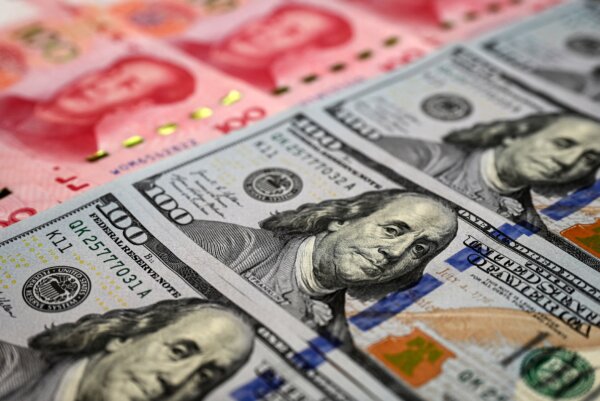
 For decades, the Chinese Communist Party (CCP) operated under the delusion that it could weaponize the global dollar-based system to fund its own rise while simultaneously building the tools to dismantle it.
That free ride is over.
The Iran Nexus: Cutting the Flow of War Money
The catalyst for this escalation is the CCP’s role as the primary financier of the world’s most destabilizing regimes. While “Operation Epic Fury” utilizes kinetic military force to degrade the Iranian regime’s nuclear capabilities and leadership, Operation Economic Fury strikes the financial channels that make its nuclear ambitions and Jihadist proxy wars possible.
Beijing is no longer a passive observer; it is the key player in funding Iran’s military activities. By purchasing roughly 90 percent of Iranian oil, China provides the hard currency Tehran needs to develop nukes, fund proxies, and manufacture the drones and missiles currently raining down on the Middle East.
U.S. Treasury Secretary Scott Bessent has issued a warning to China’s financial giants: If you move money for the mullahs in Tehran or the masterminds in Moscow, you will be severed from the U.S. dollar. The United States is now enforcing secondary sanctions that force Beijing into a binary choice—participate in the world’s largest economy or fund the regional wars of its junior partners.
The CCP has decried these moves as “financial hegemonism,” a predictable response from a regime watching its illicit revenue streams dry up. It has also warned the United States against disrupting Chinese trade with Iran and Russia.

The Treasury Bond Threat: A Blunt and Broken Instrument
In a desperate bid for leverage, Beijing has invoked its favorite rhetorical threat: a massive fire sale of its $800 billion U.S. Treasury portfolio. State-run media hints that this “nuclear option” could crash the U.S. economy, but the logic is as questionable as a CCP census report.
De-Dollarization and the BRICS Mirage
To escape the long arm of U.S. law, Beijing is doubling down on de-dollarization through the BRICS-Plus alliance. The goal is a blockchain-based payment system designed to bypass the dollar entirely and create a so-called sanction-proof world.
However, the BRICS alliance is built on a foundation of sand. The members fundamentally don’t trust each other. India has already publicly distanced itself from a common BRICS currency, preferring to protect the rupee and its burgeoning relationship with the West. Furthermore, without a free and open capital account—which the CCP will never allow, fearing loss of control—the yuan will remain a niche currency used only by those with no other options.

Global Retreat: Defeats in Panama, Venezuela, and Beyond
The CCP’s influence through its Belt and Road Initiative is hitting a wall of American resolve in the Western Hemisphere. In Panama, Chinese port contracts were canceled, and facilities were seized by local authorities. Of course, these actions were backed by serious U.S. diplomatic pressure, resulting in a significant strategic defeat for Beijing.
Shortly thereafter, U.S. military strikes against the Maduro regime in Venezuela in early 2026 humiliated Beijing once again. These operations disrupted the “oil-for-influence” deals that China used to anchor its presence in South America. The world watched as China, faced with actual U.S. military and economic resolve, stood down.
The Age of Consequence
The CCP is discovering that you cannot destroy a system while simultaneously relying on it for your very existence. By targeting Chinese banks and their treacherous trading partners, the United States is striking at the heart of the Party’s power.
Beijing may bluster about BRICS currencies and Treasury sales, but the fundamental truth remains: Without access to the dollar, the CCP’s global machine runs out of fuel. The age of consequence has arrived, and for the first time in decades, Beijing is the one being hunted.