
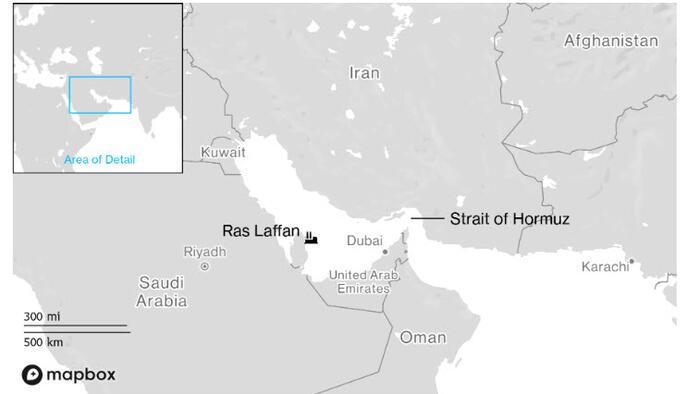
Less than a month after Reuters reported that QatarEnergy was ready to resume LNG production at its Ras Laffan LNG plant “very quickly” and expected to reach within a month full output of facilities unaffected by Iranian strikes, this morning Bloomberg reports that Qatar is pausing efforts to rapidly revive production at the world’s largest LNG facility, after an attack on one of its tankers in the Strait of Hormuz raised fears that transit through the crucial waterway is still too risky.
According to the report, QatarEnergy officials held a series of meetings following the attack on Tuesday, with CEO Saad Al-Kaabi deciding to cease plans to increase output at the Ras Laffan complex. Operations will be kept at a minimum for safety reasons and the number of vessels scheduled to dock at the plant in the coming days will be reduced/
The pause is one of the most high-profile fallouts to date of the heightened tensions this week with attacks on a number of ships near Hormuz and the US striking Iran for two consecutive days. President Trump on Wednesday even raised the prospect of a return to all-out war, a worst-case scenario for energy producers in the region who were gradually recovering from the impact of the conflict.
Delaying the Ras Laffan’s ramp-up threatens to further tighten the global gas market, risking more intense competition between Asia and Europe for spare supply as they restock for the coming winter. According to analyst calculations, Europe is badly behind in its winter stockpiling, and absent new sources, it risks a major price surge should the European winter be cold. It also explains why Asian LNG spot prices are more than 80% higher than pre-war levels, highlighting anxiety surrounding the restart of Qatar, which supplied about a fifth of the world’s LNG last year.
According to Bloomberg, since the US and Iran signed an interim peace deal in June, Qatar had been pushing ahead with plans to revive most of its LNG production within two months. It has been running some of Ras Laffan’s production trains at reduced capacity to be ready for a quickly ramp-up when the time was right. That’s likely to continue as the company still aims to boost exports as fast as possible following the safe opening of Hormuz.
As part of its restart prep, Qatar had increased loadings and brought back empty tankers to take on more fuel. Eleven empty LNG vessels are currently sitting outside Ras Laffan, according to ship-tracking data. But those efforts will now be temporarily paused as the world’s second-largest LNG exporter waits for tensions to ease.
The giant facility had been largely shut since early March after an Iranian drone attack, and about 17% of the plant’s production capacity was damaged in a separate missile strike weeks later. As we reported at the time, repairs to that part of the project is estimated to take at least three years.
Last week, QatarEnergy extended force majeure notices on LNG supply for some of its Asian customers to August, causing some uncertainty in the market about when the company would restart production, Bloomberg reported. In Europe, Italian utility Edison SpA said the clause will now be in place until early September for its imports.
The confusion about Qatar’s timelines heightened further after the country said its Al Rekayyat LNG tanker was struck by Iran on Tuesday. The ship was disabled, with the crew abandoning it shortly after, Bloomberg reported. This was the first time a Qatari LNG tanker was targeted since the war in Iran began in late February.
Two other vessels were also attacked, and Iran has fired projectiles on some Gulf countries as it came under attack from the US this week. The tensions brought maritime traffic through the Strait of Hormuz to a near standstill on Thursday.