
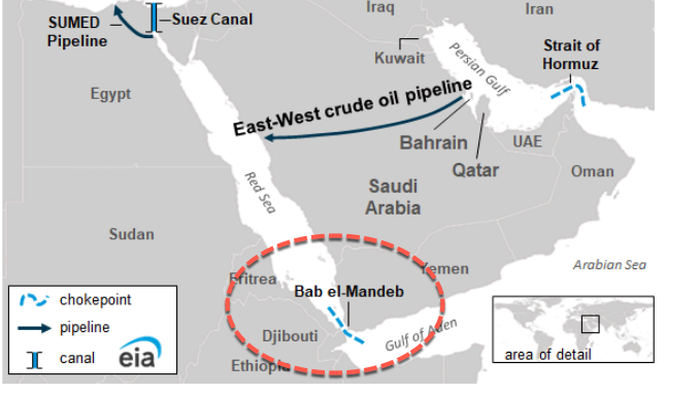
A Red Sea disruption would be terrible timing for global shipping and energy markets, coming just as vessel traffic through the Strait of Hormuz has started to normalize in recent weeks.
An overnight report that a cargo ship was attacked by “armed assailants” in the southern Red Sea off Yemen is a reminder that the region’s maritime-risk premium has not totally disappeared; it has simply shifted chokepoints.
“UKMTO has received a report of an incident 30NM southwest of Al Hudaydah, Yemen. A cargo vessel has triggered a distress alert stating that they are under attack by unknown armed assailants,” the United Kingdom Maritime Trade Operations wrote in an alert published on X early Sunday morning.
If the Bab el-Mandeb Strait, the southern gateway of the Red Sea that sits between Yemen and the Arabian Peninsula, begins flashing red again, the Suez-Red Sea maritime trade route could quickly become a major headache for global shipping companies, forcing more vessels around the Cape of Good Hope and reigniting pressure on freight rates, insurance costs, and energy-linked supply chains – thus fueling inflation.

Nomura’s Chief Economist for India and Asia ex-Japan, Sonal Varma, recently outlined for clients the critical importance of the Red Sea:
Since the Houthi attacks in 2023, global trade via the Red Sea has fallen, but the Bal el-Mandeb Strait and Suez Canal still account for 9% of global maritime traffic, ~20% of global container traffic and ~8.7% of world oil supply (including the SUMED pipeline). The Cape of Good Hope is an alternative route that will be used, but it involves longer transit times, higher fuel costs and increased freight rates.
Why this matters for Asia:
Most of the crude oil and condensate shipped via the Red Sea is destined for Asia (~68% of total), especially India. Around 40% of Asia-Europe trade transited through the Suez Canal in early 2024, including manufactured goods (electronics, vehicles and textiles), intermediate inputs for supply chains (auto and electronic components) and agricultural products (wheat, rice, sugar and tea).
Implications for Asia:
With the Strait of Hormuz blocked, Red Sea disruptions would aggravate the supply crunch. The cost of oil and petroleum product imports would rise for the region overall, with a higher burden for India, owing to its dependence on Russian oil via the Suez Canal. Asia’s exports to Europe could also be adversely affected, due to higher freight costs and longer transit times. The dependence of the European auto industry on component imports from Asia would also likely impact the auto sector.
Latest Gulf area news (courtesy of Bloomberg):
Khamenei Funeral Proceedings
• Iran began a mass funeral for Supreme Leader Ayatollah Ali Khamenei on Saturday, July 4, with his body lying in state at Tehran’s Imam Khomeini Mosalla mosque complex for public visits over the weekend
• Tens of thousands of mourners streamed to the Grand Mosalla religious complex in Tehran on Saturday to view the caskets of Khamenei and some of his family members
• Iranian authorities predict up to 20 million people will turn out over six days of funeral ceremonies beginning Saturday
• Khamenei’s coffin, wrapped in an Iranian flag, was placed on a platform alongside the coffins of family members killed in the same US-Israeli attack on February 28
Khamenei’s Death and War Context
• Khamenei, who ruled over Iran for 37 years, was killed along with several family members in a US and Israeli airstrike on the first day of the war in late February
• Iran feared it was too dangerous to hold funeral rites for four months, but is now proceeding shielded by a tentative truce and an America distracted by its 250th July Fourth celebration
Post-War Political Landscape
• Iran’s new leadership is described as younger, savvier, ruthless and even more hard-line, contradicting Trump’s claim of accomplishing “regime change”
• After surviving months of strikes by the US and Israel, the Iranian regime has emerged emboldened
Hormuz Tensions
• At least eight ships attempting to leave the Persian Gulf along the Omani coast turned back between Friday and Saturday, with some switching to a route closer to Iran
• The number of vessels sailing through the Strait of Hormuz along the Omani coast fell to a trickle on Sunday, after several made sharp reversals on Saturday
• Iran’s ambassador to Beijing said China and other friendly nations will be granted ‘special considerations’ when Tehran determines service fees for ships using the Strait of Hormuz
• Iran’s Deputy Foreign Minister warned the UK and France against meddling in the Strait of Hormuz, stating it is not a military playground for extra-regional powers
International Naval Presence
• French aircraft carrier Charles de Gaulle will return to its home port in Toulon after a nearly two-month deployment near the Strait of Hormuz, while mine countermeasure assets will remain deployed
Oil Market
• Major OPEC+ members agreed on Sunday to add 188,000 barrels a day to their output target for next month, adding to the prospect of more supply if a US-Iran peace pact can stick
• Flows of oil and natural gas have been returning to normal and prices have tumbled since an interim US-Iran accord was signed last month that pried open the Strait of Hormuz
Latest ZH Coverage:
• Ships Abruptly U-Turn Near Hormuz As Some Shift To Iran-Approved Routes
• Europe Capitulates, Sees Iranian Hormuz Fee Collection As ‘Inevitable’
• Iran Runs Into Big Problem: No Buyers For Its Oil, As Full Tankers Pile Up Off China
• ‘Gave Iran Week Off Because We’re Nice’: Trump References Ayatollah Funeral In Rushmore Speech
Professional subscribers can read more on energy markets and chokepoints here at our new Marketdesk.ai portal.