
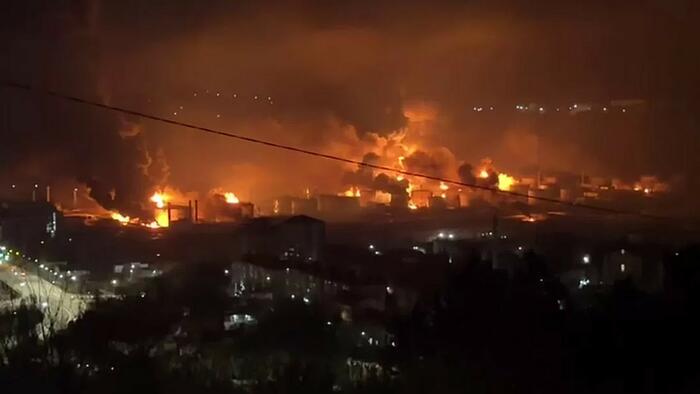
There’s been yet another major attack on Russia’s major Black Sea energy hub and port of Tuapse, after just a few days prior a drone wave had unleashed a fire so big it cold be seen from space, given the over 100-mile smoke plume that had spread over the Black Sea.
In this latest overnight Ukrainian assault reported Monday, the drone attack killed least one person and resulted in more major fires, and now emergency crews are battling their second huge blaze at the site in under a week. There’s been a massive oil spill into coastal waters to boot.
Last week’s fires (which began with the last Thursday strike) had only just been extinguished at the Rosneft-owned refinery.
The prior drone wave had damaged residential areas, while this fresh attack has damaged a gas pipeline, a church and two schools – according to regional reports.
“Fire crews and rescue services are currently engaged at every site,” Tuapse Mayor Sergei Boyko said, confirming that several locations along the export terminal were struck.
Ukraine’s military took responsibility for the attack, as well as hits on two oil depots in nearby Crimea.
As for last week’s initial assault, Russian media says it resulted in a significant oil spill into the waters of the Black Sea, with TASS providing the following details:
- An oil product spill into the Black Sea waters occurred in Tuapse after the UAV attack carried out by Ukrainian forces on the night of April 16, according to the regional operational headquarters’ Telegram channel.
- On April 19, an oil slick was detected in the sea on a satellite image.
- The oil slick is located about one and a half miles from the port of Tuapse.
- The area of contamination of the Black Sea with oil products amounts to 10,000 square meters, according to the Telegram channel of the Krasnodar Region operational headquarters.
- Specialists have also contained the oil spill in the Tuapse River following the UAV attack on the night of April 16.
- A total of 750 meters of containment booms and five specialized oil recovery devices have been deployed, and an oil trap has been installed.
These daily and nightly cross-border attacks have however largely slipped from mainstream headline coverage, given their frequency – to the point of being ‘routine’ (a grim reality).
Rosneft’s Tuapse Oil Depot and Export Facility in Krasnodar Krai, Russia, is currently ablaze, with dozens of tanks seen burning as thick black smoke pours into the sky, following a large-scale drone attack tonight by Ukraine against oil infrastructure across Southern Russia. pic.twitter.com/ZmtlLljYiI
— OSINTdefender (@sentdefender) April 20, 2026
Often even when refineries or major infrastructure is hit in either country, the event barely gets coverage in Western media at this point. With the globe’s attention focused on the Iran war and blockaded Hormuz Strait, and Russia-Ukraine negotiations having long effectively collapsed, the war in eastern Europe is expected to grind on for some time to come.