
OAN Staff Addie Davis
12:39 PM – Thursday, April 30, 2026
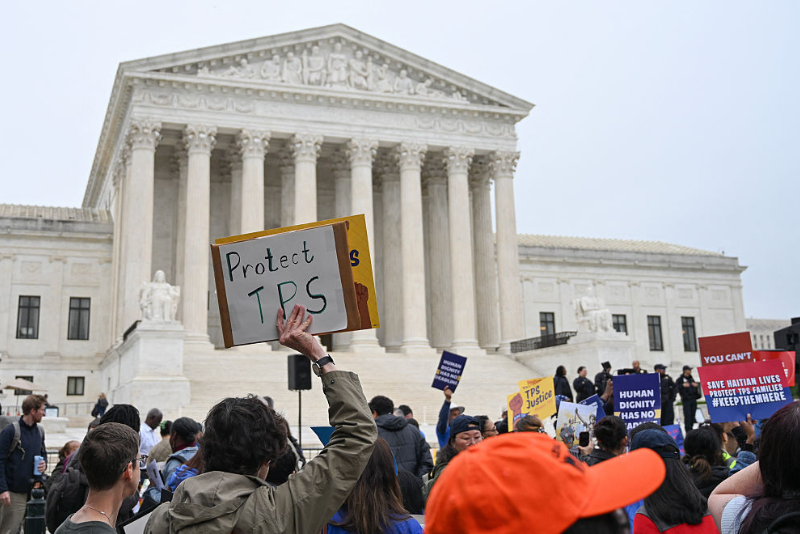
The Supreme Court of the United States (SCOTUS) heard oral arguments on Wednesday related to the Trump administration’s efforts to end temporary protected status (TPS) for Haitian and Syrian nationals.
Under the Obama administration, both countries were granted TPS through a 1990 Congressional law that allows certain immigrants to receive this status if they are nationals of countries designated “to be subject to armed conflict, natural disaster, or other extraordinary temporary conditions.”
Haiti was given this designation for a period of 18 months shortly after an earthquake in 2010 rattled the Caribbean country, killing hundreds of thousands.
In 2012, Syrian nationals were also granted TPS, with then-Department of Homeland Security (DHS) Secretary Janet Napolitano citing “deteriorating conditions” in the Middle Eastern nation. SCOTUSblog, which covers news regarding the High Court, attributed the “brutal crackdown” by the former Syrian Dictator Bashar al-Assad, who was ousted in 2024 following a civil war.
Despite the original short-term nature of the designations, they have persisted for well over a decade, with former DHS Secretary Kristi Noem announcing their termination in 2025. However, federal courts later blocked the move.
In the case brought to the Supreme Court, U.S. Solicitor General D. John Sauer, representing the Trump administration, argued on Wednesday that courts cannot review determinations made by the DHS secretary, a position now held by Markwayne Mullin, in regard to TPS, the SCOTUSblog explained.
Sauer pointed to the statute creating the program which “provides that there is no judicial review of any determination of the Secretary with respect to the designation or termination or extension of a designation of a foreign state for Temporary Protected Status.”
“That provision means what it says,” Sauer said. “Both ‘any’ and ‘with respect to’ have an expansive meaning and a broadening effect.”
“The provision thus bars judicial review of both the Secretary’s ultimate decision whether to designate, extend, or terminate and of each antecedent step along the way to that determination,” he asserted.
Geoffrey Pipoly, counsel for the Haitian nationals, countered that the administration’s review process was a “sham,” arguing that internal documents prove the decision to terminate TPS was a predetermined outcome rather than a good-faith assessment.
“The termination of Haiti’s TPS was different. It was not the result of the mandatory review process but was instead a preordained result driven by the President’s resolve to end TPS for Haiti no matter what,” Pipoly claimed.
The Court’s three liberal justices expressed skepticism toward the idea that the judiciary is barred from reviewing whether the administration followed proper procedures in terminating TPS. Beyond procedural concerns, the plaintiffs also asserted that the decision to end the protections was unconstitutionally rooted in racial animus.
“Now we have a President saying at one point that Haiti is a ‘filthy, dirty, and disgusting s-hole country’” Justice Sotomayor said. “He complained that the United States takes people from such countries instead of people from Norway, Sweden, or Denmark, where he declared illegal immigrants, which he associated with TPS, as poisoning the blood of America.”
“I don’t see how that one statement is not a prime example of the Arlington example at work and showing that a discriminatory purpose may have played a part in this decision,” she continued.
Sauer asserted, however, that the president’s comment never mentioned or were related to race, but instead referred to problems like crime, poverty, drug importation and other issues.
The court is expected to make a decision by the end of June or early July.
Stay informed! Receive breaking news alerts directly to your inbox for free. Subscribe here. https://www.oann.com/alerts
What do YOU think? Click here to jump to the comments!
Sponsored Content Below