
OAN Staff Jenna Lee and Brooke Mallory
6:32 PM – Monday, April 27, 2026
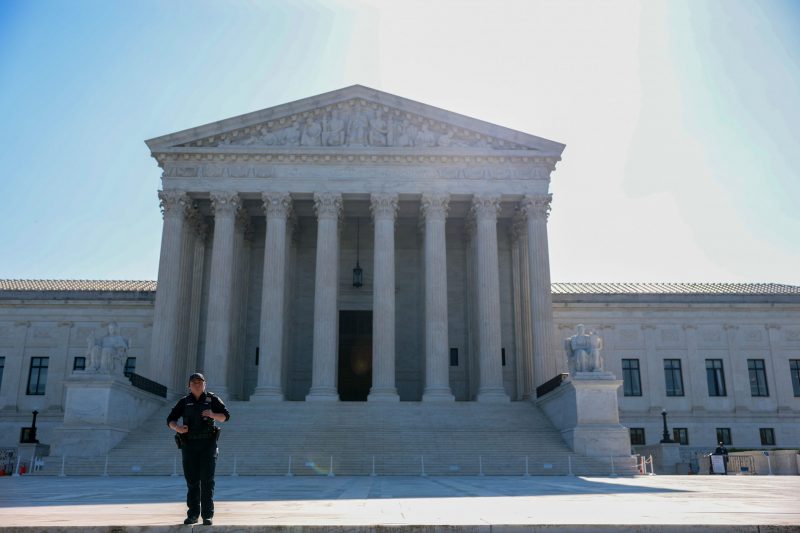
The Supreme Court of the United States (SCOTUS) heard oral arguments on Monday in a pivotal case that could significantly curtail the ability of Americans to sue pesticide manufacturers over alleged health risks.
At the center of Monsanto v. Durnell is glyphosate, the active ingredient in herbicides formerly produced by Monsanto and now owned by the German conglomerate Bayer. While the company maintains the product’s safety, the chemical has been linked to cancer in various scientific studies, sparking a wave of litigation across the country.
In this specific challenge, Monsanto is asking the High Court to overturn a $1.25 million Missouri verdict awarded to John Durnell, who successfully argued that the company failed to warn consumers about the potential carcinogenic risks of its Roundup weed killer.
A ruling in favor of the chemical giant could establish a federal precedent that effectively shields the industry from similar “failure-to-warn” claims in state courts.
“There’s really no way to look at this case and not come to the conclusion that a Missouri jury has told us that a cancer warning that EPA hasn’t required us to put on the label is required to [be] put on that label, and that just seems like a requirement in addition to what’s required by the EPA,” stated Monsanto lawyer Paul Clement.
“If it all does boil down to the impossibility idea — that it’s hard to add these labels without EPA’s permission — what do we do about the fact that, at least as briefs before us suggest, registrants have added cancer warnings to their labels without EPA permission or objection?” conservative Justice Neil Gorsuch asked.
Clement responded that those cases were “essentially implementation mistakes.”
For the past decade, Bayer has been embroiled in a massive legal battle, defending against more than 100,000 lawsuits from plaintiffs who attribute their development of non-Hodgkin lymphoma to exposure from Monsanto’s glyphosate-based herbicides.
In the landmark Durnell case, as with numerous other trials that have reached a verdict, juries have consistently determined that Monsanto was liable for failing to provide adequate warnings that glyphosate could potentially cause cancer.
These findings exemplify a broader judicial trend of holding the manufacturer accountable for its labeling practices, even as the company continues to challenge the scientific and legal basis of such claims before the nation’s highest court.
“I believe that the express preemption clause is requiring uniformity in law: the law of Missouri and the law of the United States have to be the same,” stated Ashley Keller, Durnell’s lawyer. “It does not require fact finders to find the facts the same way. One jury could say, ‘Monsanto didn’t do it, there’s nothing wrong with this pesticide’…and a different jury could come out the way Mr. Durnell’s jury did,” Keller added.
The Bayer CEO stated that the settlement and the Supreme Court case are “independently necessary and mutually reinforcing steps” as part of a strategy to contain litigation.
“The proposed class settlement agreement, together with the Supreme Court case, provides an essential path out of the litigation uncertainty, said Bayer CEO Bill Anderson in the company’s release.
Stay informed! Receive breaking news alerts directly to your inbox for free. Subscribe here. https://www.oann.com/alerts
What do YOU think? Click here to jump to the comments!
Sponsored Content Below