
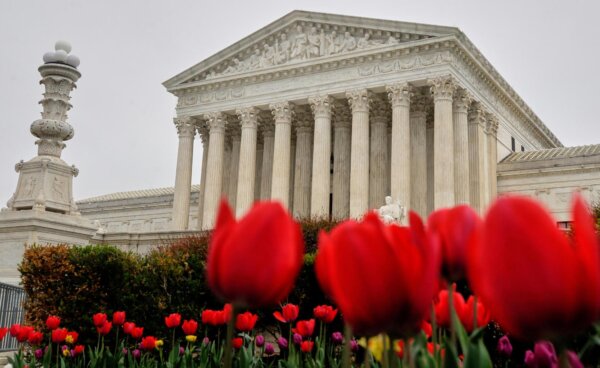
 The U.S. Supreme Court on May 18 ordered lower courts to reconsider rulings in two redistricting cases that concern whether private individuals may sue to enforce a federal law that bans discriminatory voting practices.
The court directed the lower courts to take another look at the cases from Mississippi and North Dakota in light of its recent landmark ruling limiting the use of race in redistricting efforts.
Justice Ketanji Brown Jackson dissented from both new rulings.
Lawyers call this process, which disposes of cases without holding an oral argument, GVR, which stands for grant, vacate, and remand.
North Dakota
In the North Dakota case, the Turtle Mountain Band, the Spirit Lake Tribe, and three Native American voters sued the state’s secretary of state after the state legislature redrew the boundaries of state legislative districts in 2021. The move took the number of majority-Indian districts in the northeastern section of the state from three down to one, and this, the tribes’ petition argued, constituted illegal dilution of Indian voting power.
They filed what’s called a private enforcement lawsuit against the secretary of state to enforce Section 2. They brought their legal action under 42 U.S.C. Section 1983, a federal law that allows individuals to sue the government for civil rights violations.
Secretary of State Michael Howe urged the federal district court to dismiss the case, arguing that there was no implied right of action allowing enforcement of Section 2. The court did not rule on the issue because the plaintiffs also pleaded their case under Section 1983, which the court found yielded a cause of action to enforce Section 2. A cause of action is a set of facts that provides a legal basis for suing someone, the petition said.
The district court ruled in favor of the plaintiffs, finding that Section 2 created individual rights and that nothing in the section’s enforcement provisions was “incompatible with private enforcement.”
Howe appealed, and the U.S. Court of Appeals for the Eighth Circuit found for the state and reversed the district court. The appeals court found that Section 2 does not make provisions for an implied private right of action, and that private plaintiffs may not “instead maintain a private right of action for alleged violations of [Section] 2 through 42 U.S.C. [Section] 1983.”
Section 2 “did not unambiguously create an individual right against collective vote dilution,” and the section’s prohibition against dilution is not privately enforceable under Section 1983, he said.
The tribes said in their petition that the Eighth Circuit erred in finding that Section 2 was not privately enforceable and urged the Supreme Court to grant their petition.
Mississippi
In the Mississippi case, the NAACP challenged a map for state legislative districts drawn by the Mississippi Legislature after the 2020 census, the NAACP said in its brief.
The group argued that some of the new districts in the 2022 redistricting plan violated Section 2 and the U.S. Constitution, by cracking “large, cohesive Black populations.” Cracking is drawing districts that divide a population or constituency across several districts.
The NAACP argued that four Senate districts and three House districts violated Section 2. The plaintiffs cited Section 1983 and the implied right of action under Section 2 as bolstering their right to privately enforce Section 2, the brief said.
A district court panel of three Mississippi federal judges ruled that the redistricting plan violated Section 2. The court gave the legislature an opportunity to fix its legislative map and ordered special elections in specific districts.
That issue regarding private enforcement action is “unsettled and profoundly important” and has divided the regional courts of appeals. Section 2 does not, in “clear and unambiguous” terms, create a federal right to enforce the law under either an implied right of action or Section 1983.
Jackson’s Dissent
Jackson wrote a nearly identical dissent to both Supreme Court rulings.
“This case presents only the question of Section 2’s private enforceability, which our decision in Louisiana v. Callais … did not address,“ she said. ”Thus I see no basis for vacating the lower court’s judgment.”
Citing the Morse precedent from 1996, Jackson said she would affirm the lower court’s ruling in the Mississippi case, and reverse the lower court’s ruling in the North Dakota case.