
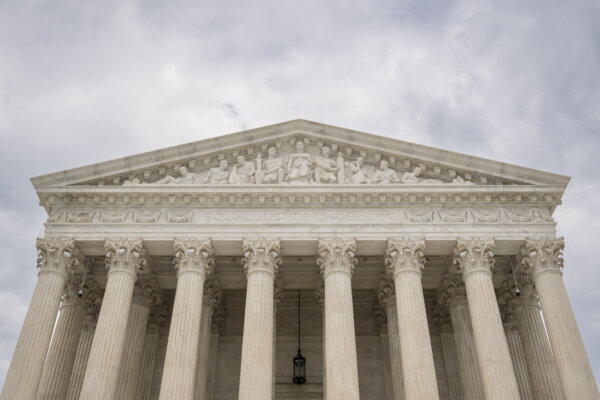
 Hours before Missouri’s deadline to finalize the Nov. 3 election ballot, late on Sept. 8, the U.S. Supreme Court declined to restore a Republican-drawn congressional map—and minutes later a federal judge ordered officials to use that same map.
Judge Stephen R. Clark of the U.S. District Court for the Eastern District of Missouri issued an order directing Missouri to use that same map in the midterms.
Because of the contradictory rulings, it is unclear whether the Republican-dominated Legislature’s 2025 map or the old 2022 map will be used in November.
The 2022 map was drawn after the 2020 Census to give Republicans a 6–2 edge over Democrats. The 2025 map, which came after a mid-decade redistricting, was designed to provide Republicans a 7–1 advantage over Democrats.
The state’s high court held that the 2025 map must first be approved by voters in a November referendum before it can take effect. The court ordered that the referendum question be placed on the Nov. 3 ballot.
If the referendum on the 2025 map is approved by voters weeks from now, the underlying law will take effect 30 days later, allowing the map to be used in future elections.
The Missouri Supreme Court said the citizen petition to place House Bill 1, the redistricting plan, on the ballot was “legal, sufficient, and timely,” and Missouri Secretary of State Denny Hoskins “incorrectly concluded otherwise” when he disallowed the petition.
The state court said the 2025 map approved by the state Legislature “is not the law and has never been the law.”
“There is only one valid congressional redistricting in effect—the congressional redistricting the General Assembly established in 2022,” the court said.
Under U.S. Supreme Court rules, Missouri still could present its emergency application to another justice.
The ruling, which may hinder Republican efforts to maintain their majority in the U.S. House of Representatives, could help longtime Rep. Emanuel Cleaver (D-Mo.) retain his seat.
His Kansas City-based district had been broken up under the redrawn map the state legislature approved in 2025.
The U.S. Supreme Court’s ruling, which left the Missouri Supreme Court decision intact, meant the general election in November would be based on the 2022 map, even though the primary election was held on Aug. 4 based on the 2025 map.
However, state officials now say they will follow Clark’s ruling, not that of the Missouri Supreme Court.
Clark said he granted the restraining order because without it many Missouri voters would have “to cast their general-election votes for candidates whom they had no role in nominating.”
“Using any map other than HB 1’s for the general election creates two classes of voters: those who happen to stay in their HB 1 congressional districts, and those who do not,” he said.
Because the primary already took place, Missouri “must honor the equal right to vote of all its eligible voters, regardless of geography,” Clark said.
The group that wants Missourians to vote on HB 1, People Not Politicians, and its executive director, Richard von Glahn, have filed an appeal of the restraining order and a request to stay the order with the U.S. Court of Appeals for the Eighth Circuit.
Clark’s order “places Missouri’s election officials in the impossible position of choosing which court’s order to violate,” they said in the court filing.
“It also places Missouri in the position of being forced to violate federal law by using districts other than those that were established by law,” it reads.
Missouri Gov. Mike Kehoe, a Republican, hailed Clark’s ruling.
“With today marking the deadline for changes to the November ballot, the [2025] Missouri First Map will be used in the general election,” the governor said on X.
“Voters and candidates deserve consistency, certainty, and not to have the rules changed between elections.”
Former federal prosecutor Neama Rahmani said the “very inconsistent state supreme court ruling” and the federal district court ruling have created a “mess.”
The case may end up returning to the U.S. Supreme Court “because it’s a matter of constitutional significance and a very clear disagreement and difference of legal opinion between the federal judiciary and the highest court of a state regarding a state law issue,” he told The Epoch Times.