
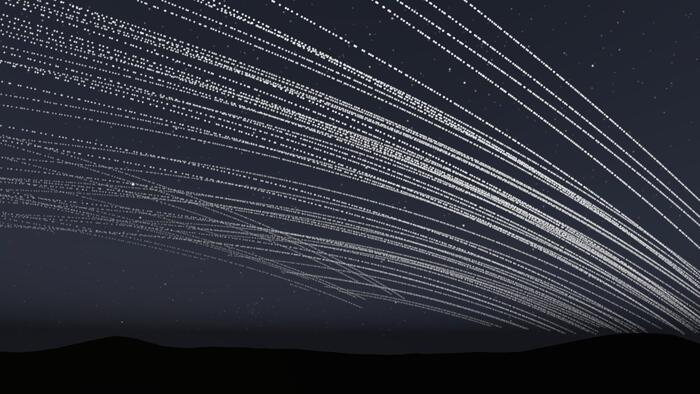
If built as filed with the FCC (by SpaceX, Blue Origin and Cowboy Space), the number of orbital data centers could, if left unmitigated, put roughly 100 times more visible satellites than stars in the night sky at some hours, according to a preprint by astronomers Aaron Boley, Samantha Lawler and Hanno Rein.
The paper, “Rings in the Sky,” models three designs taken from company filings which suggest Blue Origin’s Sunrise would be up to 51,600 satellites, Cowboy Space’s Stampede 20,000, and SpaceX’s constellation, which its filing describes as 1 million satellites, about 1.2 million once the orbits listed in a later update are added. Because the filings give only narratives and a few representative orbits, the authors fill in the rest with their own assumptions.
The satellites are big… and droppy.
SpaceX told the FCC its data center satellites would present about 800 square meters of area, counting radiators and solar panels. Cowboy’s sketch implies a solar array of about 4,800 square meters, more than double the roughly 2,250 square meters on the International Space Station.
At 30 degrees latitude on a winter evening, the authors count about 98,000 satellites brighter than magnitude 5 in the sky from SpaceX’s design alone, against roughly 500 stars of that brightness.

The rings would not be spread evenly.
The satellites would sit in Sun-synchronous rings that each cross the sky twice a day, and the paper says the largest impacts come in winter, when ring structures could be seen sweeping through otherwise dark skies. Near the poles they would stay in view through the day.
“People have lost the sense of the night sky because of the light-polluted cities,” Boley told Scientific American. Gaspar Bakos of Princeton, who was not part of the study, told the magazine, “The effect of satellites is truly global, with no place to retreat from them.”
The numbers rest on a simple model that treats each satellite as a reflective sphere, and the authors say actual brightness could be higher or lower.
The paper’s conclusion is that only brightness reductions “by orders of magnitude” or hard limits on satellite numbers would avoid the worst case, and that “the only clear way to reduce the on-sky impacts of ODCs is to limit their use.”
The authors list other costs.
A fleet of 1 million satellites with five-year lifetimes would mean one disposal every three minutes, and the paper says the metal deposited in the stratosphere would be orders of magnitude beyond anything yet modeled.
Not everyone’s Panicking…
Stefan Andersson wrote on X that some people “want it to be impossible to build orbital data centers, so they make up all sorts of irrational reasons to justify their false beliefs,” adding that SpaceX “already has 11,000+ satellites in LEO that demonstrate the feasibility of computing in space.”
However, his point goes to whether the data centers can be built, not to the paper’s brightness figures.
Some people want it to be impossible to build orbital data centers, so they make up all sorts of irrational reasons to justify their false beliefs. Fortunately for SpaceX it already has 11,000+ satellites in LEO that demonstrate the feasibility of computing in space. $SPCX https://t.co/QDhIRT863Y pic.twitter.com/zh4h0tOo5K
— Stefan Andersson (@Stefan_A) November 3, 2026
SpaceX has already dimmed its existing Starlink satellites and has promised mitigation in its filings, according to Scientific American, which says the other companies have not publicized plans.
Nevertheless, the American Astronomical Society has already asked the FCC to deny SpaceX’s application, and says its concerns extend to the Starcloud, Blue Origin and Cowboy Space filings.