
The great commercial real estate waiting game may finally be running out of time, according to Bloomberg.
For years after Covid fundamentally changed how Americans use office space, lenders and property owners managed to postpone much of the financial damage. Loans were modified, maturities were pushed out and buildings were given more time to recover. The basic assumption was that eventually interest rates would come down, employees would spend more time downtown and refinancing markets would reopen.
Instead, many owners are reaching the end of the runway with rates still elevated and buildings worth dramatically less than the debt sitting against them.
Chicago’s Aon Center offers an almost absurd illustration. The 83-story skyscraper changed hands for $712 million in 2015 and was subsequently refinanced, with $536 million of debt eventually packaged into commercial mortgage-backed securities. Today, after losing important tenants, the building is worth nowhere near that amount. Its latest appraisal came in at just $195 million — a decline of roughly 73% from its 2015 purchase price.
Bloomberg writes that when the debt matured in July, the owner couldn’t repay it and sought another three years to sort things out. This time the lender wasn’t interested. The request was “unequivocally denied.”
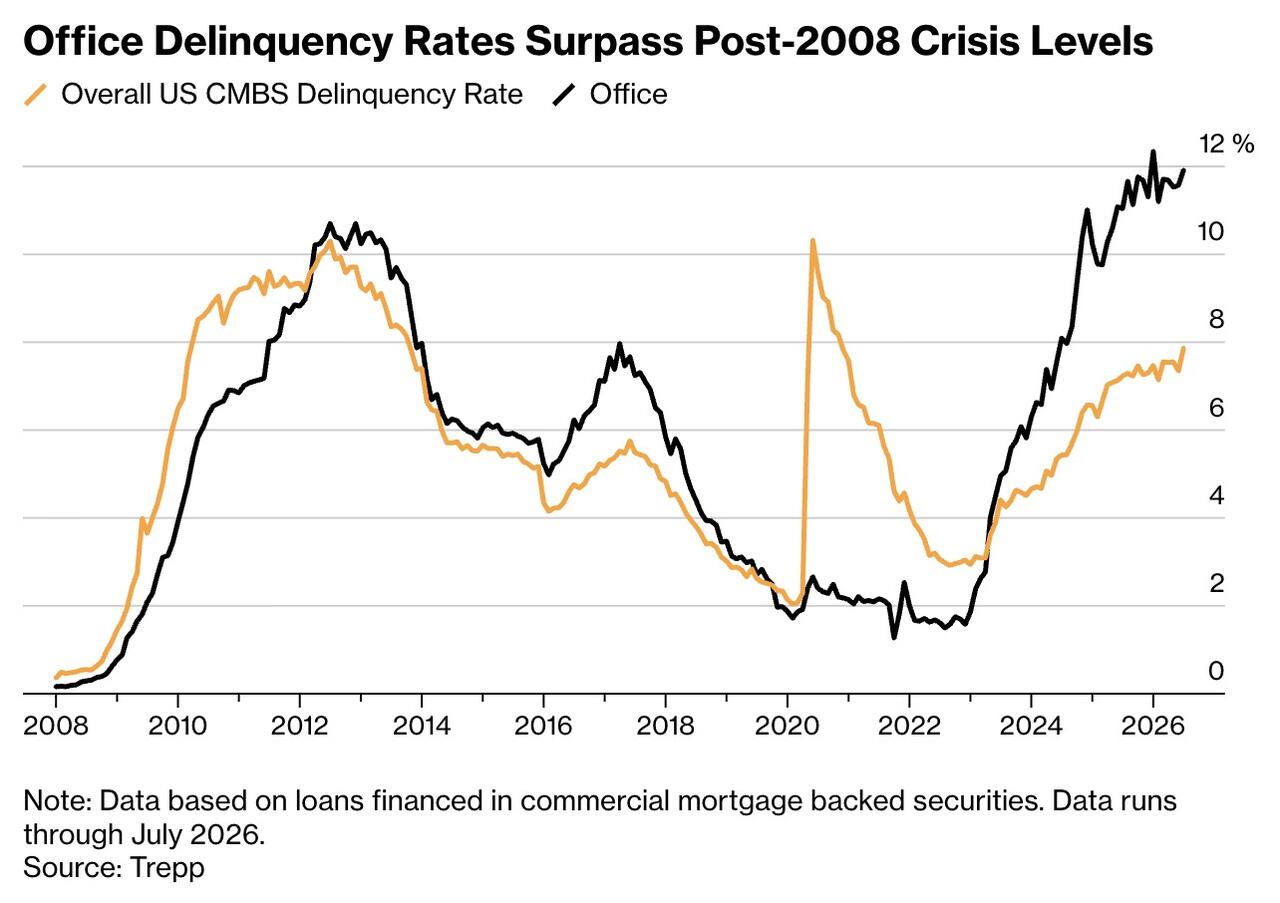
Situations like this are beginning to pile up across the country. Office loans packaged into CMBS are now delinquent at a 12% rate, according to Trepp. That puts distress near an all-time high and, remarkably, beyond the levels seen in the aftermath of the 2008 financial crisis. Meanwhile, approximately $64 billion of office CMBS loans come due this year and next. Nearly $40 billion of that pile is already delinquent, in default or flagged as potentially troubled.
But this isn’t one uniform nationwide office collapse.
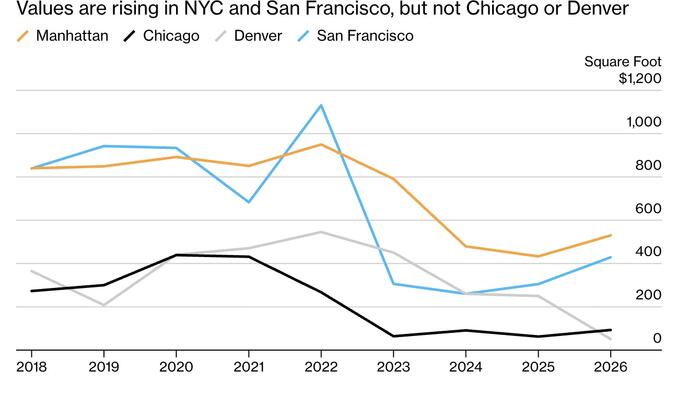
New York has been surprisingly resilient, with finance, law and technology companies still competing for desirable space. San Francisco, despite enormous problems left over from the pandemic, has received a new source of demand from the AI boom.
Other cities have considerably less working in their favor. Chicago’s downtown office vacancy rate is roughly 27%. Denver’s has reached an astonishing 39%. Los Angeles and several other downtown markets are also struggling, especially in areas dominated by older office stock.
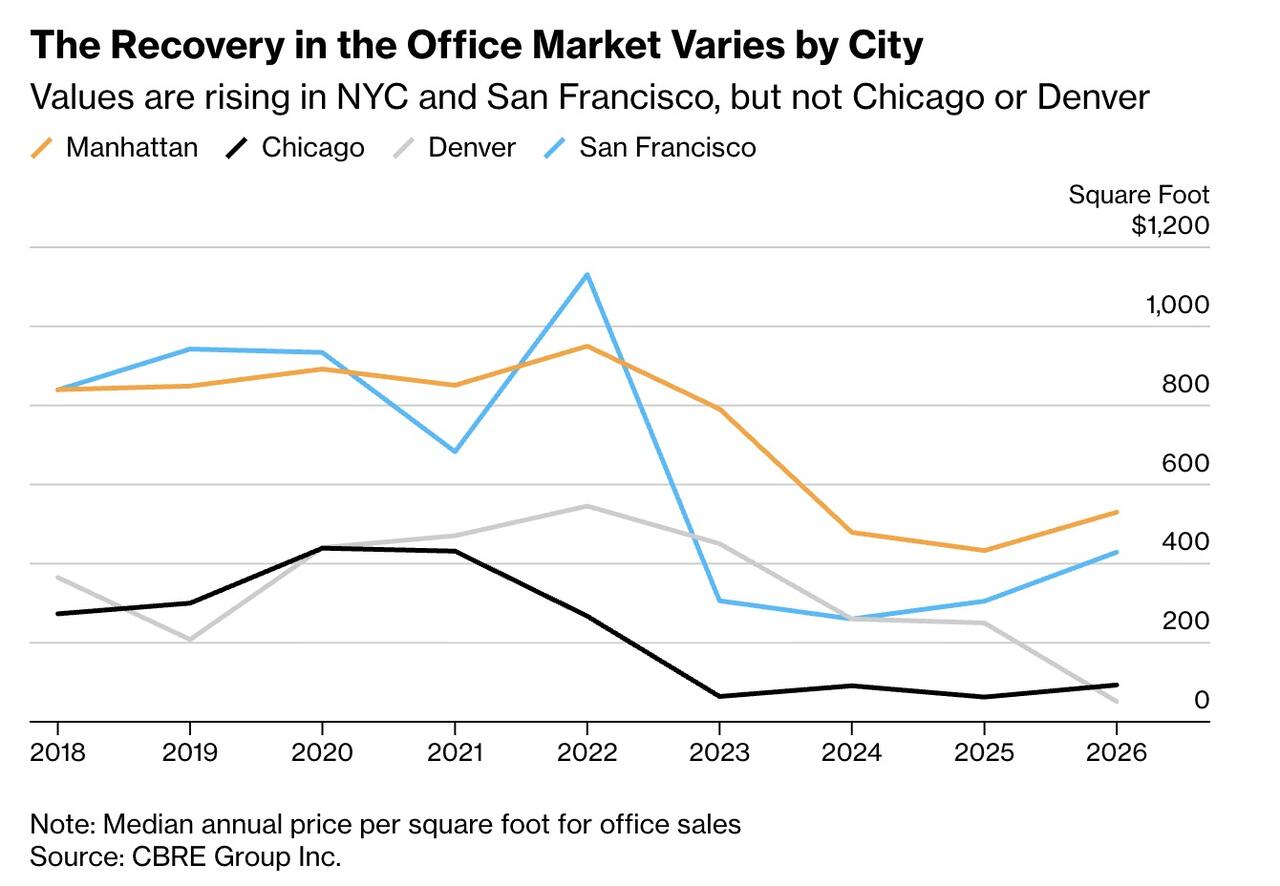
There’s also increasingly a tale of two office markets within individual cities. Companies willing to spend money on office space generally want newer buildings, good locations and modern amenities. That leaves yesterday’s Class B towers fighting over a shrinking pool of tenants while their economics deteriorate.
And some of the repricing has been brutal.
Denver’s Republic Plaza has lost roughly 80% of its value compared with when Brookfield financed the property in 2012. Chicago’s Citadel Center recently changed hands for $137 million, approximately 76% below what the building sold for in 2006. The situation is bad enough that CoStar expects roughly 11.5 million square feet of Chicago-area office space to simply disappear through demolition by 2031.
Even those enormous valuation declines may understate what lenders ultimately recover.
Distressed office properties sold this year have fetched prices roughly 20% below their latest appraisals, according to Deutsche Bank research cited in the report. In other words, marking a building down dramatically on paper doesn’t necessarily mean you’ve marked it down enough.
There is, however, another side to the collapse. Once prices fall far enough, someone eventually decides the risk is worth taking. That process is now beginning. Investors are stepping into buildings at fractions of their former valuations, effectively resetting the cost basis of properties that made little economic sense at yesterday’s prices.
The same 601W connected to the troubled Aon Center recently bought Chicago’s 175 West Jackson Boulevard for only $41 million, nearly 90% below its pre-Covid sale price. Elsewhere in Chicago, investors acquired the debt behind another major tower for around $100 million, roughly 76% below the building’s previous purchase price.
That’s probably the most important part of what is happening now. An office recovery doesn’t necessarily require these buildings to regain anything close to their old valuations. It requires the old valuations to finally die.
For years, the industry could avoid discovering what many of these buildings were actually worth because lenders kept extending loans and owners kept waiting. As maturities arrive and extensions become harder to obtain, those theoretical losses increasingly have to become actual ones.
And only after that happens can buildings move into new hands at prices that make sense in the post-Covid world. As Polpo Capital’s Dan McNamara put it: “One of the scariest headlines is that office CMBS delinquencies are higher than after 2008.”
“And it’s going to go higher as we face more maturities.”