
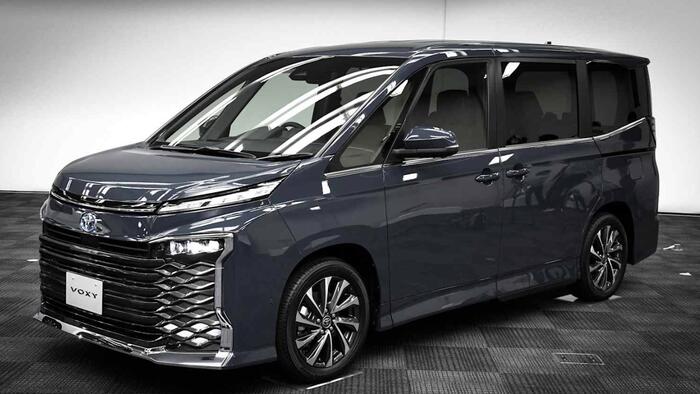
Toyota will start shipping Taiwan-built Noah and Voxy minivans to Japan later this year, marking a rare shift in the company’s production strategy as mounting pressures strain the country’s auto manufacturing sector, according to Nikkei.
Production for the Japanese market is set to begin in October on a dedicated line at Toyota’s plant in northern Taiwan, according to Nikkei. While Japanese automakers have long sold foreign-built vehicles at home, those models were typically intended for overseas markets first. Toyota’s decision to create an offshore production line specifically for Japanese consumers is highly uncommon, particularly for two of its key domestic models.
The move comes as Toyota faces increasing difficulty expanding output inside Japan. Factory utilization is already near its limits, while labor shortages, higher material costs, and tighter compliance requirements have made domestic manufacturing more expensive and less flexible. Delivery delays for popular vehicles have stretched for months — and in some cases more than a year — forcing the automaker to suspend orders periodically as demand outpaces supply.
Nikkei writes that Toyota has committed to maintaining annual domestic production above 3 million vehicles to support employment and preserve Japan’s industrial base. At the same time, however, the company is increasingly relying on overseas operations to ease bottlenecks and reduce operational risk.
The Noah and Voxy are among Toyota’s strongest-selling minivans in Japan, with annual sales typically ranging between 70,000 and 80,000 units. To help meet demand, Toyota plans to build roughly 100,000 vehicles per year in Taiwan, focusing mainly on lower-cost variants. Production in Japan will continue in parallel.
The Taiwan facility already assembles models including the Corolla sedan and Yaris Cross through a local joint venture. For the fiscal year ending March 2026, the plant produced around 120,000 vehicles. Expanding output for Japan-bound minivans is expected to significantly increase overall production volumes.
Building a new automotive production line with annual capacity of 100,000 vehicles can require investments worth tens of billions of yen. Even so, Toyota appears willing to absorb those costs as domestic factories struggle to accommodate additional output. The company currently produces about 14,000 vehicles per day across Japan, leaving little spare capacity.
Pressure on the production system intensified after certification issues uncovered in 2024 prompted Toyota to tighten testing and regulatory oversight procedures, further constraining manufacturing flexibility.
Producing vehicles in Taiwan also introduces new challenges. The yen recently fell to its weakest level against the New Taiwan dollar in more than three decades, raising labor and operating costs for Japanese manufacturers there. Still, Toyota sees offshore production as necessary to stabilize supply and reduce delivery times.
Toyota president Kenta Kon has warned that persistent shortages are unsustainable, calling the situation “abnormal and critical.” The company fears prolonged waits could eventually push customers toward rival automakers.
Toyota is not alone in turning to reverse imports. Industry data shows sales of Japanese-brand vehicles built overseas and sold domestically climbed 19% last year to more than 111,000 units — the highest level in three decades. Honda is also preparing to bring an India-made EV into the Japanese market by fiscal 2028 as automakers increasingly seek lower-cost production bases abroad.