
OAN Staff Lillian Mann and Brooke Mallory
5:30 PM – Friday, May 1, 2026
Trump administration officials have declared that the United States’ military engagement in the Middle East has officially concluded, preempting the 60-day deadline established by the 1973 War Powers Resolution.
The federal law serves as a “critical check on executive authority,” analysts say, requiring the U.S. Commander-in-Chief to notify Congress within 48 hours of deploying armed forces into hostilities.
Once this notification is submitted, a 60-day window begins and the president must terminate the use of force by the end of this period unless Congress grants a specific authorization or extension.
While the law permits an additional 30 days to facilitate a safe and orderly withdrawal of troops, the administration maintained that such an extension is unnecessary in this instance.
The 60-day clock was set to expire this Friday, counting from the formal notification sent to Congress on March 2nd following strikes in Tehran. Despite the looming deadline, a senior administration official clarified that the operation against Iran was already considered terminated as of the ceasefire agreement brokered by President Trump on April 7th.
By emphasizing that the initial two-week ceasefire has since been extended indefinitely, the administration asserts that the current status of forces no longer constitutes active hostilities, thereby satisfying the legal requirements of the Resolution without necessitating further congressional action.
“On April 7, 2026, I ordered a 2-week ceasefire. The ceasefire has since been extended. There has been no exchange of fire between United States Forces and Iran since April 7, 2026. The hostilities that began on February 28, 2026 have terminated,” Trump wrote.
Since the commencement of Operation Epic Fury on February 28th, congressional Republicans have successfully defeated more than half a dozen War Powers resolutions designed to curtail the president’s military authority. While the GOP has maintained a largely united front, several members have suggested their support is not indefinite and could pivot following the 60-day legal deadline depending on the administration’s next steps.
Bolstering this position, House Speaker Mike Johnson (R-La.) dismissed the necessity of formal congressional intervention during an interview with NBC News on Thursday, maintaining that the United States is not technically at war with Iran.
“I don’t think we have an active, kinetic military bombing, firing or anything like that. Right now, we are trying to broker a peace,” Johnson said. “I would be very reluctant to get in front of the administration in the midst of these very sensitive negotiations, so we’ll have to see how that plays out.”
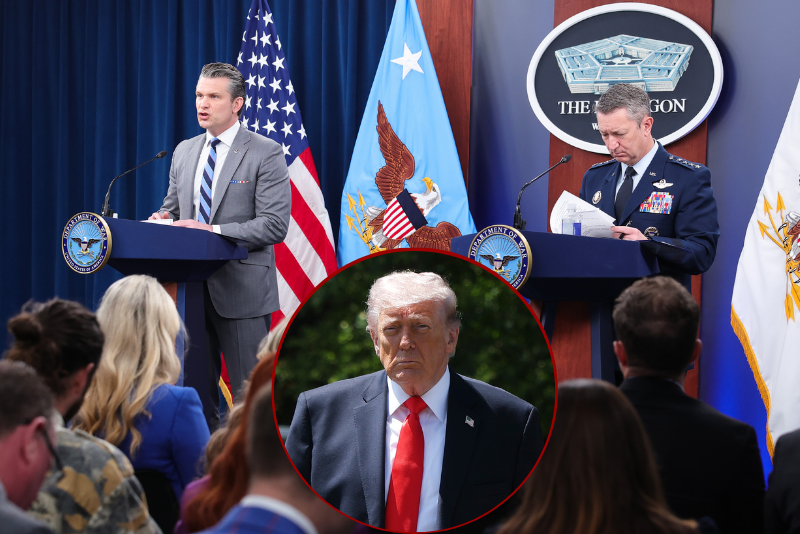
Speaking in front of the Senate Armed Services Committee on Thursday, War Secretary Pete Hegseth also argued that the clock stopped with the ceasefire. “We are in a ceasefire right now, which our understanding means the 60-day clock pauses or stops in a ceasefire,” Hegseth said.
GOP lawmakers, however, were not in full agreement on the new timeline. Senator Thom Tillis (R-N.C.) questioned Hegseth’s argument.
“I felt like the War Powers resolution says in 60 days you have to take some action,” Tillis said. “We need to start talking with the administration and in cooperation with them, to get an authorization for the use of military force so the American people understand the Congress is behind what the president is trying to do,” he added.
Senator John Curtis (R-Utah) also added that he would “not support ongoing military action beyond a 60-day window without congressional approval.”
In addition, Senators Susan Collins (R-Maine) and Rand Paul (R-Ky.) joined Democrats on Thursday in their latest effort to push the Trump administration to withdraw troops from the Middle East.
“The Constitution gives Congress an essential role in decisions of war and peace, and the War Powers Act establishes a clear 60-day deadline for Congress to either authorize or end U.S. involvement in foreign hostilities,” Collins said in a statement. “That deadline is not a suggestion; it is a requirement.”
Senator John Curtis (R-Utah), who voted against the War Powers Resolution, noted that he will withhold further funding for the conflict until Congress is consulted.
“This is not an adversarial stance against the Administration; rather, it is a commitment to our system of government,” Curtis wrote in a statement. “It is critical to our national security that Iran’s malign capabilities are neutralized, but it is equally critical that we do so on a sound constitutional footing.”
While Congress has passed resolutions to end military operations, they have almost never survived the presidential veto. The 1973 law was designed to be a “self-executing” check, but in practice, it has been difficult to enforce against a determined president, according to analysts.
“It’s very hard to look back on the 50-year history of the War Powers Resolution and say that it has successfully constrained presidential action,” David Janovsky, who leads the Constitution Project at the Project on Government Oversight, noted.
In 2011, the Obama administration argued it did not need congressional approval for its air strikes against Libya beyond the 60-day mark since the operations did not qualify as “hostilities” under the law and did not involve U.S. ground troops. In 1999, the Clinton administration similarly continued its bombing campaign in Kosovo past the statutory deadline, contending that Congress had effectively authorized the action by approving its funding.
“What we’ve seen in the past year is the War Powers Resolution acting in the political sphere much more so than in the legal sphere,” Katherine Yon Ebright, an attorney at the Brennan Center’s Liberty and National Security Program, noted.
Senator Lisa Murkowski (R-Alaska) announced Thursday that she is drafting a formal authorization for the use of military force in Iran if she does not see a “credible plan” from the White House in the next week. However, it is unclear if there is enough support to pass such a measure.
“I do not accept that we should engage in open-ended military action without clear direction or accountability. Congress has a role, [and] Congress has to step up and fulfill that role, that obligation that the Constitution assigns to us,” she stated.
Murkowski expressed that she will introduce the measure — known as an Authorization for Use of Military Force (AUMF) — after the Senate returns from its recess the week of May 11th.
“President Trump has been transparent with The Hill since before Operation Epic Fury began, and administration officials provided over 30 bipartisan briefings for members of Congress to keep them apprised of military updates,” White House spokeswoman Anna Kelly said in a statement on the issue.
Stay informed! Receive breaking news alerts directly to your inbox for free. Subscribe here. https://www.oann.com/alerts
What do YOU think? Click here to jump to the comments!
Sponsored Content Below