
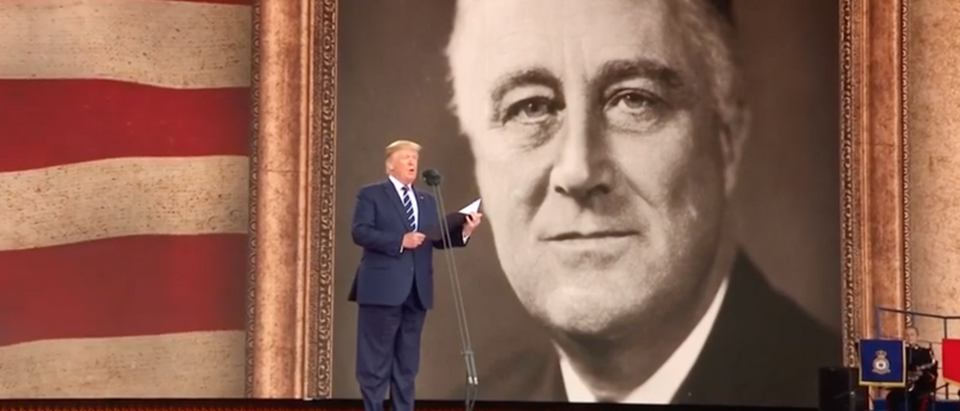
Ever since historians spoke to him about building his legacy, President Joe Biden has reportedly been obsessed with emulating the Democratic Party’s most transformational president. But in a twist of irony, it’s Donald Trump who is most likely Franklin D. Roosevelt.
FDR coined the term “first 100 days,” as a way to urge the public to pay attention to the unprecedented number of sweeping economic reforms he enacted immediately upon taking office. The country was in dire straits when he first took office in 1933, reeling from the Great Depression. One of the wealthiest men in the country, he genuinely cared for — and inspired — the ordinary man. Over the next five years, his New Deal would re-shape the relationship between government and the individual, labor and capital — laying the foundation for the modern economic system we know today.
FDR embraced Keynesian economic ideas, which held to the bold notion that government spending would stimulate economic activity during recessions. Keynes argued that government-led job creation would boost overall demand in the economy, providing income for individuals to spend elsewhere and multiply. This inspired a host of public works projects, a hallmark of the New Deal.
Keynes also favored robust social safety nets as a way to insulate demand. Economic collapse could be avoided or minimized if the government subsidized consumer spending throughout a downturn. Social security, unemployment, and other forms of social welfare programs emerged from the New Deal.
Through a series of labor and financial reforms, FDR also re-balanced the relationship between the classes in society. The New Deal gave more power to the unions and introduced labor standards like minimum wage, maximum hours, and overtime pay. Financial reforms separated commercial and investment banking to minimize risky investments, insured deposits, and increased transparency around securities sales.
Of course, income taxes were hiked to historic levels in order to pay for all of this. Overall, the New Deal empowered workers at the expense of businesses and introduced a responsibility for government to provide for individual well-being.
What began as novel and often brilliant solutions for a critical moment in history ossified into dysgenic dogma in the decades to come. The New Deal is the lens through which we view the modern political-economic world around us. With the rise of globalization, the wealthy gained the obligation to stimulate growth as much as possible through competitive business practices, while responsibility fell to government to care for everyone else. Eternal growth would fund ever-expanding compensation. Through technical management by experts, this dynamic could be maintained forever — or so the theory goes.
Historian Michael Beschloss told Axios in March 2021 that FDR was the “closest analogue” to how Biden was “transforming the country in important ways in a short time.” After a 2-hour sit down with historians echoing the same sentiment, the “growing narrative” clearly went to his head. Yet while FDR devoted his first 100 days to transformative action, Biden only offered more of the same.
What Build Back Better and subsequent spending boondoggles really delivered was a form of zombie New Dealism, using COVID as an excuse to further insulate the existing order from a Trumpist revolt. They flooded the economy with government stimulus artificially boosting consumer demand, and massively expanded the role of government to care for individual welfare. The only difference is that Biden targets what Democrats now perceive as the “little man” in America— racial and sexual minorities who are said to be viciously discriminated against by “the system.” The system is re-jiggered to look out for their interests, but everything else remains in place: creeping paternalism, higher taxes, and the insulated wealthy perpetually doing better as long as modest growth continues apace. While ideological historians may cheer him today, history will remember Biden’s presidency as the last gasps of a dying era.
Consistent with FDR, it is Trump who has largely dealt the death blow to the old regime.
Like FDR, Trump came from great wealth but still has the ability to connect naturally with the common man as if he is one of them. Biden pretends to be folksy middle-class Joe, but is scripted and artificial; Trump walks into any small town in the Heartland and seems like he is right at home. More importantly, the average man believes in Trump as a symbol against the predations of a coastal elite. The most powerful thing he ever said was, “They’re not coming after me. They’re coming after you — and I’m just standing in their way.” Trump was the first politician in a generation who not only understood the interests of the forgotten man, but earned their respect by actively seeking to defend it.
( @realDonaldTrump – Truth Social )
( Kimberly Guilfoyle – Truth Post – Oct 02, 2023, 10:58 AM ET )Donald J. Trump ReTruthed
— Kimberly Guilfoyle – @kimguilfoyle
“In the end, they’re not coming after me. They’re coming after you — and I’m just standing in their way.”
— Donald J. Trump 🇺🇸 TRUTH POSTS (@TruthTrumpPosts) December 12, 2023
But the connection goes much deeper than style and sensibility. Trump proposed an entirely new social contract, a small-n new deal for the 21st first century. The ideas that economic health could be judged by corporate efficiency and that federal bureaucrats had a right to rule both fell apart and the decades-long ruling class lost much of its legitimacy. Welfare handouts were acknowledged as an unworthy substitute for an honest day’s work. The lie that American culture was whatever the free market decided became seen for what is — a dereliction of duty that allowed the left to take over every major American institution. The government would again be geared toward the ideal of “we the people” rather than brazenly flaunting it.
By any measure, Trump’s execution fell short from the lofty goals of his campaign rhetoric. Trump pursued this paradigm shift through executive action, aggressive trade policy, sanctions, and a willingness to employ state power to fight the culture war, but the mission remains far from complete. While he cannot yet be credited with transforming America’s governing system, he deserves credit for transforming the American ethos in a way that will surely continue whether or not he re-takes the White House in 2024. No one in the modern era had ever talked like this before Trump before 2016; now, no one will ever go back.
FDR was not just transformative because he was a big government liberal who blew out federal spending more than ever. Plenty of administrations have done that. What truly sets both FDR — and Trump — apart is that they saw what was needed at a specific crisis point in history and possessed the visionary leadership to change the way we think about politics, government, the economy, and our role within them all.
The New Deal was unimaginable among FDR’s contemporaries, but it saved the country from the brink of collapse and now, much of the world economy is built in its image. The Trump Train is just getting started.