
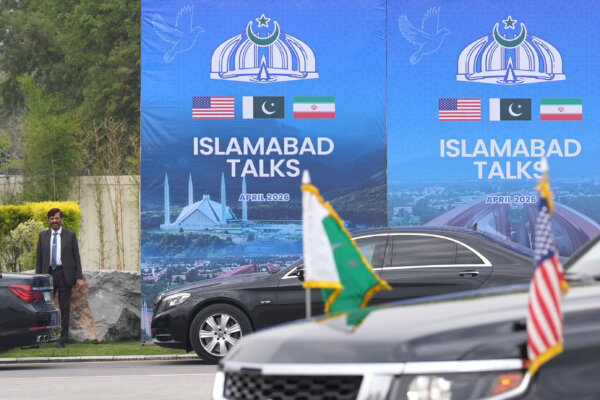
 President Donald Trump said on April 19 that U.S. representatives will arrive in Pakistan on the evening of April 20 in preparation for negotiations with Iran.
Trump made the announcement on Truth Social and said that Iran had violated a ceasefire agreement by firing shots on April 18 aimed at a French ship and freighter from the UK in the Strait of Hormuz.
“Iran recently announced that they were closing the Strait, which is strange, because our blockade has already closed it,” Trump posted on April 19. “They’re helping us without knowing, and they are the ones that lose with the closed passage, $500 Million Dollars a day!”
Vice President JD Vance, special envoy to the Middle East Steve Witkoff, and special envoy Jared Kushner are expected to travel to Pakistan as part of the U.S. delegation.
Trump warned that if Iran does not agree to a deal, the United States could target key infrastructure.
“The United States is going to knock out every single Power Plant, and every single Bridge, in Iran,” he wrote on Truth Social.
“If they don’t take the deal, it will be my Honor to do what has to be done.”
Iran had not confirmed that it would attend negotiations with the United States.
Trump announced on April 19 on Truth Social that the United States had warned an Iranian ship attempting to bypass the blockade to stop. When the Iranian vessel did not stop, the Navy destroyer USS Spruance intercepted it in the Gulf of Oman.
“The Iranian crew refused to listen, so our Navy ship stopped them right in their tracks by blowing a hole in the engine room,“ Trump said. ”Right now, U.S. Marines have custody of the vessel. We have full custody of the ship, and are seeing what’s on board.”
The ship was identified by Trump as a nearly 900-foot-long cargo ship named Touska that the president said weighed almost as much as an aircraft carrier.
Average gas prices in the United States have increased to $4.05 per gallon for regular gas from $3.15 per gallon on April 19, 2025, according to the American Automobile Association.
The survey showed that 69 percent of Americans are concerned about higher gas prices resulting from military action against Iran.
The Islamic Republic News Agency reported on April 18 that peace negotiations “could materialize” if Trump were to accept Iran’s 10-point proposal “as the framework for negotiations.”
The news agency said one of the “essential preconditions” was a ceasefire on all fronts, including Lebanon.
If the United States were to agree to the ceasefire on all fronts, Iran would reopen the Strait of Hormuz for commercial ships but not for military vessels, according to the Iranian news agency.
The Islamic Republic News Agency said that Iran had received “new proposals from the Americans, which the Islamic Republic has not yet responded to.”
Iran said it would consider a military blockade on the Strait of Hormuz a violation of the ceasefire, the Islamic Republic News Agency reported.
Trump said on April 17 on Truth Social that the blockade was not ending.
“The Strait of Hormuz is completely open and ready for business and full passage, but the naval blockade will remain in full force and effect as it pertains to Iran, only, until such time as our transaction with Iran is 100 [percent] complete,” Trump posted in all-caps. “This process should go very quickly in that most of the points are already negotiated.”
Mohammad Bagher Ghalibaf, Iran’s chief negotiator, said on X on April 17 that with the continuation of the blockade, the Strait of Hormuz would not remain open. Passage through the strait would be done with “Iranian authorization.”
The Iranian news agency said the 21-hour peace talks in Pakistan ended without results “due to new and ambitious demands of Washington.”
The United States and Iran agreed to a two-week ceasefire that took effect on April 8 and is set to expire on about April 22.
The two countries have had strained relations for decades, dating back to the 1979 Iranian Revolution, which led to the severing of diplomatic ties.
Trump said the operation’s goal is to eliminate threats from Iran and ensure that the regime can never have a nuclear weapon.
Iran said on April 18 that it was not prepared to resume peace talks with the United States unless Trump were to ease what officials describe as a “maximalist” position on the country’s nuclear program, according to Iranian Deputy Foreign Minister Saeed Khatibzadeh.
Khatibzadeh said negotiations would require a “framework of understanding” before moving forward.
Previous diplomatic efforts have yet to produce an agreement. Vice President JD Vance led a 21-hour round of talks with Iranian representatives on April 11. No deal was made.
Vance said at the time that Iran’s refusal to explicitly renounce the pursuit of nuclear weapons was a sticking point.
Iran’s military said on April 18 that it had reinstated “strict military oversight” over the Strait of Hormuz. Iran said it was due to Washington’s ongoing naval blockade of Iranian shipping.