
After five straight months of JOLTS beats, including two blowout prints for April and May and zero misses since 2025…
… it was inevitable that the BLS would eventually pot out a disappointment, if only to preserve the myth of “accurate data.”
That’s what happened today when in the latest JOLTS report, the US dept of labor reported that in June the US had 7.359 million job openings, down 178K from the (downward revised) May total of 7.537 million, and below the median estimate of 7.454 million.

Where did the openings come from? According to the BLS the number of job openings increased in transportation, warehousing, and utilities (+97,000) and in federal government. Job openings decreased in wholesale trade (-74,000), nondurable goods manufacturing (-55,000), and mining and logging (-9,000).

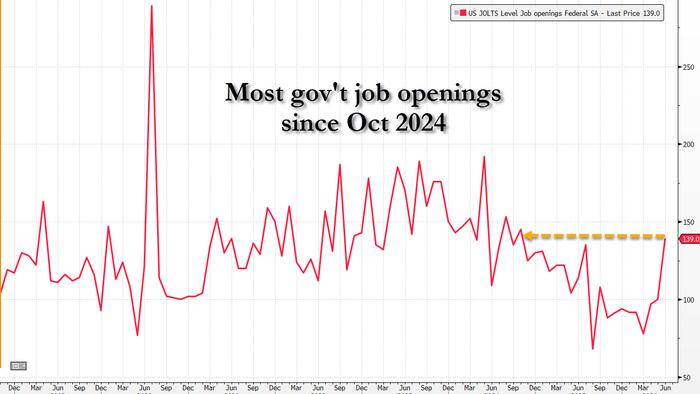
Of note, Federal government soared by 39K from 100K to 139K, the highest print not only of 2026 but the highest print going back all the way to October 2024 (i.e., when Biden was still president).

The June drop in job openings was juxtaposed with an overall drop in June employment, which meant that after 9 months of labor surplus which ended in March, we now have a third consecutive month of more job openings than unemployed workers, and in June the surplus was 265K, the biggest surplus since the 566K in Jan 2025, and a concerning development for the broader labor market which according to most other measures continues to fire on all cylinders.

The latest JOLTS report also means that after falling back to 0.9x in March, in April the ratio of job openings rose over 1.0x and was the highest since January 2025.

While the job openings number was weaker than expected for the first time this year, in June we saw continued strength in both hires and quits, In June the number of Quits – or the “take his job and shove it” indicator – rose by almost 100K to 5.252MM from 5.348MM indicating a modest rise in confidence that better jobs await elsewhere, at the same time hires also rose by about 80K, from 3.153MM to 3.232MM, and followed a 110K increase in May.

It goes without saying that job openings sliding while hires are jumping, and more people are voluntarily leaving their jobs, while payrolls are growing (as we will find out on Friday), leads one to scratch their head just what is going on here, besides data massaging of course.
In any case, since this hires number feeds directly into the payrolls calculations (after netting out separations) this explains why the May payrolls report jumped by 57K, even as the JOLTS implied number was far weaker than that.

Overall, this was a weak mixed JOLTS report, with weakness in openings offset by strength in hires and quits, but most notably, the surge in government job openings as Trump appears to backtrack on even more of his promises, and shows that after some significant strength in the early part of of 2026, US labor market is now hitting an air pocket and this could translate into a notable miss in this Friday jobs report. Then again, it is common knowledge that JOLTS lags the payrolls report by a month, which is why it gives us little insight into what Friday’s jobs report will be, although if the hires less separations dataset is any indication, it suggests that the July print will come well below expectations.