
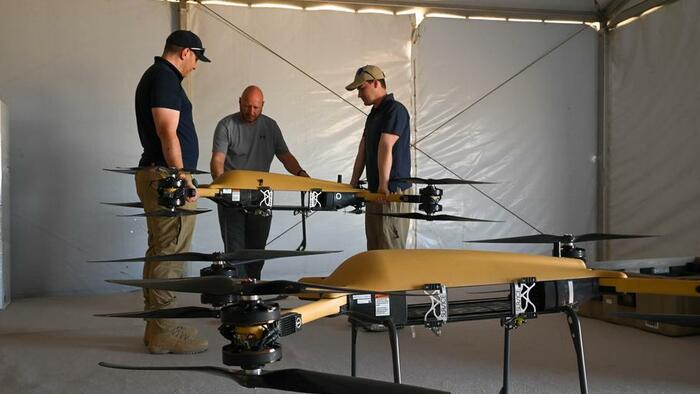
Compared to what Ukraine and Russia are learning in the context of their grinding years-long war, the Pentagon is a bit late in putting together comprehensive drone swarm battle plans and tactics, but it seems to be the clear direction of future conflict spaces.
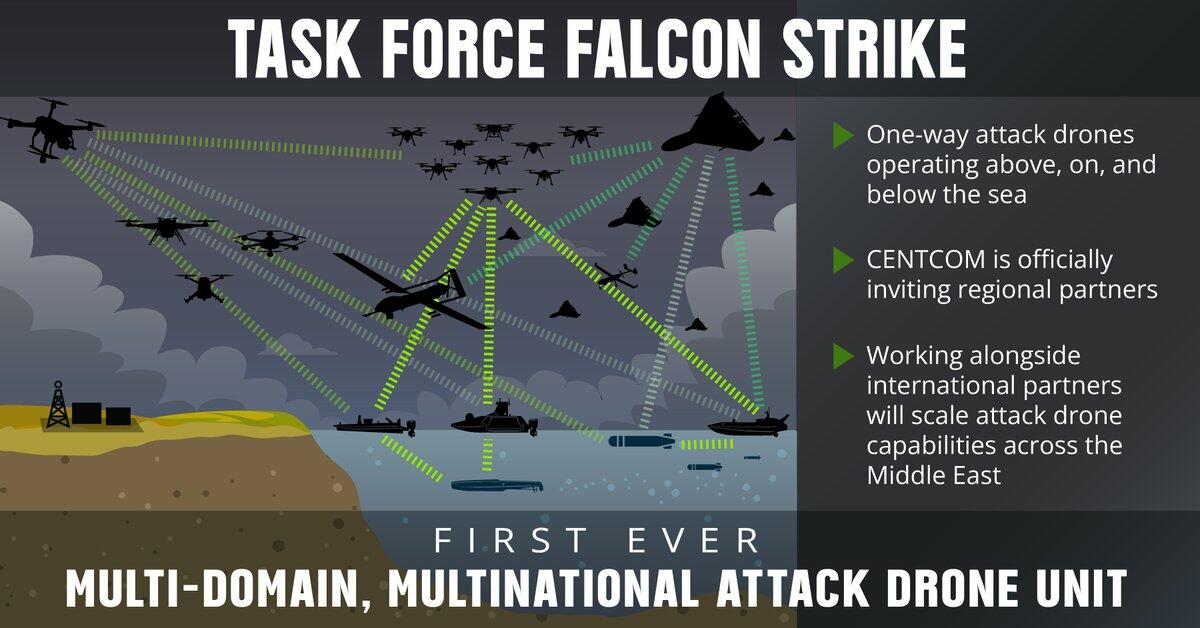
On Thursday US Central Command unveiled that it is officially establishing America’s first-ever multi-domain, multinational attack drone task force.
An announcement identified the initiative as Force Falcon Strike, which “will employ one-way attack drones consisting of unmanned systems from above, on, and below the sea operated by military support staff from the United States and regional partners.”
Already the Pentagon has been deploying one-way attack drones in the context of ongoing Middle East Operations, which has been dubbed Task Force Scorpion Strike.
“Task Force Falcon Strike will expand on Scorpion Strike’s success given the tremendous innovation happening among our regional allies and partners,” stated Adm. Brad Cooper, CENTCOM commander. “Integrating and deploying our new capabilities together will help us rapidly realize the new possibilities that are on the horizon.”
The broader initiative will invite regional partners to coordinate and cooperate with Pentagon operations, and it will ultimately be commanded from MacDill Air Force Base in Tampa.
The aforementioned example of Ukraine war has been dominated by literally hundreds of thousands of small UAVs, sometimes hitting in waves of ‘drone swarms’ on either side – and China too is said to be bulking up its arsenal with AI drone swarms with an eye on potential Taiwan action.
Consider for example, the following observation related to the recent Ukraine battlefield:
Ukraine just mounted an attack that marks a turning point in the history of warfare Hundreds of drones were pre-deployed and then struck 40+ aircraft 1000+ km inside of Russia >$1B in damage by <$1m of drones Critical infra is no longer safe,” Sequoia partner Shaun Maguire wrote on X.
This is the new face of warfare — covert, mobile, and nearly impossible to detect until it’s too late. Also, the US now faces growing vulnerabilities, not only from irregular warfare but also from potential internal security lapses. And as the battlefield leaves the era of conventional ‘fronts’ – the Pentagon wants to catch up on holding the edge on weapons tech.
Many independent observers fear that with all the recent leaps in AI in the context of military applications, a futuristic and dangerous SkyNet scenario could be just around the corner.