
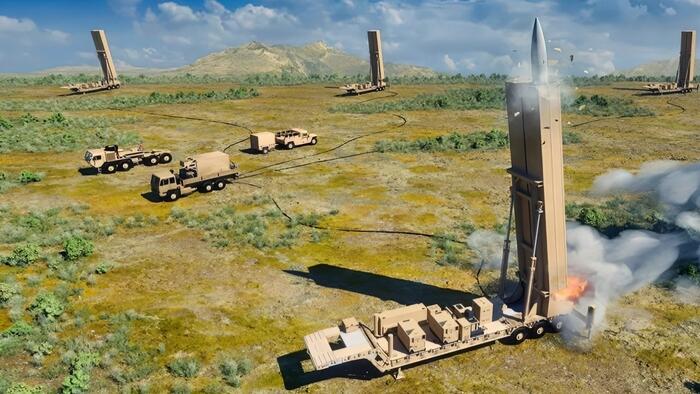
US Central Command has asked to send the Army’s long-delayed Dark Eagle hypersonic missile to the Middle East for possible use against Iran, seeking a longer-range system to hit ballistic-missile launchers deep inside the country Bloomberg reports.
If approved, this would mark the first time the US will have deployed its hypersonic missile, which is running far behind schedule and hasn’t been declared fully operational even as Russia and China have deployed their own versions. And since Trump isn’t shy when it comes demonstrating force, it is unlikely that the request will be denied.
The military’s Request for Forces submission reportedly justifies the move by saying Iran has moved its launchers out of range of the Precision Strike Missile, a weapon that can hit targets at more than 300 miles. If approved, the deployment would also send a signal to Russia and China that the US is finally able to match a capability that they’ve long since mastered.
Dark Eagle, also known as the Long-Range Hypersonic Weapon, or LRHW, has a reported range of more than 1,725 miles, although its exact capabilities are secret. It is designed to glide to its target at more than five times the speed of sound and can maneuver to avoid interception. The missile was designed to fight Chinese or Russian advanced air defenses. The problem is that each Lockheed Martin missile costs about $15 million, and there are no more than eight missiles, so any assault using hypersonics would be rather brief. Also, since each battery will cost about $2.7 billion, according to the Government Accountability Office, they will make attractive targets for Iran’s own hypersonics.
The US already transferred most of its supplies of the stealthy JASSM-ER cruise missile, also designed for a fight with a near-peer adversary, to the Iran fight. About 1,100 of the missiles have been fired so far in the conflict.
The US has said it has local air superiority, meaning that in some parts of Iran its aircraft can operate without facing much of a threat. But dozens of MQ-9 aircraft, plus several crewed fighters, have been downed, showing that other parts of Iran’s airspace remain dangerous.
The Bloomberg report comes as Axios rehashed an earlier report, according to which President Trump will receive a briefing on new plans for potential military action in Iran on Thursday from CENTCOM Commander Adm. Brad Cooper. The briefing signals that “Trump is seriously considering resuming major combat operations either to try to break the logjam in negotiations or to deliver a final blow before ending the war.”
The report goes on to note that CENTCOM has prepared a plan for a “short and powerful” wave of strikes on Iran – likely including infrastructure targets – in hopes of breaking the negotiating deadlock. The hope would be that Iran would then return to the negotiating table showing more flexibility on the nuclear issue.
Another plan expected to be shared with Trump is focused on taking over part of the Strait of Hormuz to reopen it to commercial shipping. Such an operation could include ground forces.
A third option that has been discussed in the past and might come up in the briefing is a special forces operation to secure Iran’s stockpile of highly enriched uranium.