
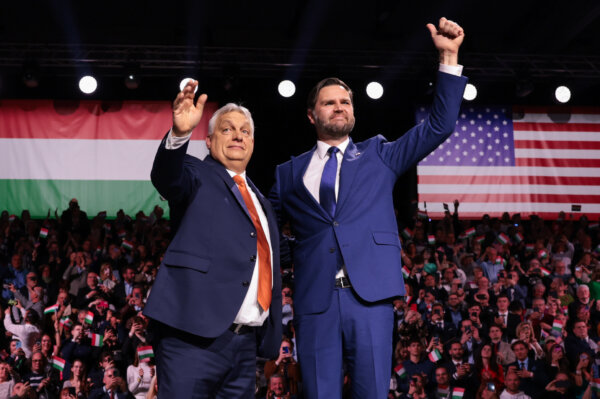
 U.S. Vice President JD Vance took aim at what he called “disgraceful” interference by the European Union in Hungary’s upcoming general election as he gave his backing to populist Prime Minister Viktor Orban.
Vance arrived in Budapest for a two-day visit on April 7, just days before a vote that polls suggest Orban, an ally of U.S. President Donald Trump, is likely to lose.
Describing the longtime Hungarian leader as “a defender of Western civilization,” Vance said: “What has happened in this country, what has happened in the midst of this election campaign, is one of the worst examples of foreign election interference that I’ve ever seen or ever even read about.
“The bureaucrats in Brussels have tried to destroy the economy of Hungary. They have tried to make Hungary less energy-independent. They have tried to drive up costs for Hungarian consumers, and they’ve done it all because they hate [Orban].”
The U.S. vice president said he wanted to “send a signal to the bureaucrats of Brussels,” whom he accused of doing “everything they can to hold down the people of Hungary because they don’t like the leader of Hungary.”


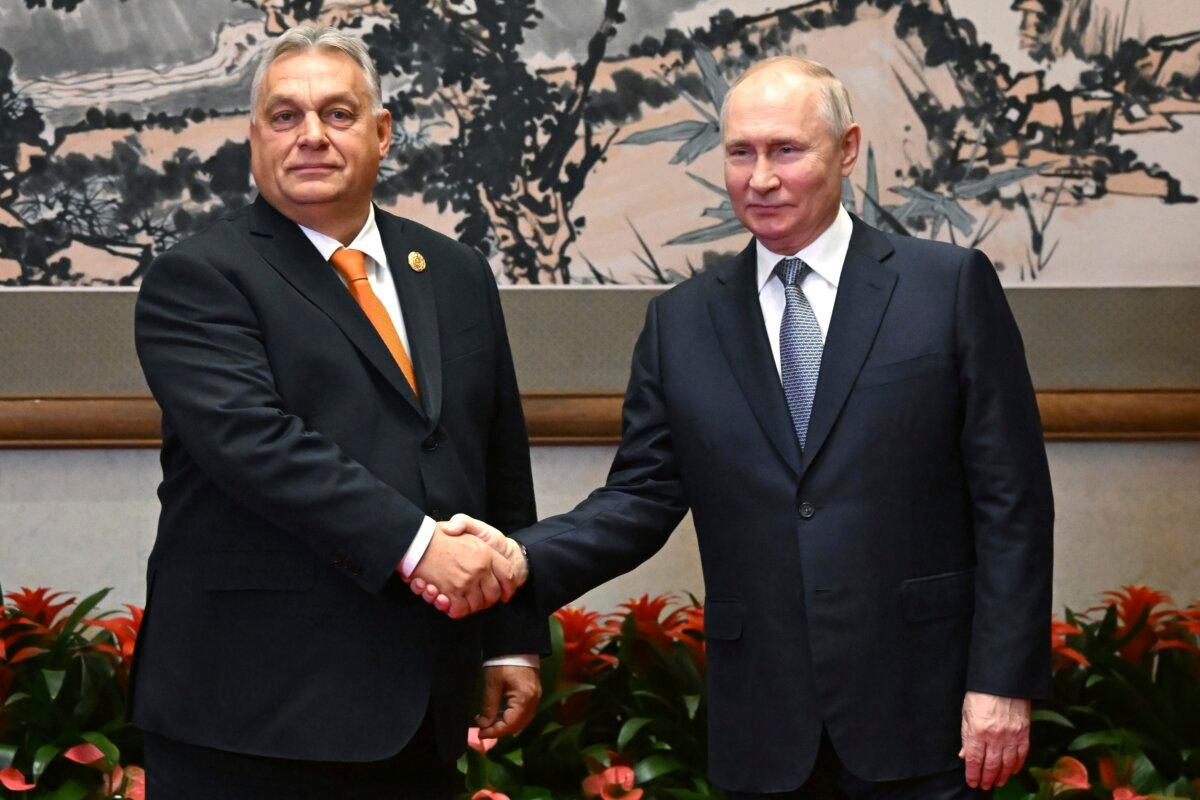
The vice president did not directly reference the relationship between Orban and Russian President Vladimir Putin, which has remained cordial throughout the Ukraine conflict. Orban has said that Russian energy is essential for the Hungarian economy.
‘Defense of Western Civilization’
Vance referred to the “moral cooperation” between the United States and Hungary for the preservation of Western civilization, which he stressed was founded on Christian values.
He emphasized the two governments’ similar stances on family policy, gender ideology, immigration, and the “global society.”
Trump has previously given his personal endorsement of Orban as “a truly strong and powerful leader.”
Orban, 62, who is facing what appears to be the toughest reelection bid of his political career after 16 consecutive years in power, paid tribute to what he called “a golden age” in relations between the United States and Hungary under Trump’s leadership.
Similar to the Trump administration, Orban’s government has adopted populist and socially conservative policies, including a tough stance on immigration and skepticism toward globalist institutions that could potentially undermine the national interest.
Orban, who was the first European leader to endorse Trump during his 2016 presidential bid, has taken aim at far-left “woke” culture and the institutions that promote it.


EU Veto Over Ukraine
The Hungarian leader has been a frequent critic of the EU, which his country joined in 2004, 15 years after the collapse of Eastern bloc communism and five years after becoming a NATO member.


Critics have accused Orban of taking over his country’s institutions, clamping down on press freedom, and allowing entrenched political corruption to take hold in Hungary—charges he denies.
Call to Trump
Vance used his phone to call Trump from the lectern, at first reaching an automated message before Trump answered and told the crowd through a microphone, “I love Hungary, and I love that Viktor—I tell you he’s a fantastic man.”
“He’s kept Hungarian people in your country,” Trump said.
Orban told the crowd that “freedom-loving Americans and Hungarians must unite and save Western civilization.”
“To do this, we must fight the progressives that nest in Brussels,” he said, adding that Hungary had launched a “reconquista” of EU institutions that “will bring new patriotic governments to power.”
Russia Echoes Claims
Russia on April 8 echoed Vance, saying that some within the EU are opposed to the reelection of Orban and are trying to help his opponents.
“Many forces in Europe, many forces in Brussels, would not like Orban to win the elections again,” Kremlin spokesman Dmitry Peskov said when asked about a leaked transcript, published by Bloomberg, of a conversation last year between Orban and Putin.
“This is well-known, it’s obvious to the naked eye, and, of course, they’re playing into the hands of those forces that politically oppose Orban and believe that publishing such materials could harm him.”
The Hungarian leader offered to help Moscow in its communications with the West, including the United States, according to the transcript.
Peskov did not deny that the remarks were genuine and said they demonstrated that Orban was a pragmatist.
“He is indeed a very effective politician … one who is specifically defending the interests of his own country,” Peskov said.