
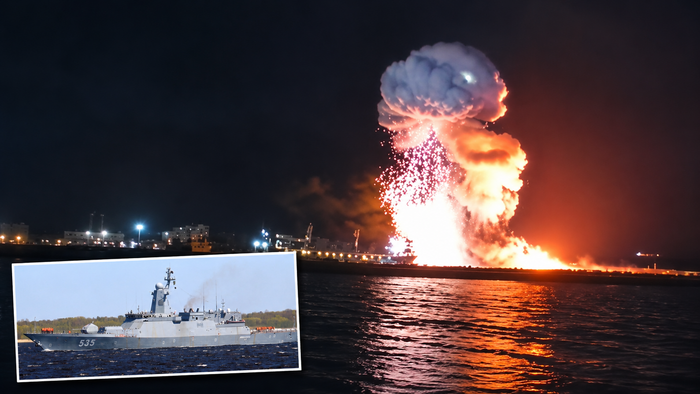
Libya’s eastern government said Sunday that a preliminary investigation points to an explosion aboard a Russian vessel in the port of Benghazi, and that it suspects a drone strike. The blasts and fire tore through the city’s naval base before dawn.
The ship appears to be the Russian Navy’s Merkury, a Project 20380 Steregushchiy-class missile corvette. Naval analyst H I Sutton provisionally identified it for Naval News and said the warship was almost certainly destroyed, citing several sources and satellite imagery of the ship ablaze. Whether it sank at its berth or burned out is still unclear.
Footage of the Russian Navy’s Steregushchiy-class corvette Merkury suffering a catastrophic explosion in the port of Benghazi, Libya, last night.
The ship was destroyed. pic.twitter.com/hw1mez49Ab
— OSINTtechnical (@Osinttechnical) November 22, 2026
The corvette had been docked in Benghazi for several days, escorting a convoy of Russian ships that Naval News tied to Russia’s arms exports. Formally part of the Black Sea Fleet, the Merkury had been operating out of Northern Fleet bases since the war in Ukraine kept it out of the Black Sea.

Benghazi’s civil defence service first said the blasts came from an ammunition store inside the naval base, told residents there was “no cause for alarm” and later said the fire was out. Residents reported three loud blasts and heavy anti-aircraft fire, and local social media pages described aircraft over the city, according to local media.
Explosion hits ammunition depot inside naval base in Libya’s eastern port city of Benghazi – local emergency authorities pic.twitter.com/D8XAVo23QV
— TRT World Now (@TRTWorldNow) November 22, 2026
Tawfiq al-Shamekh, head of media at the eastern region’s National Safety Authority, said teams had brought the situation under control and that the detailed causes would be set by a specialist expert report. No official casualty figure had been released by midday Sunday.

A Libyan source in Benghazi told Italy’s Agenzia Nova that a drone had targeted either the Russian warship or its cargo, and blamed Ukraine. Neither Moscow nor Kyiv has commented, and the General Command of Khalifa Haftar’s forces, which hold Benghazi and its port, has issued no statement.
Libya has been a launchpad against Russian shipping before: in March, the Russian-flagged LNG tanker Arctic Metagaz exploded and burned between Malta and Libya, and Russia’s Transport Ministry said the attack was “carried out from the Libyan coast by Ukrainian unmanned boats.” We reported at the time that Reuters also named Ukraine as the suspect.

A month later, two Libyan officials told the Associated Press that Ukrainian forces, most of them drone experts, were operating in western Libya, mostly from an air base in Misrata, with others in Tripoli and Zawiya. One called it a “covert deal” between Kyiv and the Tripoli government, backed by Western countries including the US, and said the strike on the tanker was launched from a military facility in Tripoli. Kyiv never confirmed it.
Benghazi is on the other side of that divide: Haftar’s forces back the eastern government aligned with the House of Representatives, against Abdul Hamid Dbeibah’s Government of National Unity in Tripoli, and Haftar has long had ties to Moscow.
The blast caps a week of Ukrainian strikes far from the front: the Crimean Bridge was hit three times in a week, and Finland’s military reported a strike on a Russian warship in the Gulf of Finland, prompting Helsinki to warn Kyiv against widening the war.
Drones also disabled the roll-on/roll-off cargo ship Sparta II three nautical miles from Russia’s maritime border, Leningrad Region Governor Alexander Drozdenko said, and the ship later drifted into Finnish waters, where its crew was evacuated to a nearby vessel. Helsinki-based daily Helsingin Sanomat reported that the Sparta II has links to Russia’s military and may have been carrying military equipment, though its cargo has not been verified. Finnish President Alexander Stubb wrote on X, “The events involving the Sparta II vessel in the Gulf of Finland are serious.” Finnish armed forces spokesperson Aki-Mauri Huhtinen told reporters it is likely Ukraine is behind the attack, and Kyiv had not commented as of Sunday morning.
It was the second reported drone strike on a ship in the Gulf of Finland this month, after the attack on Russia’s Naro-Fominsk corvette during a strike on Ust-Luga, one of Russia’s largest Baltic Sea export hubs, in the Leningrad region. Baltic ports handled 65.3% of Russia’s seaborne grain exports in October, with volumes up 8.7x from a year earlier, according to the Russian Grain Union, and Ust-Luga became the country’s largest grain export port that month, handling 684,000 tons. The ports are also major export gateways for crude oil and refined fuels.
If the Merkury is confirmed lost, Russia will have lost a warship more than 1,000 miles from Ukraine’s coast, in a port where it was guarding arms shipments.