
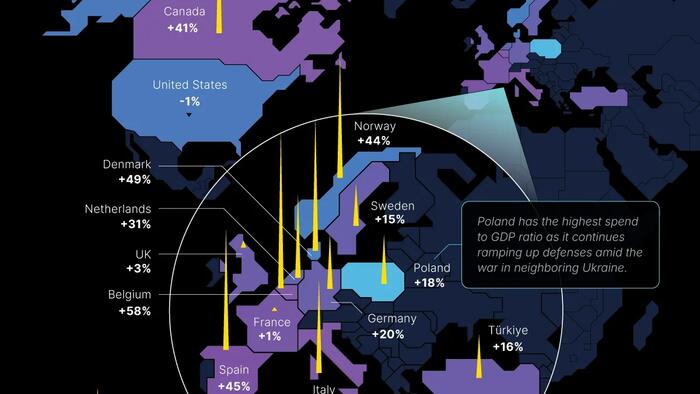
NATO’s European members and Canada increased defense spending by 20% in 2025, the group’s biggest military buildup in the last decade.
Created in partnership with Inigo, this graphic, via Visual Capitalist’s Jenna Ross, shows which NATO countries increased spending the most and how much they now spend as a share of GDP.
Spending Heavyweights, Ranked by Annual Increases
Our analysis covers NATO countries that spent over $10 billion on defense in 2025.
Belgium was the country with the biggest spending jump of 58%. Once among NATO’s lowest defense spenders, Belgium has boosted its budget to meet the alliance’s current 2% of GDP target. The country’s increased spending is focused on operations, maintenance, and research and development.

Source: NATO. Figures for 2025 are estimates.
The next largest jump among big spenders was Denmark, with a 49% increase. Threats from Russia and a bid from the U.S. administration to buy Greenland prompted the focus on defense. In the Arctic, Denmark is investing in two new ships, maritime patrol planes, drones, early-warning radar, and a new command headquarters.
Defense Spending of NATO Countries Relative to GDP
Among NATO countries, Poland spends the most on defense compared to its economic size. The country began significantly increasing its spending in 2022 after Russia’s invasion of neighboring Ukraine. In 2025, its focus has been on equipment, which climbed to over half of the country’s total defense spending.
All NATO allies now meet or exceed the previous defense spending target of 2% of GDP. Most have also pledged to reach 5% by 2035, split between 3.5% on core defense and 1.5% on broader security-related investment such as infrastructure and cyber resilience. However, Spain secured an exemption from the 5% target, and pledges of that length carry their own uncertainty.
Why Increased Defense Spending Matters
Underlying the rise in spending is growing uncertainty around the stability of the rules-based international order. As alliances are strained and tensions build, geopolitical events can create interconnected losses.
Insurance risk managers and brokers can take time to understand indirect exposures and accumulation risks across energy markets, supply chains, political violence, trade credit, and business interruption portfolios.