
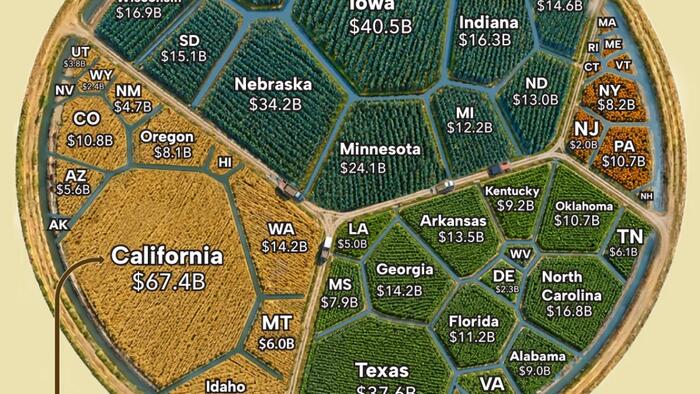
From California’s fruit and vegetable farms to the Midwest’s vast corn and soybean fields, agriculture looks very different across the United States.
Using the latest data from the U.S. Department of Agriculture (USDA), this graphic, via Visual Capitalist’s Dorothy Neufeld, ranks every state by its agricultural production value in 2024.
America’s Largest Agricultural Economies
The table below shows each state’s agricultural production value in 2024.

Together, the top 10 states account for well over half of America’s agricultural production value. Geography, climate, water availability, and decades of specialization have helped create distinct regional farming economies across the country.
California Remains America’s Agricultural Giant
California generated $67.4 billion in agricultural production value in 2024, nearly twice as much as any other state.
Its combination of specialty crops, fruits, vegetables, nuts, dairy, and favorable growing conditions allows it to produce more agricultural value than any other U.S. state despite accounting for only a small share of the nation’s farmland.
Texas, another large state by both population and land area, ranks third nationally, generating $37.6 billion driven largely by cattle production.
The Midwest Is America’s Food Engine
While California tops the rankings individually, the Midwest dominates collectively.
The region accounts for 44% of U.S. agricultural production value, powered by states including Iowa, Nebraska, Minnesota, Indiana, and Illinois. Taken together, these states produce over 60% of America’s corn volume.
Many Midwestern states also specialize in soybeans, livestock, and dairy, forming the backbone of both the U.S. food system and global agricultural exports. This makes the Midwest one of the world’s leading agricultural production corridors.
A Diverse Agricultural Economy
Agricultural strength varies widely by region. Western states generate high-value specialty crops, vineyards, and dairy, while Southern states are major producers of poultry, cotton, rice, and cattle. Although Northeastern agriculture is smaller by value, it remains an important source of dairy, produce, and regional food supply.
This regional specialization helps make the U.S. one of the world’s leading agricultural producers and food exporters, supplying both domestic consumers and global markets alike.
To learn more about this topic, check out this graphic on the states with the most farmland.