
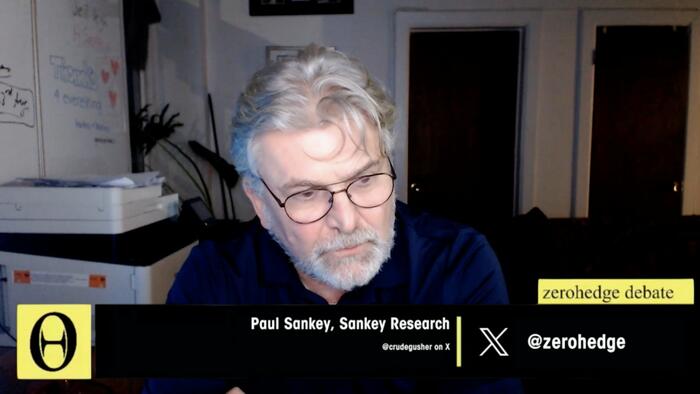
The damage inflicted on global energy infrastructure during the Iran war could have consequences lasting well beyond the conflict itself, according to veteran energy analysts Paul Sankey and Arjun Murti, who joined Erik Townsend for last night’s zh Debate.
Sankey predicted that 2028 crude futures will see large moves upward as markets adapt to the reality that refinery capacity will not recover anytime soon.
Townsend fears that not only will 2028 prices rise… but that the globe may face a decades-long shortage of refined oil products, a risk he thinks people are not taking seriously. Murti meanwhile, in light of these realities, thinks “cash is king” for those weary of volatility.
Below were some highlights from the discussion though we highly recommend the full conversation for those who missed it live:
Could Refinery Damage Take A Decade To Repair?
“If you kept blowing refineries up around the world, you’d get to the point where we just don’t have enough refining capacity to run the planet, period.”
So what if the conflict drags on for years? Townsend asked:
“How far does this have to go before we get to the point where we look back on $60 crack spreads and say those are the good old days before we got to $200 crack spreads?” Crack spread being the difference in the price of crude and the consumable refined products.
“If the Iran conflict goes to five years and it’s punctuated by blowing up a lot of refineries, both in the Middle East and in Russia, how long do we go before the world has a problem that cannot be recovered for a full decade ’cause that’s how long it takes to build new refineries?”
Sankey said that we might already be there… “The short answer is it’s going to take an awful long time to recover from this, I’m afraid to say.“
“Back in Q1 results, Valero said that I think the line was […] for every day out, we need a week to recover.”
— zh Debates (@zerohedgeDebate) October 14, 2026
Playing Oil’s Volatility: ‘Cash Is King’
Murti argued companies and investors should resist becoming too greedy.
“Our call has been geopolitical super volatility is here to stay. And that means generally high but volatile prices. You gotta be prepared for the pullbacks that will happen.”
With oil around $100 per barrel and refining margins elevated, Murti expects companies to face pressure from investors demanding larger payouts.
“There’s a real strategic value to companies having cash on their balance sheet. We have generally stressed fortress balance sheets as a mindset in a deeply cyclical, volatile business.”
Murti pointed to the industry’s recurring downturns: 2015, the COVID collapse in 2020, and oil’s retreat from $120 in 2022 toward $50 in 2025.
“Every five years we’re having some notion of a pullback. We can’t predict the next one will be 2027 or 2030, but there’s a real strategic value to these publicly traded companies, especially in the oil value chain, to actually hoard some cash… Cash is king.”
— zh Debates (@zerohedgeDebate) October 14, 2026
Check out the full discussion below, on the zh Youtube channel, or listen on Spotify.
Can The Gulf Be Repaired? Paul Sankey, Arjun Murti, and Erik Townsend https://t.co/RRIMna9Z1A
— zerohedge (@zerohedge) October 13, 2026