
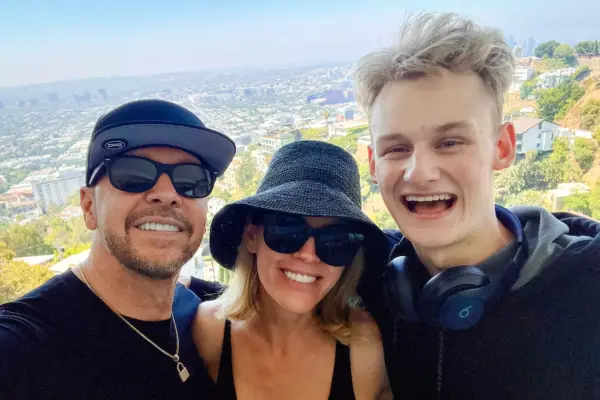
 Jenny McCarthy (C) at her son Evan’s high school graduation with her husband, Donnie Wahlberg, in an undated photo. McCarthy says Evan’s condition improved after she discovered Generation Rescue, a nonprofit that promotes a protocol to help autistic children. Courtesy of Jenny McCarthy Productions
Twenty years have passed since Jenny McCarthy became a household name as the original “anti-vaxxer”—a label she has always rejected.
For McCarthy, it is a moment of vindication and of answered prayers.
“A lot still needs to happen,” she told The Epoch Times. “But at least we’re on a path now where children can have a better chance of not having this happen to them, and generations can be saved from the pain that we have gone through as parents.”
McCarthy, 53, rose to the spotlight as a model, actress, and television host in the 1990s, but became a household name in 2005 after she shared the story of her son Evan’s autism diagnosis.
Along with campaigning for autism awareness, McCarthy did not shy away from her belief that the MMR vaccine had been part of the cause, quickly earning her the anti-vaxxer label.
From Entertainer to Campaigner
McCarthy’s unexpected path from entertainer to campaigner began a few days before Evan’s MMR shot, when she read a Time magazine feature about parents who said their children developed symptoms of autism after receiving the vaccine.
“I felt a pit in my stomach, perhaps mother’s intuition, that Evan should not get this shot,” McCarthy said. Then, McCarthy was married to film director John Asher, who was also at the appointment.

McCarthy expressed her concerns to the pediatrician and referenced the article. She asked if he could hold off on the vaccine.
“He got very angry at me and said it was just parents’ desperate attempts to blame something. He said the vaccine had nothing to do with it,” McCarthy said.
She refused to sign a waiver allowing the physician to administer the MMR vaccine. Asher signed it, and Evan received the shot.
That is when life for son and mother abruptly changed.
“Until that point, he had hit every milestone that a child his age should reach. After the MMR shot, he started showing regression. His babbling stopped. Eye contact went away. He no longer smiled,” McCarthy said.
“He developed blue circles under his eyes, a bloated belly, gas, constipation, eczema, yeast,” she added. “I didn’t know then that these are all comorbid conditions that go with autism. I didn’t know why Evan was suddenly unhealthy and sick.”
McCarthy does not believe that the MMR shot alone triggered Evan’s autism. She blames “a compilation of so many shots to a kid who clearly had autoimmune disorders.”
Still, Evan’s most serious reaction occurred after the MMR vaccine.
The same year, McCarthy was drinking her coffee one morning when she sensed something was wrong. She walked into Evan’s bedroom and found him struggling to breathe.
“He was shaking, and he had pasty white and blue lips,” she said.
Frantic, she called 911, and it took the paramedics around 20 minutes to stop what they said was a febrile seizure.
Three weeks later, Evan was struggling to breathe again. By the time paramedics arrived, he had gone into cardiac arrest. They administered CPR, brought Evan back, lost him again, then brought him back while in the ambulance, McCarthy recalled.
Doctors diagnosed him with epilepsy and gave him anti-seizure medication.

“They kept asking me if anyone in the family has a history of epilepsy. Nobody did. The mommy instinct in me told me there was something more to the story,” she said.
After visits to multiple physicians, a neurologist diagnosed Evan with autism.
“He just said, ‘I’m sorry, he has autism, and there’s not a lot you can do. There’s some therapies, behavior therapies, but I’m sorry,’” McCarthy said.
First Eye Contact
That night, McCarthy opened Google and searched for the condition. In the sponsored links, she discovered Generation Rescue, a nonprofit that provided assistance to families affected by autism spectrum disorders. The ad said, “Autism is reversible.”
McCarthy initially doubted the organization’s credibility.
“Remember, at this time, there was little information online about autism. And if it was true, why didn’t one of the best neurologists in the world tell me there’s something I could do to reverse autism?” McCarthy said.
Within two weeks of removing wheat and dairy from Evan’s diet, he had more direct eye contact and had increased his language.
She followed the next step and added vitamins and supplements. His sleeping and overall behavior improved.
“It was like someone turned the light switch back on. Words started coming out of his mouth again,” McCarthy said. “If I didn’t click on Generation Rescue’s website, I never would have found how to help heal Evan. I followed the path of all these other moms, and I felt it was my calling to use my platform to help parents who were feeling so helpless.”

The book inspired the 2023 documentary “Spellers,” which chronicles the lives of eight children who are nonverbal with autism.
Handley commends McCarthy for her passion and courage to use her platform to educate parents, knowing that she would face backlash that could harm her professional career.
“Our mission had always been to warn and educate as many parents as humanly possible,” Handley told The Epoch Times. “If we were bumping along, going a mile an hour, trying to get the word out, Jenny took us up 200 miles an hour overnight.”
“She told the truth at great expense to her,” he added.
In 2007, McCarthy appeared on “Oprah” to promote her book “Louder Than Words: A Mother’s Journey in Healing Autism.” She told her story in detail and initially the response was favorable.
Launch of ‘Anti-Vax’ Label
Not long after, McCarthy encountered pushback from critics who don’t believe vaccines are tied to autism.
One day, a man knocked on the door and asked to speak with her.
“He told me that he runs a public relations company and was approached by a government agency that wanted to hire him to create a campaign against me labeling me as an anti-vaxxer,” McCarthy said.
“That was the first time I had heard that term. I kinda laughed and said, ‘Well, that’s not gonna stick because in every media appearance I make it clear that I’m not against vaccines, I’m for making them safer and looking at the ingredients and side effects,’” she added.
The man told McCarthy that he declined the agency’s offer because he also had a son with autism.
“He told me they would hire another agency to create the campaign against me, but I didn’t give it a second thought,” she said.
“I was naive. In a matter of a few months, bullets began flying my way. Suddenly, I was no longer known as an actress, an author, a mother, or a wife. I was just an anti-vaxxer. That was my title for a very long time,” she said.
The backlash impacted McCarthy’s professional career. She said she lost several endorsement deals.
The CDC Reversal
The CDC now states that it’s possible vaccines cause autism, a reversal of the long-standing stance that dated back to before McCarthy’s son was vaccinated.
“The claim ‘vaccines do not cause autism’ is not an evidence-based claim because studies have not ruled out the possibility that infant vaccines cause autismIn,” the CDC states in a Nov. 19 update on its website.
“Studies supporting a link have been ignored by health authorities.”
A Health and Human Services-led investigation includes evaluating “plausible biologic mechanisms between early childhood vaccinations and autism,” the CDC said.
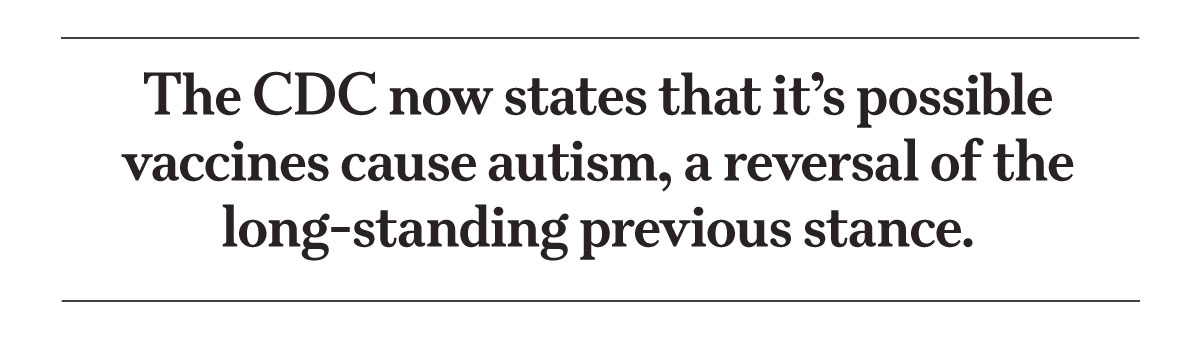
The CDC previously said that “studies have shown that there is no link between receiving vaccines and developing autism spectrum disorder” and that no links have been found between any vaccine ingredients and the disorder.
Some autism campaign groups and medical organizations have criticized the shift in stance.

Naturally, McCarthy applauds Kennedy’s efforts as health secretary.
“I’ve never prayed so hard in my life for Bobby Kennedy to be doing what he’s doing,” she said.
“I’m still not anti-vaccine,” she added. “I want safe ones. Show us the safety trials, and then we’ll talk.”
McCarthy said she would like some vaccines to be removed from the childhood schedule, such as the hepatitis vaccines. She also believes triple shots, such as the MMR vaccine, should be separated into individual shots and that safety trials should be conducted.
The diagnoses were made after the children each received the DPT vaccine for diphtheria, pertussis, and tetanus.
“I had no idea what to do. I felt like I was isolated on an island with no one to help,” Renee told The Epoch Times.
Renee also discovered Generation Rescue online, and she followed the protocol the organization recommended, as McCarthy had done.
She used glutathione and plant enzymes, removed gluten and casein, cut out artificial dyes, and implemented chelation therapy, which removes toxic metals from the body, among other actions.
“They rapidly improved in a short time. I never gave them the MMR vaccine because of what I learned from listening to Jenny,” Renee said.
Renee lived in Mississippi when her children were diagnosed. She said she felt empowered by McCarthy’s advocacy and became involved in advocacy herself, pushing for vaccine exemptions and championing informed consent, children’s rights, and parents’ rights related to medical freedom.
A former allopathic medical professional, Renee is now a holistic health practitioner who will become a board certified naturopathic physician next year. She specializes in treating children with autism and other neurobehavioral disorders.
“[McCarthy] was called crazy. Every one of us who followed her were labeled with a derogatory term using her last name,” Renee recalled.
A Story of Recovery and Pride
Today, Evan is 23. He graduated from high school and college. He still takes Lamictal, an anti-seizure medication, and it has been several years since his last seizure.

“People ask me if I cured Evan. I didn’t. There is no cure for autism as far as I know. What I did was recover him from autism,” said McCarthy.
She said she looks at the condition through the lens of injury.
“You can go in and fix the parts that are injured—like the immune system, like the gut,” she said.
Evan told The Epoch Times that it’s a “huge sense of relief” that the topic of autism has reached the mainstream, and that Kennedy, the HHS, and the Make America Healthy Again movement are addressing the condition.
“Younger generations are being diagnosed earlier. The more we understand, the more support they’ll have as they grow. As time goes on and life changes, this knowledge is going to help future generations even more,” he said.
Evan praised his mother for all she has done.
“I want people to see how hard she has fought for me and how far I’ve come. And I want people to know you can still fully be yourself if you have autism,” he said.