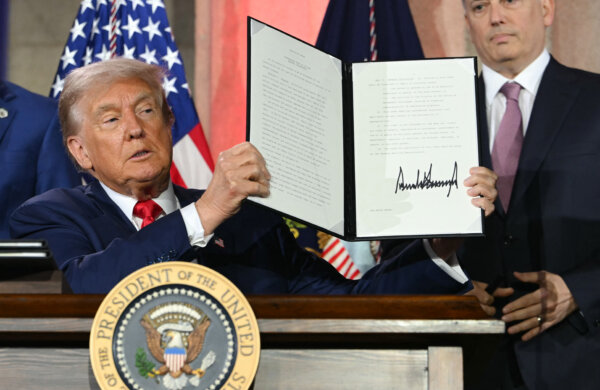
President Donald Trump said on Dec. 8 that he will sign an executive order this week to establish a single federal rulebook for artificial intelligence (AI) and limit the authority of individual states to regulate the fast-advancing technology, saying the move is necessary to ensure the United States continues to lead the global AI race.
“There must be only One Rulebook if we are going to continue to lead in AI,” Trump wrote in a post on Truth Social. “We are beating all countries at this point in the race, but that won’t last long if we are going to have 50 States, many of them bad actors, involved in rules and the approval process.”
Trump said that AI will be “destroyed in its infancy” if states wield the regulatory power to require AI companies to get separate approvals in each jurisdiction.
The upcoming order is the administration’s strongest step so far to consolidate federal power over AI governance and comes after months of pressure from leading developers and investors, including OpenAI, Google, Meta, and venture capital firm Andreessen Horowitz, to replace what they describe as a patchwork of state laws with uniform national standards.
The companies have warned that China may pull ahead of the United States on AI development if states are allowed to regulate the technology.
White House AI Strategy
Trump did not release specifics, but the move aligns with steps the White House has already taken to limit the influence of state-level AI rules. The United States’ AI Action Plan, released by the federal government in July, urges federal agencies to deny AI-related funding to states with burdensome regulations while acknowledging state-level regulatory authority more generally.
“AI is far too important to smother in bureaucracy at this early stage,” the action plan states. “The Federal government should not allow AI-related Federal funding to be directed toward states with burdensome AI regulations that waste these funds, but should also not interfere with states’ rights to pass prudent laws that are not unduly restrictive to innovation.”
The plan envisions major investments in data-center infrastructure, energy generation, semiconductor manufacturing, federal AI adoption, and export-oriented AI diplomacy, while also seeking to counter Chinese influence.
The president’s push for a single national standard also reflects his broader bid to position the United States as the world’s uncontested AI leader and to counter China’s rapid progress.
Since returning to office, Trump has rescinded the Biden administration’s AI regulatory framework—described as “onerous” in Trump’s AI action plan—and ordered agencies to remove barriers to AI development. He has also launched “Genesis Mission,” which mobilizes federal scientific data and supercomputing resources in a program he has likened to the Manhattan Project.
“In this pivotal moment, the challenges we face require a historic national effort, comparable in urgency and ambition to the Manhattan Project that was instrumental to our victory in World War II,” Trump’s Nov. 24 executive order on the Genesis Mission reads.
The initiative aims to accelerate scientific advances, bolster national security, ensure U.S. energy dominance, and improve returns on federal research investments, strengthening the United States’ technological and strategic position globally.
‘Federal Government Overreach’
Trump’s announcement of a forthcoming “One Rulebook” AI order could intensify tensions between Washington and state governments that have either passed or are considering passing laws aimed at protecting residents from AI harms such as deepfakes, online harm to children, and unauthorized political manipulation.
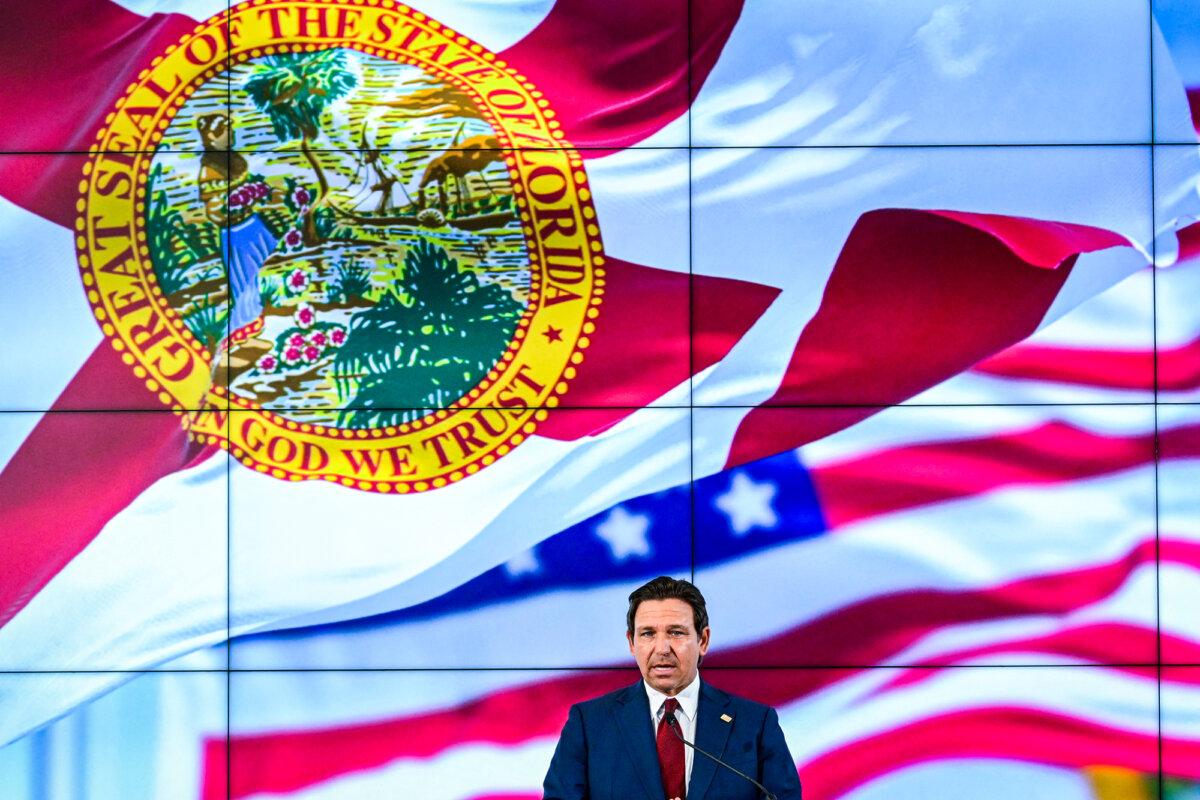
Florida Gov. Ron DeSantis speaks at Florida International University in Miami on Sept. 25, 2025. Giorgio Viera/AFP via Getty Images
Last week, Florida Gov. Ron DeSantis, a Republican, proposed an “AI Bill of Rights” establishing privacy and parental-control rules, and he denounced federal preemption as “a subsidy to Big Tech.”
“The rise of AI is the most significant economic and cultural shift occurring at the moment,” DeSantis said in a Nov. 18 post on X. “Denying the people the ability to channel these technologies in a productive way via self-government constitutes federal government overreach and lets technology companies run wild.”
Officials from the Democratic Party have made similar arguments.
When Trump urged Congress last month to ban state AI regulations through the annual defense bill, North Carolina Attorney General Jeff Jackson said lawmakers “can’t fail to create real safeguards and then block the states from stepping up.”
In July, the Senate voted 99–1 to strip a proposed 10-year cap on state and local AI regulation from the One Big Beautiful Bill Act.
Trump’s call to limit state-level AI regulatory powers also comes amid concerns about AI safety.
Sophie, a robot using artificial intelligence from Hanson Robotics, shares a high five with a visitor during the International Telecommunication Union AI for Good Global Summit in Geneva, on July 8, 2025. Valentin Flauraud/AFP via Getty Images
A recent study by the Future of Life Institute found that eight major developers had no credible plans for managing extreme risks from advanced AI systems.
The Alliance for Secure AI, a nonprofit that advocates for AI safety, has expressed opposition to Trump’s proposed executive order to preempt state AI legislation.
“A blanket ban on state AI laws will not work for America,” the group wrote in a Dec. 8 post on X. “Our laws must support safe AI development and protect American consumers.”

 President Donald Trump said on Dec. 8 that he will sign an executive order this week to establish a single federal rulebook for artificial intelligence (AI) and limit the authority of individual states to regulate the fast-advancing technology, saying the move is necessary to ensure the United States continues to lead the global AI race.