
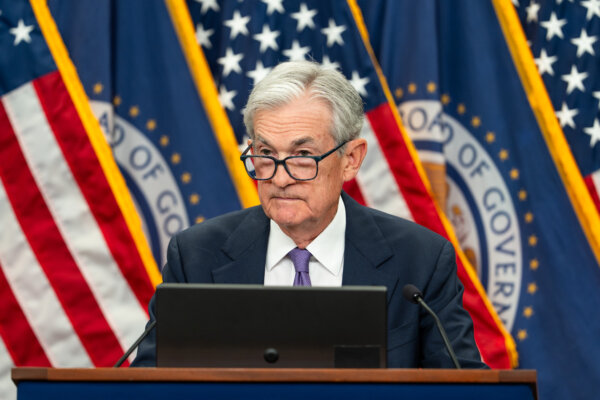
 The Federal Reserve followed through on a widely expected interest rate cut at its final policy meeting of 2025, but the Dec. 10 decision was marked by sharp dissent among officials.
Members of the Federal Open Market Committee voted 9–3 to lower the benchmark federal funds rate by a quarter point to a new target range of 3.5 percent to 3.75 percent.
Member of the Fed Board of Governors Stephen Miran voted to lower the policy rate by a half-point. Federal Reserve Bank of Chicago President Austan Goolsbee and Federal Reserve Bank of Kansas City President Jeffrey Schmid supported no rate change.
Although investors overwhelmingly penciled in the third consecutive reduction, there had been widening divergence among monetary policymakers heading into the meeting.
This is the first time since September 2019 that three members dissented—and for similar reasons. In 2019, then-Federal Reserve Bank of St. Louis President James Bullard wanted a half-point rate cut, while then-Federal Reserve Bank of Kansas City President Esther George and then-Federal Reserve Bank of Boston President Eric Rosengren preferred to leave rates unchanged.
Fed Chairman Jerome Powell, speaking to reporters at the post-meeting news conference, said the rate cut decision was a “close call.”
“I could make a case for either side,“ Powell said. ”It’s a close call. We always hope that the data will give us a clear read. It’s a very challenging situation. I think we’re in a good place to, as I mentioned, to wait and see how the economy evolves.”
The December survey revealed policymakers anticipating one rate cut in 2026, signaling a slower pace of policy easing in the year ahead. They also penciled in a single rate cut in 2027.
Officials also shaved their inflation expectations. The personal consumption expenditure price index—the central bank’s preferred inflation measure—is seen slowing to 2.4 percent next year, down from the September forecast of 2.6 percent. The core personal consumption expenditure price index, which strips out food and energy prices because of their volatility, is anticipated to ease to 2.5 percent, down from the previous projection of 2.6 percent.
Growth prospects were also revised higher. The gross domestic product growth rate is predicted to be 2.3 percent in 2026, up from the September estimate of 1.8 percent.
The unemployment rate is predicted to be 4.4 percent next year, unchanged from the previous Summary of Economic Projections.
As for next month’s meeting, the Fed will adopt a wait-and-see approach for future decisions based on incoming data and the evolving outlook.
“We’ll carefully evaluate that incoming data, and also, I would note that having reduced our policy rate by 75 basis points since September and 175 basis points since last September, the fed funds rate is now within a broad range of estimates of its neutral value, and we are well-positioned to wait and see how the economy evolves,” Powell said.
Divergence
In recent weeks, there has been increasing divergence among Fed officials. Minutes from the October meeting and public comments have highlighted the growing divide.
One camp has supported lowering interest rates amid slowing employment conditions and concerns that keeping policy restrictive could weigh on economic growth prospects, given the lag effect of monetary policy.
The other side suggests leaving rates steady to prevent a further reacceleration of inflation, arguing that the labor market remains intact and the broader economy continues to expand.
It has become a balancing act for the U.S. central bank, and policymakers have acknowledged that the dual mandate—maximum employment and price stability—is under threat.
Another challenge for the institution has been the lack of government economic data. The key numbers, particularly the November jobs report and November inflation figures, will be released shortly after the Fed meeting.
The nonfarm payrolls report for October and November will be published on Dec. 16. The November consumer price index will come out on Dec. 18.
Committee members will convene for the next two-day meeting on Jan. 27 and Jan. 28.