
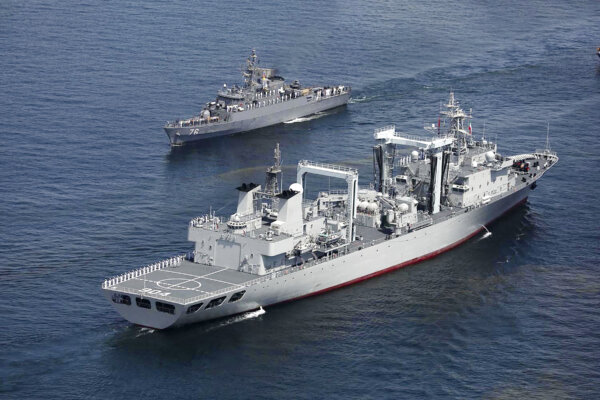
 The U.S. seizure of a China-linked ship carrying weapons-related components to Iran marks a shift from sanctions enforcement to direct maritime interdiction, exposing the Chinese communist regime’s role in arming U.S. adversaries and signaling broader implications for Iran, Russia, and a potential Taiwan conflict.
U.S. special operations teams boarded a China-linked cargo ship in international waters in the Indian Ocean near Sri Lanka in November and seized cargo bound for Iran, as first reported by The Wall Street Journal on Dec. 12. U.S. authorities had tracked the vessel as it traveled from China toward Iran and intercepted it several hundred miles off the coast of Sri Lanka. After the cargo was confiscated, the ship was allowed to continue its voyage.
U.S. officials said the seized materials consisted of dual-use components with civilian applications that are also critical for manufacturing conventional weapons, including missiles and drones. The cargo was subsequently destroyed. U.S. intelligence assessments indicated the shipment was destined for Iranian companies involved in procuring components for the country’s missile program.

During the June conflict, Iran sought to overwhelm Israeli air defenses through volume, and U.S. officials believe Tehran is importing components to restore those capabilities. The boarding of the China-linked vessel was part of Washington’s broader effort to block transfers of dual-use technologies, including microelectronics and software critical to precision-guided weapons that are difficult to restrict because of their civilian applications.
China has also been accused of supporting Iranian proxy forces, including alleged sales of missile components and targeting data to the Houthis in Yemen for attacks on Israeli and U.S. shipping in the Red Sea.
Beijing is similarly supporting Russia’s war in Ukraine by supplying large volumes of dual-use and military-critical components that sustain Moscow’s defense-industrial base. Chinese companies provide machine tools, microelectronics, drone and turbojet engines, cruise-missile technology, nitrocellulose for propellants, gunpowder, and specialty chemicals, with confirmed deliveries to at least 20 Russian defense factories.
By early 2025, about 80 percent of electronic components found in Russian drones and roughly 90 percent of Russia’s microelectronics imports originated in China. Chinese and Russian entities have also cooperated on drone production inside Russia, while Beijing has supplied satellite imagery and space-based support for battlefield use.
Although the Chinese Communist Party (CCP) denies providing weapons, officials estimate dual-use shipments worth roughly $300 million per month, and trade between China and Russia reached a record $240 billion in 2023, reinforcing the CCP’s role in sustaining Moscow’s war effort.
November’s interdiction of a cargo ship in the Indian Ocean, followed by the December seizure of a Venezuelan oil tanker, signals a shift in U.S. enforcement strategy. U.S. officials have concluded that economic sanctions alone have not stopped the flow of critical components to sanctioned states, prompting a shift from financial pressure to direct physical intervention.
These actions reflect a willingness to enforce what Washington describes as long-arm jurisdiction, a concept the CCP has rejected, and mark the first known instances in recent years of the U.S. military interdicting commercial shipping bound for sanctioned countries.
By physically seizing shipments, the United States can prevent materials from reaching weapons manufacturers even when sanctions fail to deter suppliers. If maritime interdiction becomes a regular enforcement tool, the same logic could extend beyond Iran to CCP support for Russia’s war in Ukraine, including efforts to disrupt shipments transiting the Mediterranean or other maritime routes.
The precedent set in the Indian Ocean also carries implications for a Taiwan contingency, demonstrating U.S. capabilities to enforce blockades, interdict supply ships, and control sea lanes of communication. Such actions could disrupt China’s energy imports and exports, directly affecting its ability to sustain military operations.
China’s export-driven economy depends heavily on reliable energy supplies. Disruptions would reduce manufacturing output, raise production costs by forcing reliance on higher-priced or riskier energy sources, and accelerate the drawdown of strategic petroleum reserves.