
 The U.S. Supreme Court voted 5–4 on Jan. 9 to toss a procedural limit that had prevented a federal inmate from contesting a sentence.
The ruling increases the post-conviction legal options of federal prisoners seeking to challenge their sentences.
The nation’s highest court sided with petitioner Michael S. Bowe, rejecting a limit backed by the Trump administration on how many times a federal prisoner may challenge the lawfulness of his sentence.
Bowe was convicted of participating in an armed robbery of an armored car in Palm Beach County, Florida, in 2008.
He entered guilty pleas to three offenses in a federal district court in Florida. The first two offenses, conspiracy to commit Hobbs Act robbery and attempting to commit Hobbs Act robbery, fell under Section 1951(a) of Title 18 of the U.S. Code.
The Hobbs Act is a federal statute that prohibits actual or attempted robbery or extortion affecting interstate or foreign commerce, as well as conspiracies to do so.
The third offense—using, carrying, brandishing, or discharging a firearm in relation to a violent crime—fell under Section 924(c)(1)(D)(ii) of Title 18. Bowe seeks to appeal the sentence for that offense.
Bowe was sentenced to 24 years of incarceration in total. Fourteen of those years were for the robbery-related convictions, while the remaining 10 years were for the Section 924 conviction.
“Simply put, no element of attempted Hobbs Act robbery requires proof that the defendant used, attempted to use, or threatened to use force,” Justice Neil Gorsuch wrote for the court.
“Congress has not authorized courts to convict and sentence [the defendant] to a decade of further imprisonment” under Section 924, the justice added at the time.
The high court ruled in 2022 that Bowe’s habeas corpus petition had been denied.
Habeas corpus, which is Latin for “you should have the body,” refers to the right of individuals to appear in front of a judge to contest their confinement. In the United States, prisoners may file for a writ of habeas corpus, a kind of post-conviction relief in which the lawfulness of their incarceration is reviewed by a court. Prisoners often use habeas petitions to challenge their convictions or sentences.
Bowe refiled his petition, citing the new ruling in the Taylor case, but the U.S. Court of Appeals for the 11th Circuit found that his habeas claim was precluded by the federal Antiterrorism and Effective Death Penalty Act.
In the Supreme Court’s Jan. 9 decision, it vacated the 11th Circuit’s decision and sent the case back to that court to be reconsidered in light of the new ruling.
Sotomayor said that Congress created a system to govern when and how state and federal prisoners may apply for post-conviction relief in federal courts. A state prisoner may file for a writ of habeas corpus under Section 2254 of Title 28 of the U.S. Code. A federal prisoner may file a motion to vacate, set aside, or correct a sentence under Section 2255 of Title 28.
The justice said Bowe’s case involves the “more complicated situation” of a prisoner returning to federal court after a previous attempt at relief has failed.
Congress allows the federal courts of appeals to take on a gatekeeping role when a federal or state prisoner brings a second or successive filing for post-conviction relief. Those courts have to certify that a filing meets certain minimal conditions before it is allowed to proceed in a federal district court, she said.
Although both Sections 2254 and 2255 have their own distinct requirements, language in 2255 references how, in 2244, a filing is certified by a panel. Congress applied some of the procedures pertaining to state prisoners in 2244 so that they also applied to federal prisoners in 2255, she said.
The Supreme Court has jurisdiction, or authority, over “any case in the courts of appeals … upon the petition of any party to any civil or criminal case, before or after rendition of judgment or decree,” Sotomayor said, quoting a federal law.
“Given that broad grant of jurisdiction, Congress must speak clearly if it seeks to impose exceptions to that jurisdiction,” she said. There was no “clear indication” that Congress stripped the Supreme Court of jurisdiction, she added.

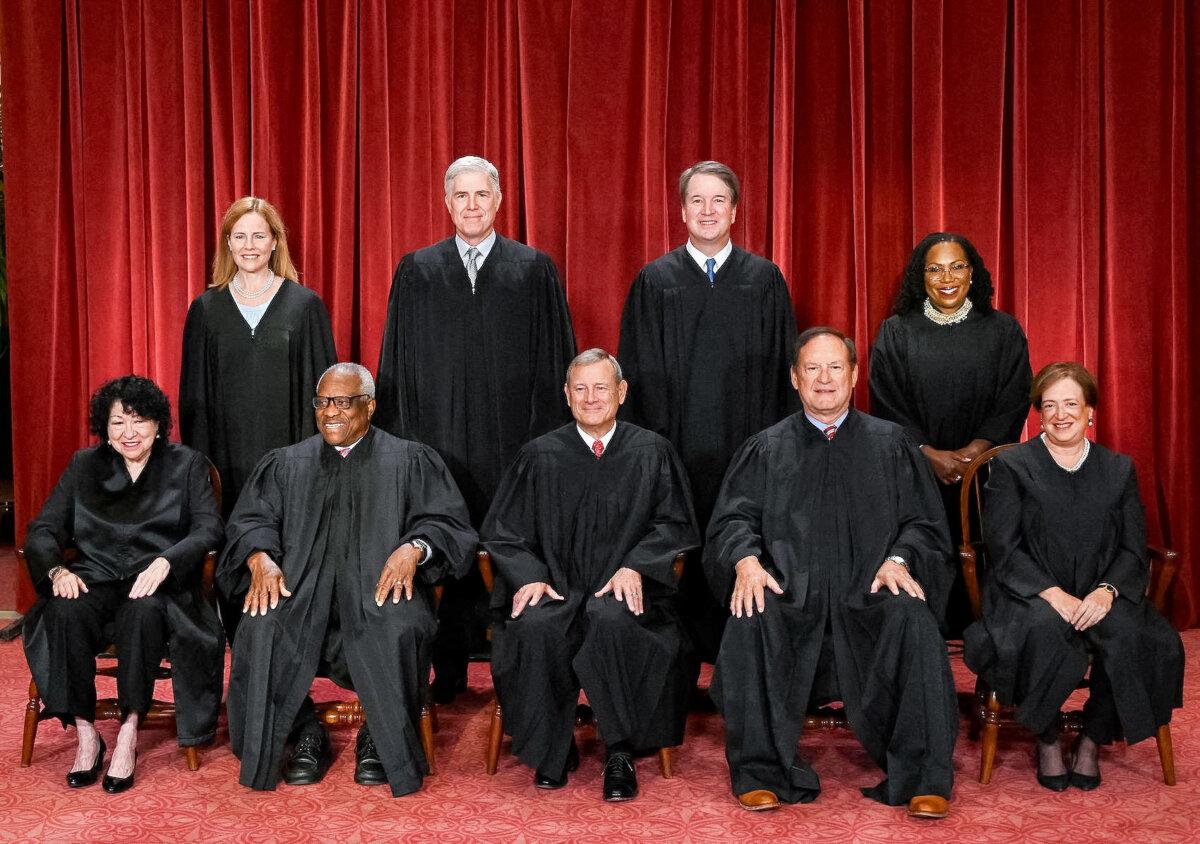
Justices Elena Kagan, Brett Kavanaugh, and Ketanji Brown Jackson, and Chief Justice John Roberts joined Sotomayor’s opinion.
Justices Neil Gorsuch, Clarence Thomas, and Samuel Alito dissented in full. Justice Amy Coney Barrett dissented in part.
Gorsuch said in his dissenting opinion that “to my eyes, [the Antiterrorism and Effective Death Penalty Act] precludes us from exercising certiorari jurisdiction.”
A writ of certiorari is a court order that allows the justices to move forward with hearing an appeal.
Gorsuch said the majority’s “bespoke certiorari-for-federal-prisoners-clear-statement rule lacks any grounding in law,” and appeared to come out of “thin air.”
“Exactly nothing in this history or [the Antiterrorism and Effective Death Penalty Act’s] structure suggests Congress sought to loosen do-over restrictions for anyone—let alone completely do away with those restrictions for federal prisoners,” Gorsuch said.
“To the contrary, the statute’s history and structure suggest, as we have long observed, that [the statute] imposed new and ‘stricter limits’ on post-conviction relief.”