
Supreme Court Votes 7–2 to Let
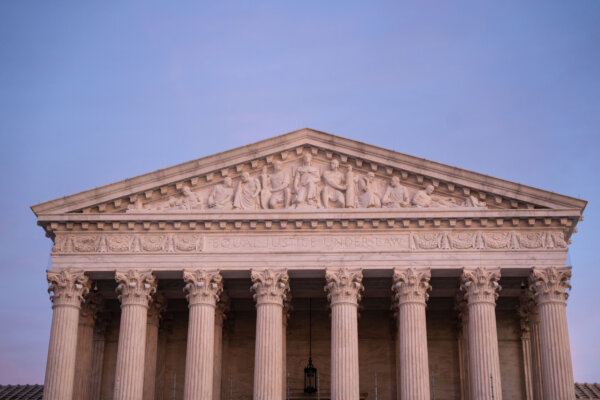 The U.S. Supreme Court voted 7–2 on Jan. 14 to allow a Republican congressman to challenge an Illinois law that allows the counting of ballots for two weeks after Election Day.
The new decision could make it easier for candidates to sue over election laws.
The nation’s highest court ruled in Bost v. Illinois State Board of Elections that Rep. Michael Bost (R-Ill.) has legal standing to contest the Illinois statute
Standing refers to the right of someone to sue in court. A party must show a strong enough connection to the claim to justify participating in a lawsuit.
“Candidates have a concrete and particularized interest in the rules that govern the counting of votes in their elections, regardless whether those rules harm their electoral prospects or increase the cost of their campaigns,” Roberts wrote.
“Their interest extends to the integrity of the election—and the democratic process by which they earn or lose the support of the people they seek to represent.”
“As a candidate for office, Congressman Bost has standing to challenge the rules that govern the counting of votes in his election,” the chief justice wrote.
Bost brought the appeal alongside Laura Pollastrini and Susan Sweeney, who were Republican presidential elector nominees for the 2020 and 2024 federal elections.
Bost said he has standing in the case because he incurs expenses in running his campaigns for an extra two weeks to keep an eye on the receipt and counting of ballots.
He also argued that as a candidate, he has an interest in ensuring that validly received ballots are accurately counted, according to the petition.
“For over 130 years, this court has heard claims brought by federal candidates challenging state time, place, or manner regulations affecting their federal elections,” the petition reads. “Until recently, it was axiomatic that candidates had standing to challenge these regulations.”
Bost sued the state elections board, but a federal district judge ruled in July 2023 that he lacked standing to proceed. Standing cannot be established merely based on Bost’s status as a political candidate and voter, the court held.
In August 2024, the U.S. Court of Appeals for the Seventh Circuit affirmed.
The appeals court found that Bost had presented a “generalized grievance affecting all Illinois voters” that was not “a sufficiently concrete and particularized injury” to support standing.
In its new decision, the Supreme Court reversed the Seventh Circuit and sent the case back to that court “for further proceedings consistent with this opinion.”
In a dissenting opinion, Jackson said the new ruling could harm the electoral process by encouraging more legal challenges.
“[Bost did not allege facts] that support an inference of standing under our established precedents,” she said.
“By carving out a bespoke rule for candidate-plaintiffs—granting them standing ‘to challenge the rules that govern the counting of votes,’ simply and solely because they are ‘candidates’ for office—the court now complicates and destabilizes both our standing law and America’s electoral processes.”
Justice Amy Coney Barrett concurred with the end result of the majority opinion, but wrote a separate opinion saying that the court should have ruled more narrowly.
“Rather than take this straightforward path, the court charts a novel one,” Barrett said. “I cannot join the court’s creation of a bespoke standing rule for candidates. Elections are important, but so are many things in life. We have always held candidates to the same standards as any other litigant.”
Judicial Watch, a watchdog group that represents Bost, hailed the Supreme Court’s ruling.
“This is the most important Supreme Court election law ruling in a generation,” Judicial Watch president Tom Fitton told The Epoch Times.
“Too many courts have denied candidates the standing to challenge unlawful election rules, such as the outrageous ballots that arrive after Election Day,“ Fitton said. ”American citizens concerned about election integrity should celebrate this Supreme Court victory.”
Bost said the ruling was “a critically important step forward in the fight for election integrity and fair elections.”
“I look forward to continuing to pursue this case as we navigate the next stages of the legal process,” the congressman told The Epoch Times. “It’s vitally important that we restore the people’s trust in our elections.”
“Political candidates, more than political parties and even more than the voters themselves, are most likely to be directly harmed when a state legislature enacts an improper voting law,” O’Neill told The Epoch Times.
“They are, therefore, entitled to the opportunity to challenge the legality and constitutionality of those state laws,” he said.
Attorneys for the Illinois State Board of Elections did not respond to a request for comment by publication time.