
OAN Staff Katherine Mosack and Brooke Mallory
4:00 PM – Thursday, February 19, 2026
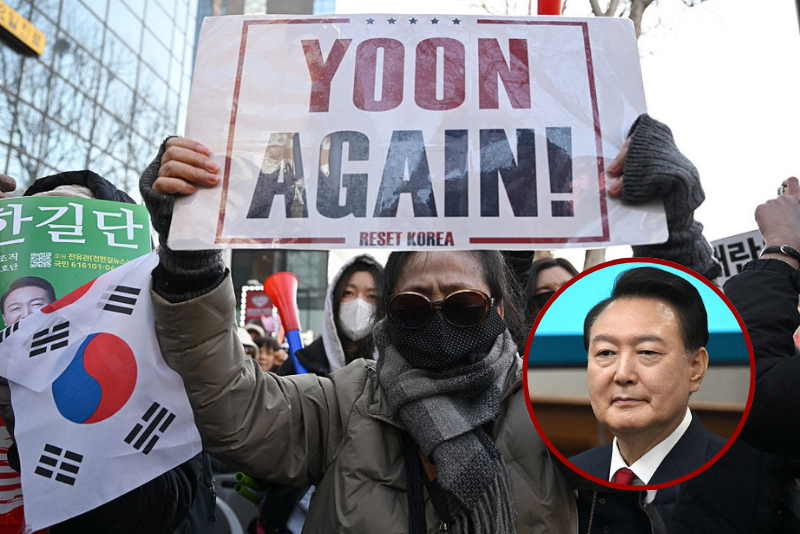
Former South Korean President Yoon Suk Yeol, who was impeached and removed from office following his short-lived declaration of martial law in December 2024, has been sentenced to life in prison by the Seoul Central District Court.
Yoon, 65, was sentenced to life in prison after he was found guilty of abuse of authority and masterminding an insurrection, in relation to when he declared martial law in December 2024 — the country’s most intense political scandal in decades.
Yoon’s brief declaration on December 3, 2024, lasted only about six hours before the National Assembly voted to lift it and he revoked the decree. However, despite its short duration, the attempt caused significant and lasting damage across multiple areas of South Korean society, politics, economy, and international standing.
It triggered immediate nationwide protests, deep societal polarization and extreme political confrontation between supporters and opponents that lasted a year later, as well as damage to the political neutrality of the military and police — as troops were deployed to surround the National Assembly, break windows, and attempt to block lawmakers — undermining public trust in these institutions.
In court, Yoon denied the charges and reiterated that at the time, he had lawful authority to declare martial law to draw attention to opposition parties’ obstruction of government and root out “anti-state forces.”
Yoon’s other stated reasons in the past centered on “protecting South Korea’s democracy” and national security from what he described as severe internal threats. In Yoon’s televised announcement that night, he stated that he was declaring emergency martial law to:
- Protect the free Republic of Korea from the threat of North Korean communist forces.
- Eradicate “shameless” or “despicable” pro-North Korean anti-state forces that were allegedly pillaging citizens’ freedom and happiness.
- Restore and safeguard the constitutional democratic order against forces seeking to overthrow the system.
However, Judge Jee Kui-youn argued that the real purpose behind Yoon’s declaration was “to send troops to the national assembly to blockade the assembly hall and arrest key figures, including the assembly speaker and party leaders, thereby preventing lawmakers from gathering to deliberate or vote.”
Although prosecutors argued for the death penalty, citing “irreparable” damage to the military’s political neutrality, the court instead handed down a life sentence, noting that the former president appeared to have attempted to limit physical force during the commission of the crime.
Yoon reportedly remained stone-faced as the verdict was read — a moment broadcast live to a captivated nation. His sentencing also follows a turbulent year that began with a high-stakes standoff at the presidential compound, where security forces initially shielded him from arrest.
Outside the courthouse, the scene was one of grief and fury. Hundreds of supporters waved South Korean flags and chanted “Yoon again!” As news of the life term filtered out, the crowd erupted, with some weeping and declaring “the country is finished,” while others directed their rage at the bench, shouting, “Political judge, step down!”
In stark contrast, nearby progressive groups erupted in cheers and embraced as news of the life sentence broke. For many, however, the victory was bittersweet. They expressed disappointment that the court stopped short of the death penalty — the maximum statutory punishment for his conviction.
While such a sentence would have been largely symbolic, given that South Korea has maintained a moratorium on executions since 1997, activists argued it was the only fitting response to the gravity of his crimes.
Former Prime Minister Han Duck-soo was also sentenced to 23 years in prison for his involvement in the declaration in January, while former First Lady Kim Keon Hee was arrested in August on charges of bribery and corruption.
Stay informed! Receive breaking news alerts directly to your inbox for free. Subscribe here. https://www.oann.com/alerts
What do YOU think? Click here to jump to the comments!
Sponsored Content Below