
Submitted by Thomas Kolbe
Even with some temporal distance and broader perspective, the election result in Baden-Württemberg makes no sense. That the two eco-socialist parties, fused into a kind of political twin planet—Bündnis 90/Die Grünen and the CDU—could claim almost two-thirds of the votes cast is staggering given the economic situation in the country. It raises a fundamental question: Can—or will—Germans no longer connect economic decline with political responsibility in any meaningful way?
Baden-Württemberg’s capital, Stuttgart, is notably at the epicenter of this decline. The city serves, in a way, as a blueprint for the future envisioned by green transformation advocates.
It makes no difference whether it is green ideologues and hardliners like Jürgen Trittin exploiting the cultivated German guilt complex for their degrowth fantasies, or CDU politicians of the Merkel-Merz line staging placebo reforms for public consumption. Both strategies ultimately point to the same goal: replacing traditional German industry with a state-controlled command economy.
That the Mittelstand and major industry are collapsing under mounting fiscal pressure and the energy transition catastrophe is undeniable. Added to this is a kind of vacuum effect in the capital markets.
Every subsidy, especially the state-guaranteed high returns in the green art economy, drains valuable resources from the free market. Startup funding, growth financing, and venture capital are systematically squeezed or driven abroad.
Entrepreneurs may even choose the simpler path of marching along, extracting subsidies on the way to the green paradise. The problem is that state-run economics, whether executed by private companies as government proxies or directly by the state, adds no value to the economy. It is a destructive mechanism, felt even by city treasurers in Stuttgart, the new capital of ideological escapists.
Last year, trade tax revenue collapsed by roughly fifty percent—a clear sign of massive economic damage. The city budget deficit surged to €800 million. Only a €2.4 billion emergency credit keeps the city afloat over the next three years.
In real life, those responsible for this disaster might face court for insolvency mismanagement. But for politics in Germany—and much of the European Union—different standards evidently apply.
Hardly anyone seems to notice that the technological and emotional flagships with which the region identified over generations are collapsing under the green regime. Daimler alone cut 7,000 jobs in the Stuttgart region, Bosch another 4,000.
The state risks becoming a gigantic social park, partially deforested for monstrous wind turbines, its landscapes overrun with solar farms.
It is interesting to observe how conservative work ethic, once a prominent regional virtue, has translated over time into militant green-socialist moralism.
That the system still functions at all owes today’s Southwest Germany precisely to nuclear power from France. Even this shows: this universal law is sometimes tinged with bitter cynicism.
No matter how high Württembergers and Badeners have built their walls of illusion, the waves of real economics will shatter this political illusion of reform denial. Rumors are already circulating that Porsche may have to lay off up to 5,000 employees in the region. Regional industrial production is no longer competitive.
It will be a painful learning process. But even South German green enthusiasts cannot indefinitely evade the axioms of economics.
Competitiveness is not created in the seminars of flourishing NGOs or the numerous ecological interest groups preaching through the media in zealot tones.
No, companies will learn it the hard way: their real wealth, now overgrown with the swamp plant of moralism, was the product of rigorous discipline, market order, and rational bourgeois ethics. Globally sought-after engineering achievements contributed significantly.
Still, about twelve percent of the region’s total economic output comes from mechanical engineering—the very sector weakened most under the green-socialist regime, second only to the region’s automotive industry, another pillar. VDMA report
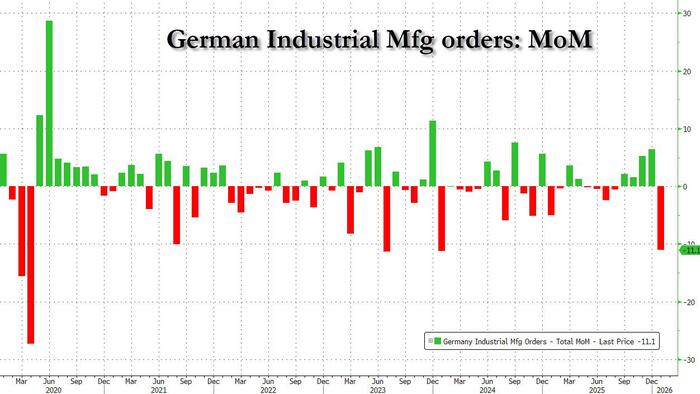
Like Shakespeare, the Romeo and Juliet of the German economy are now taking their own lives. Since 2018, industrial production in Germany has fallen over twenty percent, with mechanical engineering alone losing five percent last year.
This is no longer a recession—it is a conscious economic decline in the name of the green god, worshiped in Baden-Württemberg more fervently than anywhere else in the republic. A shame for this beautiful region with its rich and remarkable history.
* * *
About the author: Thomas Kolbe, a German graduate economist, has worked for over 25 years as a journalist and media producer for clients from various industries and business associations. As a publicist, he focuses on economic processes and observes geopolitical events from the perspective of the capital markets. His publications follow a philosophy that focuses on the individual and their right to self-determination.