
 Top War Department officials announced that the United States is striking Iran-aligned militia groups in Iraq and that the military’s objectives against Iran remain on track.
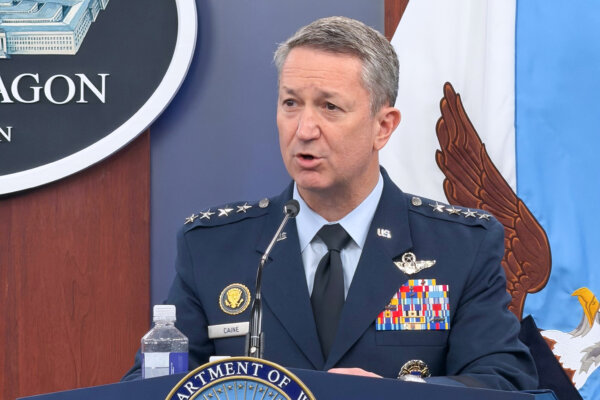
“AH-64s have been striking against Iranian-aligned militia groups to make sure that we suppress any threat in Iraq against U.S. forces or U.S. interests,” Gen. Dan Caine, chairman of the U.S. Joint Chiefs of Staff, said during a March 19 press briefing, referring to Apache attack helicopters.
In the same briefing, War Secretary Pete Hegseth said the U.S. military’s objectives in the war against Iran haven’t changed since strikes were launched in late February and that there is justification for the conflict to expand to Iraq.
The Iranian regime, he said, has set forth a mission to “to kill Americans in Iraq,” noting that a Pentagon report in 2019 said Iran was behind the deaths of more than 600 service members in Iraq.
Hegseth added that “our objectives, given directly from our America-first president, remain exactly what they were on day one,” referring to President Donald Trump. That includes destroying Iran’s missile launchers, as well as the regime’s defense industrial base and navy and to block the country from obtaining nuclear weapons, he said.
“These are not the media’s objectives, not Iran’s objectives, not new objectives. Our objectives, unchanged, on target and on plan,” Hegseth said. He spent several minutes in his opening statement criticizing media outlets during the news conference.
Since the U.S. and Israeli militaries launched the war on Feb. 28, top Iranian leaders have been killed in air strikes, and the country’s military capabilities have been severely degraded. However, Tehran is still launching drone and missile attacks against its Gulf neighbors.
Iran again launched attacks on oil and natural gas facilities around the Persian Gulf on March 19, raising the stakes in a war that has sent oil and gas prices surging in recent weeks. The strikes, in retaliation for an Israeli attack on a key Iranian gas field, sent fuel prices soaring and risked drawing Iran’s Arab neighbors directly into the conflict.
Qatar, Saudi Arabia, and the United Arab Emirates denounced the Iranian attacks. Arab League Secretary-General Ahmed Aboul Gheit called them a “dangerous escalation.”
Brent crude oil, the international standard, spiked to as high as $118 a barrel, up by more than 60 percent since Israel and the United States launched the strikes. The European benchmark for natural gas prices rose by 17 percent on March 19 and has doubled in the past month.
A top Iranian official on March 19 said through state-run media that the country is still capable of launching attacks despite the U.S. strikes and that its enemies have made a “grave mistake by attacking the energy infrastructure of the Islamic Republic of Iran, and the response to that is currently underway and is not yet complete.”
“The next attacks on your energy infrastructure and that of your allies will not cease until their complete destruction, and our response will be much more severe than tonight’s attacks,” the official said, according to state-run Tasnim News.
Also during the March 19 news conference, Caine downplayed suggestions that the U.S. military is getting low on munitions, and he also dismissed any speculation about mission creep in the campaign.
“You hear a lot of noise about widening or munitions [or] speculation about what we should or should not being doing,” Caine said. “This is a clear set of objectives. The president has given us every capability we need.”