
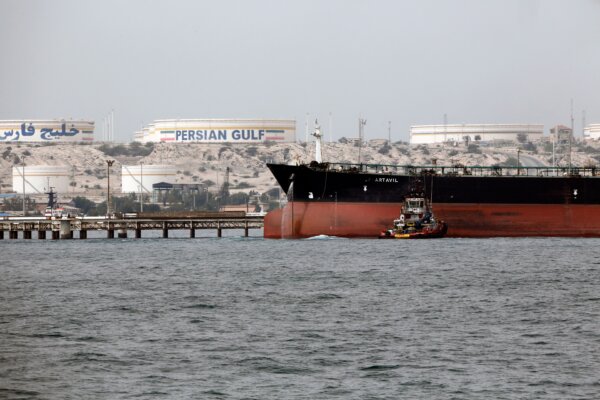
 As the fight against the regime in Iran continues, the country’s military forces have moved to cut off shipping through the Strait of Hormuz. This was apparently their threat all along, which gave them the hubristic feeling of a lack of accountability for their attacks on Israel.
Iran is mining Hormuz and shooting missiles at oil and gas tankers in the area. By the end of March 16, 21 ships around the strait, including the adjacent Gulf of Oman, had reported incidents. The risks of transit through Hormuz stranded approximately 1,000 ships in the Persian Gulf that depend on its single exit point. The gulf is critical for Saudi Arabia, Kuwait, the United Arab Emirates, Qatar, and Bahrain. Approximately 20 percent of global oil passes through the strait, and most of the currently stranded ships are oil and gas tankers.
Tehran’s actions are a form of economic warfare meant to impose enough pain on the United States and Israel that we withdraw. Iran’s Hormuz attacks have pushed up gas prices at pumps almost everywhere. On March 17, the average price of gas rose to $3.88 per gallon in the United States, up from less than $3 before the start of the conflict on Feb. 28.
Iran is allowing Iranian-flagged ships and a trickle of international ships through Hormuz. To get passage for particular ships, foreign governments are apparently negotiating with Tehran for permission. Chinese ships, and those with Chinese crew members, are getting preference. In the first half of March, 11 China-linked ships got through. A total of 21 tankers transited the strait since the conflict began. Ships from India, Pakistan, Turkey, and Greece may also have gotten negotiated transits.
These international ships tend to hug the Iranian coast and have links to Iranian companies, raising questions about whether the U.S. Navy should let Iran’s shipping through when Iran does not extend the same courtesy to international shipping. One solution is for the United States to tax or seize Iranian-flagged ships that Iran lets through, justified by the costs that the United States has long incurred for having provided security to the region.
U.S. President Donald Trump is seeking a broad coalition to help protect the shipping through the strait. On March 19, and with some prodding by Trump, the UK prime minister, and the secretary-general of NATO, seven U.S. allies agreed to assist. These include the UK, France, Japan, Germany, Italy, the Netherlands, and Canada.
These countries are likely to do more harm than good if they send naval assets to the Middle East, including through the intelligence on U.S. forces they could gather. Neither should the United States normalize them as providers of global security by treating them as we do the democracies.
In a worst-case scenario, the Chinese military could land troops on a strategic Iranian territory such as Kharg Island, through which about 90 percent of Iran’s oil exports flow. Most of that goes to China. It would be better to keep the Chinese military far away from the Middle East and contained in China. This would increase the likelihood that the United States could control the flow of Middle East oil to China, using it as leverage to force China not only into the market but also into democratic reforms and human rights improvements.
Only after China becomes democratic should the United States ask Beijing to help provide global security.
Now, the United States has a highly strategic opportunity to displace Iran’s choke hold on the Strait of Hormuz. Sen. Lindsey Graham (R-S.C.) has supported a U.S. seizure of the island, saying on March 14: “If Iran loses control or the ability to operate its oil infrastructure from Kharg Island, its economy is annihilated. He who controls Kharg Island controls the destiny of this war.”
To that end, the United States destroyed most of the island’s Iranian military installations on March 15 and is increasing the number of U.S. Marines in the region who would be capable of taking the island. They will be key to leveraging Iran’s oil to improve the chances for peace in the foreseeable future.