
WASHINGTON — It was impossible for any member of the press or public to stop their eyes from drifting time to time from the bench to the middle of the nation’s highest court, where the president was quietly making history.
The nine Supreme Court justices carried on completely unfazed by the president’s first-time presence in their courtroom for oral arguments on birthright citizenship. Justices Brett Kavanaugh and Elena Kagan still exchanged a few laughs. Justice Samuel Alito periodically shut his eyes and reclined as far back as his chair would allow as attorneys spoke. Chief Justice John Roberts held to the strictest decorum.
While taking a second glance over the briefs in preparation, I somehow missed the president take his seat. But I immediately heard the murmurs around me as the whole morning’s anticipation reached its peak.
As the chief justice recently reminded a crowd in March, justices are not obligated to carry forward the views of those who appoint them. They’re used to criticism, and there’s no reason to be moved by a president’s attendance, though his criticism has been especially sharp since the majority struck down his tariff policy in February.
Still, nobody was quite sure how the president’s attendance was going to play out.
Birthright citizenship is a major constitutional question with wide-ranging ramifications. The president has made his views clear about the damage “dumb judges and justices” could do by striking down his executive order and maintaining a policy that incentivises illegal immigration and birth tourism.
Aside from increased security, the president’s morning plans didn’t actually change much as the coequal third branch of government went about its business. Staff started retrieving reporters from the press room and seating them in the courtroom at 9:15 a.m., part of the usual routine. No official word came on the prior night’s Oval Office announcement.
“Is the president in group A, B, or C?” one reporter loudly asked.
The court staff member laughed and paused. “No response,” she replied.
Rumors swirled online the night before about a special seat reserved for the president.
“There’s literally a chair set up at SCOTUS for our presidents to sit in for oral argument,” Assistant Attorney General Harmeet Dhillon wrote in response to a reporter on X. “Your separation of powers nonsense is more imitation pearl-clutching hauteur.”
A National Park Service document does reference a black chair for the president in front of the bench, though the president’s attendance is “rare and limited to important ceremonial occasions.”
As previous presidents have done, President Donald Trump attended swearing-in ceremonies during his first term for Kavanaugh and Justice Neil Gorsuch, two of his appointees. Trump floated attending oral arguments for the tariff case in December but ultimately did not.
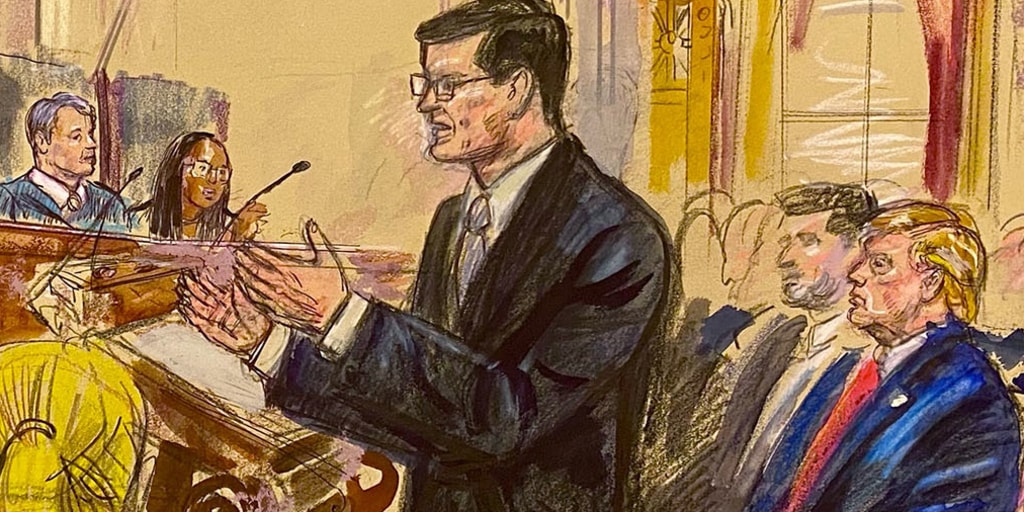
The court sketches of President Trump sitting in at the Supreme Court today as justices weighed his actions to limit ‘birthright citizenship’.
Trump is the first sitting President to attend proceedings.
He stayed just about an hour and left during the defense’s arguments.… pic.twitter.com/cqlmmzqdbw
— Scott Thuman (@ScottThuman) April 1, 2026
As reporters lined up before entering the courtroom, a staff member finally acknowledged we “may have heard” of the president’s plans to attend. If he stayed the entire argument, reporters were instructed to remain seated until he left.
When the chief justice announces “the case is submitted” and the buzzer sounds, press typically rush out to start writing, updating editors and appearing on-camera. While the court allows an audio livestream of oral arguments, a COVID-19 protocol that became permanent, it remains a rare institution in Washington where no cameras or electronics are allowed.
Seated in the courtroom, reporters without details of the president’s potential entrance craned their necks to scope out the room. Many of the press seats offer partial visibility into the courtroom, with parts of the bench obstructed by columns. On the busiest days of big cases, reporters seated in the back row behind the curtains are lucky if they can see one or two justices.

WASHINGTON, DC – APRIL 01: The Presidential limousine, “The Beast” carrying U.S. President Donald Trump arrives at the U.S. Supreme Court on April 01, 2026 in Washington, DC. The Supreme Court is hearing oral arguments in Trump v. Barbara to determine if President Trump’s executive order ending birthright citizenship is constitutional. According to historians and the Court, this is the first time a sitting president has attended oral arguments at the nation’s highest court. (Photo by Win McNamee/Getty Images)
Reporters in the first rows whispered who they spotted to those behind. Secretary of Commerce Howard Lutnick. Attorney General Pam Bondi. In the public section nearest to the press, I spotted John Eastman.
Ten minutes before arguments began, a court staff member offered some details: Trump would be sitting in the front row of the public section. Between the bench and public seating, there are about five rows of chairs reserved for Supreme Court bar attorneys.
A law enforcement official stopped by next to warn members of the press, once again, that we would be kicked out if we stood up during the arguments. The officer declined to share any more about the president’s seat. Court staff can share those details, she said, though she couldn’t.
Just before the court was called into session, the president entered.
“Can she see the president?” another reporter in the neighboring alcove asked, gesturing to the courtroom artist to my right.
I shook my head. Her view of the president’s seat wasn’t ideal, but the artist was managing by leaning to the right with a small pair of theater binoculars. The only problem with the binoculars is that they can’t see through heads, she said.

WASHINGTON, DC – APRIL 01: The Presidential limousine, “The Beast” carrying U.S. President Donald Trump arrives at the U.S. Supreme Court on April 01, 2026 in Washington, DC. (Photo by Andrew Harnik/Getty Images)
“The Honorable, the Chief Justice and the Associate Justices of the Supreme Court of the United States,” the marshall called out as the room rose from their seats. “Oyez! Oyez! Oyez! All persons having business before the Honorable, the Supreme Court of the United States, are admonished to draw near and give their attention, for the Court is now sitting. God save the United States and this Honorable Court!”
Reporters lingered just a second longer than usual, milking every moment it was permissible to stand without getting called out by court police. I still couldn’t catch a view of Trump’s face.
At 10 o’clock, the Chief Justice began the usual swearing-in of new attorneys to the bar, and oral arguments began promptly after. A court spokesperson confirmed to the New York Times then that Trump was indeed seated in the courtroom, where reporters had no contact with those outside.
For a rare hour and 20 minutes, the president sat quietly and listened as the justices pressed his solicitor general, John Sauer, with questions. No White House press pool. No cameras. Only the regular Supreme Court pool and a courtroom artist.
Shortly after Sauer concluded, the president stood to leave.
The justices continued, never acknowledging their special guest. But now I could finally catch a glimpse as the president headed for a right side exit between two columns, his silhouette clear against the window as he left.