
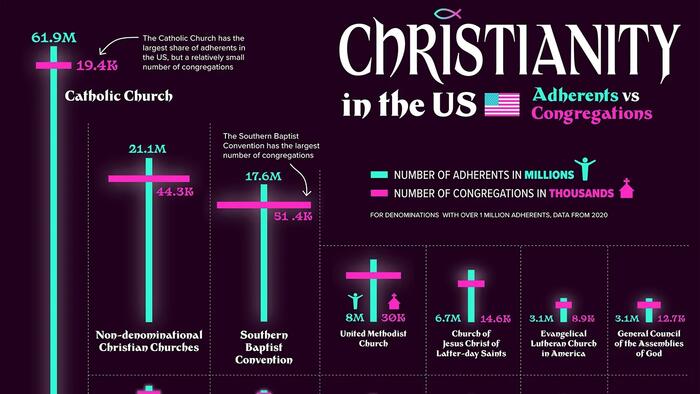
The Catholic Church is America’s largest Christian group – but it doesn’t have the most churches.
Drawing on data from the U.S. Religion Census, compiled by Julie Peasley via Visual Capitalist, this visualization compares the country’s biggest Christian denominations by two measures: adherents and congregations.
The comparison highlights a key divide in how these groups are structured. Catholics lead by membership, while the Southern Baptist Convention leads by church count. Non-denominational churches also rank near the top on both measures, reflecting how the composition of American Christianity has shifted over time.
The Largest Christian Denominations in America
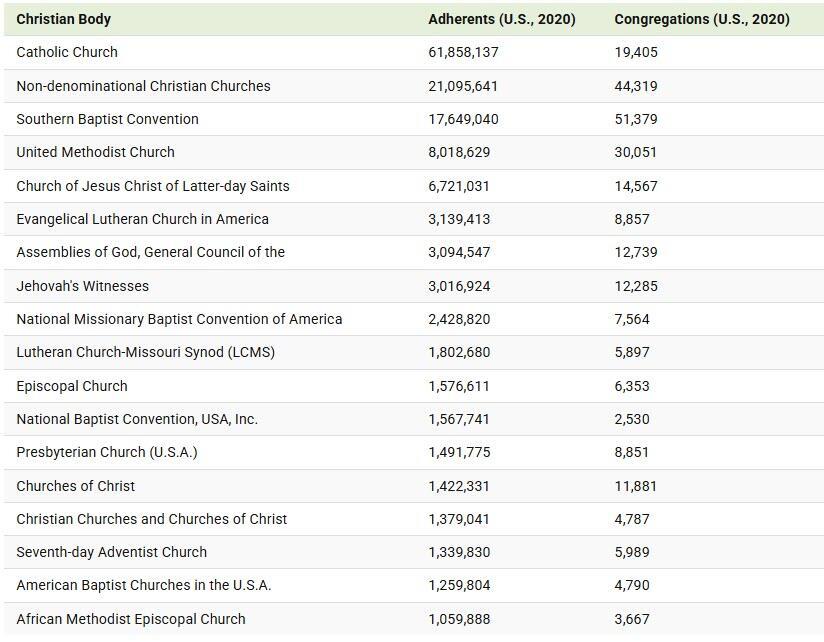
Here’s a closer look at how America’s largest Christian groups stack up:
What Are “Adherents” and “Congregations”?
Two metrics drive this comparison:
Together, they show both the size of each group and how widely it is distributed.
America’s Largest Christian Group Has Fewer Congregations
The Catholic Church has 61.9 million adherents—more than any other group—but only about 19,400 congregations.
By contrast, the Southern Baptist Convention has 51,400 churches, the most in the dataset, despite having far fewer members. Non-denominational churches also combine a large membership base with a wide church network.
The result is a clear tradeoff: some groups concentrate members into fewer congregations, while others are spread across a much larger number of churches.
The Rise of Non-Denominational Christianity
Non-denominational Christian churches have emerged as one of the largest groups in the country. Their growth reflects broader shifts in religious identity, as many Americans move away from traditional denominational labels.
According to broader research from Pew, religious affiliation in the U.S. has remained relatively stable in recent years, but the composition within Christianity continues to evolve. Non-denominational and evangelical traditions have gained prominence, especially in fast-growing regions.
A Diverse Religious Landscape
Beyond the largest groups, the U.S. is home to a wide array of smaller denominations, from Lutheran and Methodist branches to Adventist and Episcopal churches. Each contributes to a highly fragmented but vibrant religious ecosystem.
Geography helps shape these patterns. In this map of U.S. religion, Baptist and evangelical churches are heavily concentrated in the South, whereas Catholic strongholds align with areas shaped by European and Latin American immigration.
To see how Christianity compares on a global scale, check out Ranked: Countries With the Greatest Number of Christians on the Voronoi app.