The first time Iran found itself in a major regional war with Donald Trump about to enter the White House, was April 13, 2024 when as part of escalating tensions with Israel, “Iran began an attack on Israel by launching dozens of suicide drones” on April 13, 2024. That said, it is s stretch to call that particular weapons exchange war, as both sides just wanted some theatrical appreciation rather than rearranging the borders of the middle East. What is more notable, is that the war started in the deep dark of a Saturday morning (April 13, 2024) when global markets were closed, and the only traded asset was crypto in general, and bitcoin in particular. The kneejerk reaction was sharply lower.
The second time Iran found itself in a major regional war with Donald Trump (already in) the White House, was a little over a year later, on June 21-22, when in a much more serious and aggressive attack, Operation Midnight Hammer saw airstrikes, cruise missile attacks and B-2 bombers drop Massive Ordnance Penetrators on three key Iranian nuclear sites: Fordow, Natanz, and Isfahan, all of which were quickly destroyed As a result, Iran’s nuclear enrichment process was effectively (and literally) buried under a mountain, and then the major regional conflict was again promptly forgotten. What is most notable, is that that war, too, started in the deep dark of a Saturday morning (June 21, 2025) when global markets were closed, and the only traded asset was crypto in general, and bitcoin in particular. The kneejerk reaction this time too, was sharply lower.
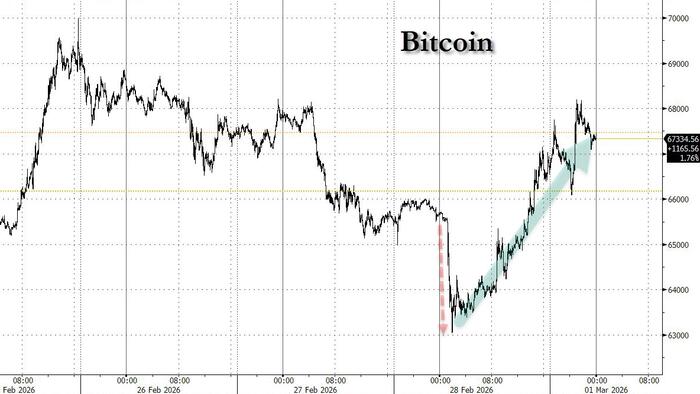
Fast forward to today, when in the most serious war between Iran and a coalition of US and Israel forces in decades, Iran was promptly “decapitated” as all of its top generals and IRGC personnel were killed, while also losing its spiritual head, the Ayatollah, who had led the country ever since those fateful days in 1978 when Shah Mohammed Reza-Pahlavi was replaced with Ruhollah Ayatollah, and an American embassy and its occupants were taken hostage. This conflict started shortly after the sun rose, as the attacking generals thought a night attack which everyone – and especially Iran – would expect as it is “meant” to be surprise would have little impact. They were right, and Ayatollah Khomeini was promptly vaporized. Where there was similarity to previous conflicts is that this one too started early on Saturday, when global markets were closed. Well, not all: bitcoin was trading. And, like the previous two most recent regional wars, Bitcoin’s kneejerk reaction this time too, was sharply lower… but not for long, and shortly after it emerged that Ayatollah Khameini was dead and most of the army leaders had been killed, bitcoin – that weekend trading risk barometer – staged a remarkable rebound and was actually trading well above where it was before the currency sold off shortly after midnight on Saturday East Coast time.
Which begs the question: is the conflict now effectively over and is Wall Street getting the all-green signals?
This is also the question asked by Academy Securities strategist Peter Tchir, who in a late Saturday note – when most of the latest development were already known – wrote that he remains comfortable buying the market.
He explains why below:
A lot was priced in. Brent has gone for $60 late December to $72 on Friday. Some of that move in energy prices likely tied to cold winter in America, etc, but away from the risk of conflict, the market was positioned for selling off. So far the “bad” news on the oil front should have been largely priced in.
- Insurance for shipping in region cancelled. pretty standard
- Limited or no transit in the Strait of Hormuz. Should be expected
The “good” news on the oil front is that nothing has happened that would prevent transit if there is an off ramp.
China supposedly has large stockpiles of crude and the U.S. in good shape, so a short disruption (a week or so) should have minimal impact. Spot oil contracts might go as high as $80 but am not expecting a big move out the curve
Furthermore, while it is early, so far intelligence and military in action have delivered at high levels for the US and Israel. Not so much for Iran. Maybe they have another round up their sleeve, but according to Tchir, :”their calculus should be adjusted – to seek off ramp“
With confirmations stating that the leadership has been hit hard, what is the thought process of those assuming command:
You know that Isreal and the U.S. probably know who you are and possibly where you will be. That cannot be comforting.
Their weapon systems have performed as advertised (or maybe even better than expected).
Your weapons, like in prior attacks, and like Russia has experience, have not been as good as expected.
Which brings us to Bitcoin, which Tchir – and anyone else – views as a risk-on type of asset in this situation, has now recovered from small early loss to slightly highere.
Putting it all together, Tchir – looking through the fog of war – says that he is optimistic for a “risk on” start to the week, while may sound a little bit callous, which is also why the Academy Strategist notes that “we can only hope that the events in the Middle East lead to a peaceful resolution, putting the Iranian people on a better path to prosperity and freedom, while minimizing the loss of life for everyone in the region.”
Loading recommendations…