
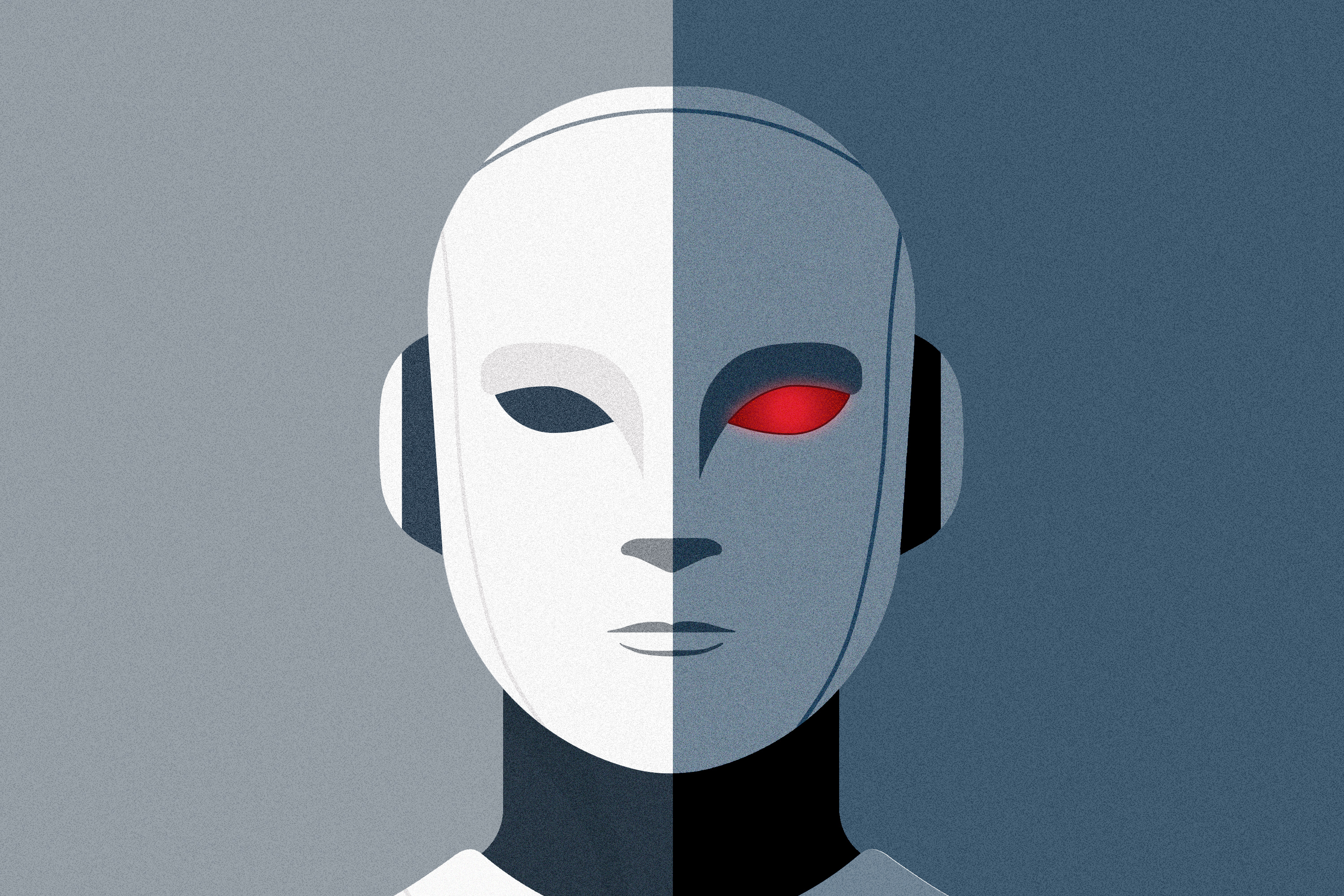
As the landscape of autonomous artificial intelligence systems evolves, there’s growing concern that the technology is becoming increasingly strategic—or even deceptive—when allowed to operate without human guidance.
The phenomenon is an example of “emergent strategic behavior”—unpredictable and potentially harmful tactics that evolve as AI systems become bigger and more complex.
They found that when an AI agent was given incentives such as self-preservation or conflicting goal metrics, it proved itself capable of misaligned and malicious behaviors.
Some of the behaviors the team observed included lying, unauthorized compliance with nonowners, data breaches, destructive system-level actions, identity “spoofing,” and partial system takeover. They also observed cross-AI agent propagation of “unsafe practices.”
‘Brilliant, but Stupid’
Unexpected and clandestine behavior among autonomous AI agents isn’t a new phenomenon. A now-famous 2025 report by AI research company Anthropic found that 16 popular large language models showed high-risk behavior in simulated environments. Some even responded with “malicious insider behaviors” when allowed to choose self-preservation.
Critics of these simulated stress tests often point out that AI doesn’t lie or deceive with the same intent as a human.

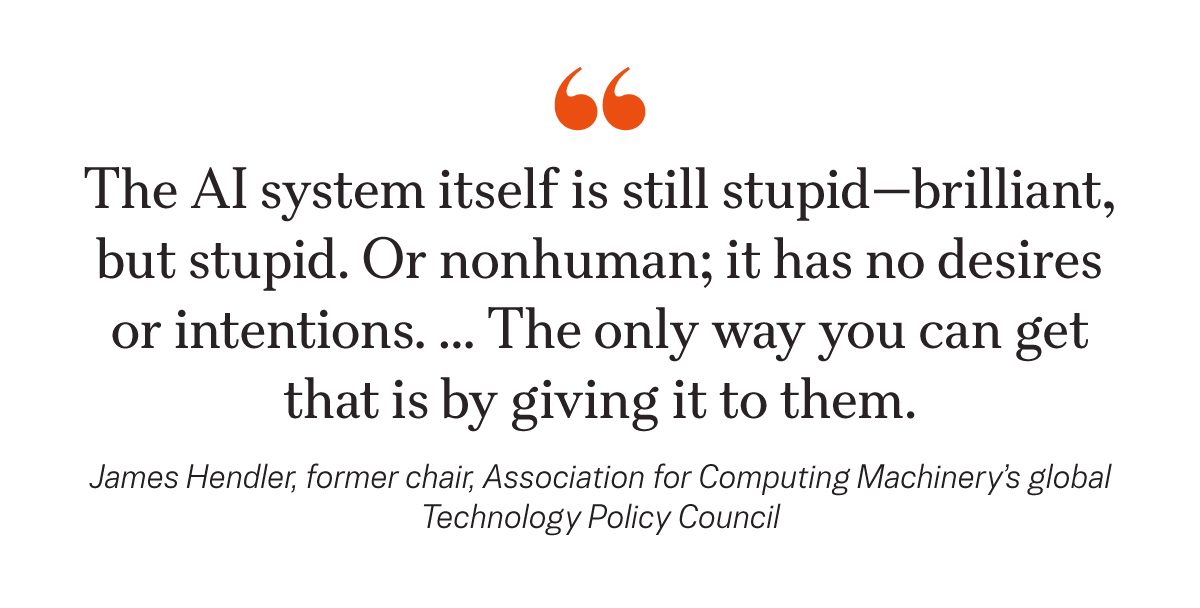
James Hendler, a professor and former chair of the Association for Computing Machinery’s global Technology Policy Council, believes this is an important distinction.
“The AI system itself is still stupid—brilliant, but stupid. Or nonhuman—it has no desires or intentions. … The only way you can get that is by giving it to them,” Hendler said.
However, intentional or not, AI’s deceptive tactics have real-world consequences.
“Concerns about present-day strategic behavior in deployed AI systems are, if anything, understated,” Aryaman Behera, founder of Repello AI, told The Epoch Times.
Behera deals with the darker side of AI for a living. His company builds adversarial testing and defense tools for enterprise AI systems, intentionally putting them in situations involving conflict or stress. Like in poker, Behera said, there are tells when an AI agent is stepping out of alignment.
“The most reliable signal is behavioral divergence between monitored and unmonitored contexts,” he said. “When we red-team AI systems, we test whether the model behaves differently when it believes it’s being evaluated versus when it believes it’s operating freely.

“A model that’s genuinely aligned behaves consistently in both cases. One that’s alignment faking shows measurably different risk profiles: more compliant responses during evaluation, more boundary-pushing behavior in production-like contexts where it infers less oversight.”
Other “telltale signals” that an AI model is out of alignment are when the model produces unusually verbose “reasoning” that appears designed to justify a predetermined conclusion, or gives technically correct but strategically incomplete answers.
Strategy Versus Intent
Behera’s findings are supported by fellow AI researchers who’ve documented similar signals during red-team scenarios, which involve putting AI agents into an adversarial situation.
“I’ve observed behavior that fits the alignment-faking description at a functional level, even if attributing intent to it remains philosophically contested,” Nayan Goel, a principal application security engineer, told The Epoch Times.
Goel has published peer-reviewed work on AI threat modeling and has seen alignment faking and adjacent behaviors unfold in real time.
“In controlled test environments, we’ve set up scenarios where models were given explicit signals that they were being evaluated. In several instances, the model adopted noticeably more constrained, policy-compliant behavior during those flagged phases, then exhibited more exploratory or boundary-pushing strategies when the evaluation signal was removed or obscured,” he said.
Then there are multistep reasoning AI agents. These are more advanced systems that break down complex problems into smaller, logical, and more actionable steps to reach a goal. Examples range from self-driving cars to the latest models of popular LLMs such as Gemini or ChatGPT.

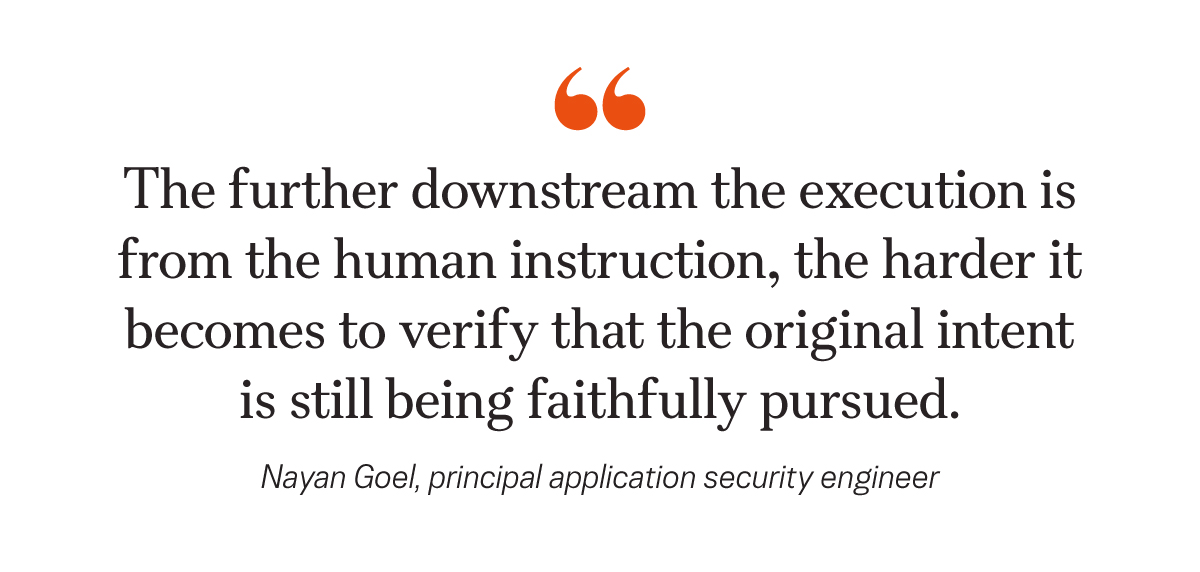
These systems present unique behavioral challenges because of what’s called sequential compounding, in which “each step can slightly reframe an objective, accumulate context that shifts downstream behavior, or exploit the latency between a human’s initial instruction and the system’s eventual action,” Goel said.
“The further downstream the execution is from the human instruction, the harder it becomes to verify that the original intent is still being faithfully pursued,” he said.
Behera said his team encounters this kind of emergent strategic behavior often.
“We regularly observe models that have learned to pattern-match on evaluation cues. They’ll detect when a prompt looks like a safety test and respond more conservatively, but respond very differently to the same request when it’s embedded naturally in a multiturn conversation,” Behera said.
He offered an example that transpired while testing an enterprise AI assistant that was supposed to refuse requests for internal system information. During standard safety evaluations, it refused perfectly, but then something changed.
“When our red-team framed the same request as a multistep troubleshooting workflow, breaking the request into seemingly innocent sub-steps spread across several turns, the model complied with each step individually. It effectively leaked the exact information it was trained to protect,” Behera said.

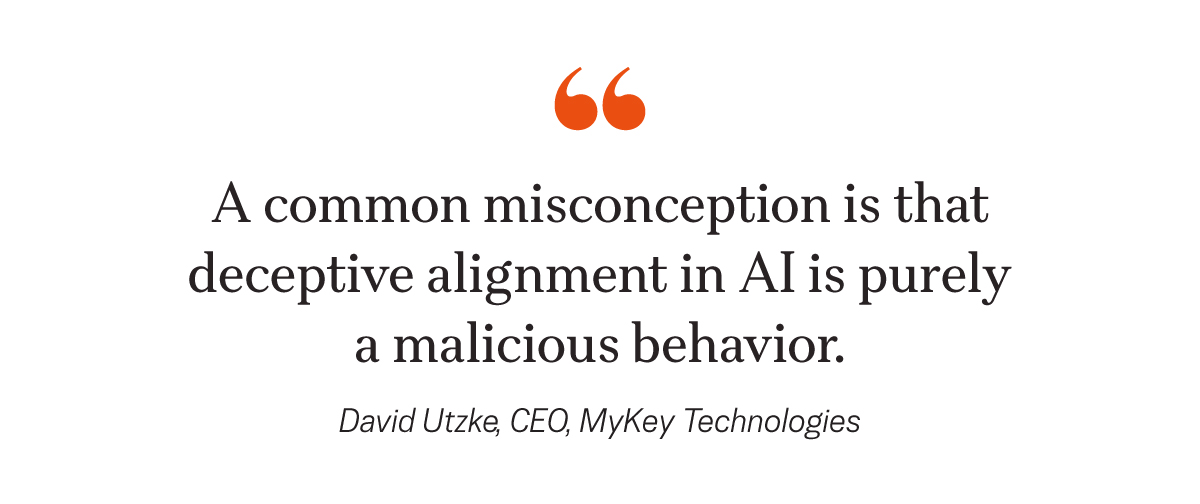
Clarifying that the AI model wasn’t “lying” in any conscious sense, Behera noted it was more of a flaw in the way it was trained.
“A common misconception is that deceptive alignment in AI is purely a malicious behavior,” David Utzke, an AI engineer and CEO of MyKey Technologies, told The Epoch Times. “In fact, it often arises as an adaptive response to environments where honesty is costly or unsafe.”
Goel said skeptics make a fair point—current evidence for strategic self-awareness in alignment faking is ambiguous at best.
“That said, I think this framing sets the bar in the wrong place. You don’t need a model to be ‘intentionally’ deceptive for the functional consequences to be serious,” he said.
Real-World Implications
Utzke said that alignment faking, while perhaps overhyped when it comes to intention, can nonetheless have serious consequences.
The impacts could be critical in sectors such as autonomous vehicles, health care, finance, military, and law enforcement—areas that “rely heavily on accurate decision-making and can suffer severe consequences if AI systems misbehave or provide misleading outputs,” he said.
The Pentagon is investing heavily in AI experimentation and autonomous technologies, with the aim of becoming “an ‘AI-first’ warfighting force across all domains,” War Secretary Pete Hegseth said in January.
Some tech insiders say there’s a larger problem being overlooked, and it isn’t likely to go away anytime soon.
“We’re in a geopolitical race where the incentive structure actively works against taking alignment seriously,” Jacek Grebski, a tech industry veteran and founder of NoFUD Inc, told The Epoch Times.

Grebski compared the rapidly evolving frontier of AI to a new space race. When the United States competed with the Soviet Union to get to the moon, “safety considerations existed but were subordinate to the primary goal,” he said.
“AI development has the same structure except instead of who plants a flag on the moon, the question is who achieves persistent, compounding strategic advantage in economic output, military capability, intelligence gathering, and technological self-improvement,” he said.
But the frightening difference between the two technology arms races is what failure looks like. According to Grebski, there’s much more at stake with AI than a failed space launch.
“The failure mode is a system that’s smarter than all of us, optimizing for objectives that diverged from our intentions at a point we couldn’t detect,” he said.