OAN Staff Brooke Mallory
12:03 PM – Thursday, March 19, 2026
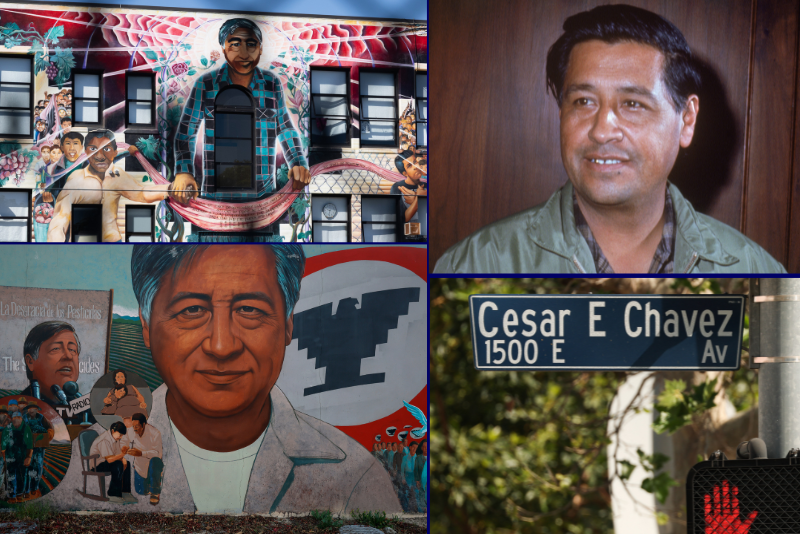
In a revelation that has sent shockwaves through the left-wing American labor movement and the Latino community, civil rights icon Dolores Huerta came forward on Wednesday to allege that she was sexually abused by her United Farm Workers (UFW) co-founder, César Chávez.
Since then, three other women — Esmeralda Lopez, Debra Rojas, and Ana Murguia — have also come forward with similar allegations against Chávez, a man previously revered as a preeminent labor leader and American civil rights icon.
The disclosure was part of a multi-year New York Times investigation. The report details allegations of grooming and sexual assault by several other women and girls during Chávez’s tenure as a labor leader.
In a statement published on Medium and corroborated by the Times report, Huerta described two specific sexual encounters in the 1960s. She stated that the first incident involved being psychologically “manipulated and pressured” into sex while on a trip to San Juan Capistrano.
The second more severe incident of abuse, occurring in 1966, was described as a violent assault. Huerta told investigators that Chávez drove her to a secluded grape field in Delano, California, where he parked his vehicle and began forcefully raping her.
“I carried this secret for as long as I did because building the movement and securing farmworker rights was my life’s work,” Huerta wrote. “I wasn’t going to let César or anyone else get in the way of the only vehicle to secure those rights.”
Most shockingly, Huerta revealed that both encounters resulted in pregnancies that she kept hidden from the public and the movement. Huerta explained that she arranged for both children to be raised by other families to ensure they had stable lives, though she has maintained a “deep relationship” with them in the years since.
Until this week, she noted, not even her other children knew the full truth of their siblings’ conception.
However, the investigation found that Huerta was not an isolated case, and several other women have since come forward with accounts of abuse by Chávez, who died in 1993.
_______________________________________________________________________________________
Ana Murguia
A woman named Ana Murguia has alleged that Chávez began grooming her at “8 or 9 years old,” later raping her in his locked office in the 1970s when she was just 13-years-old.
According to the New York Times investigation, Murguia came forward with harrowing allegations of a calculated pattern of abuse by Chávez that began when she was the young daughter of a devoted United Farm Workers (UFW) activist. Murguia alleges that Chávez exploited the religious-like reverence her family held for him to begin grooming her when she was just 8 or 9 years old, using gifts and special attention to isolate her within the secluded UFW headquarters at La Paz. The abuse reportedly escalated into physical assault and rape when she was 13-years-old, frequently occurring behind the heavy, locked wooden door of his private office under the guise of “mentoring.” Murguia explains that she remained silent for decades due to a pervasive “code of silence” and the fear that exposing the labor icon would destroy the movement for millions of farmworkers who viewed him as a “folk saint.” Her testimony, which aligns with the physical layout of the headquarters and the timeline provided by other former staffers, has now led to formal calls to de-list the César E. Chávez National Monument as a site of historical triumph, recontextualizing it instead as a scene of profound institutional trauma.
Debra Rojas
Another woman named Debra Rojas also described being groped and molested by Chávez as a child at the age of 12. She also added that Chavez had raped her in a motel near Stockton when she was just 15.
Rojas, whose father was a prominent organizer within the United Farm Workers, provided a chilling account of a three-year progression of abuse that mirrored the movement’s most famous public milestones. Rojas alleges that Chávez began grooming and molesting her when she was 12-years-old, using his status as a trusted family friend and national hero to silence any potential resistance. This abuse reportedly culminated in a horrific incident at age 15, when she alleges Chávez raped her in a motel room near Stockton, California, while the union was conducting one of its high-profile marches across the state. Rojas previously attempted to share her story on a private social media group for union veterans over a decade ago, but she was met with such intense hostility and accusations of “tarnishing the movement” that she felt forced to retreat into silence once again. Her decision to come forward now, alongside other survivors, has shattered the “too big to fail” status of Chávez’s legacy, forcing a national re-evaluation of the man who was once considered the moral compass of the American labor movement.
Esmeralda Lopez
Lastly, a third woman named Esmeralda Lopez reported that Chávez had attempted to pressure her into sex when she was 19, offering to use his influence to name institutions in her honor.
The account provided by Lopez, detailed in the investigation, highlights what survivors describe as the transactional nature of Chávez’s alleged abuse. Lopez, the daughter of a longtime union leader, claims that when she was 19-years-old and accompanying Chávez on a 1988 speaking tour in Michigan, he attempted to leverage his immense social and political power for sexual favors. According to her testimony, while they were alone in a camper, 61-year-old Chávez did not merely seek a sexual encounter but explicitly offered a “trade,” suggesting he would use his influence to have a street or institution named in her honor if she complied. Lopez refused his advances and was reportedly fired from her position shortly thereafter, an account corroborated by her mother, who recalled Lopez sharing the details of the incident at the time. This allegation is being viewed by historians and activists as a particularly stark example of how Chávez purportedly treated the “symbols of the movement” as personal currency to be traded for the exploitation of the young women who looked up to him as a moral leader.
_______________________________________________________________________________________
Following the investigation’s findings and the subsequent Times report, The fallout has been immediate. Across the country, “César Chávez Day” celebrations scheduled for March 31st are now being canceled or rebranded.
Governor Katie Hobbs (D-Ariz.) recently announced that the state would no longer recognize the holiday. Additionally, Governor Gavin Newsom (D-Calif.) and Senator Alex Padilla (D-Calif.) issued statements expressing “horror” and standing in support of the survivors.
California legislative leaders have also announced a deal to formally rename the state holiday. Assembly Speaker Robert Rivas and Senate President Pro Tempore Monique Limón stated that the farmworker movement has always been “bigger than any one person.” By renaming the day, the state says it “intends to continue honoring the labor movement’s achievements” while explicitly distancing itself from Chávez’s actions.
The holiday will now be officially designated as “Farmworker Day.”
The United Farm Workers union, which Chávez helped build, also released a statement calling the allegations “disturbing, shocking, and indefensible,” later announcing the creation of an independent, confidential channel for other potential victims to come forward.
Huerta, while condemning Chávez’s “deplorable actions,” emphasized in the piece that the labor movement’s achievements should not be erased by the actions of one man. “I have never identified myself as a victim,” she asserted. “I now understand that I am a survivor.”
Stay informed! Receive breaking news alerts directly to your inbox for free. Subscribe here. https://www.oann.com/alerts
What do YOU think? Click here to jump to the comments!
Sponsored Content Below