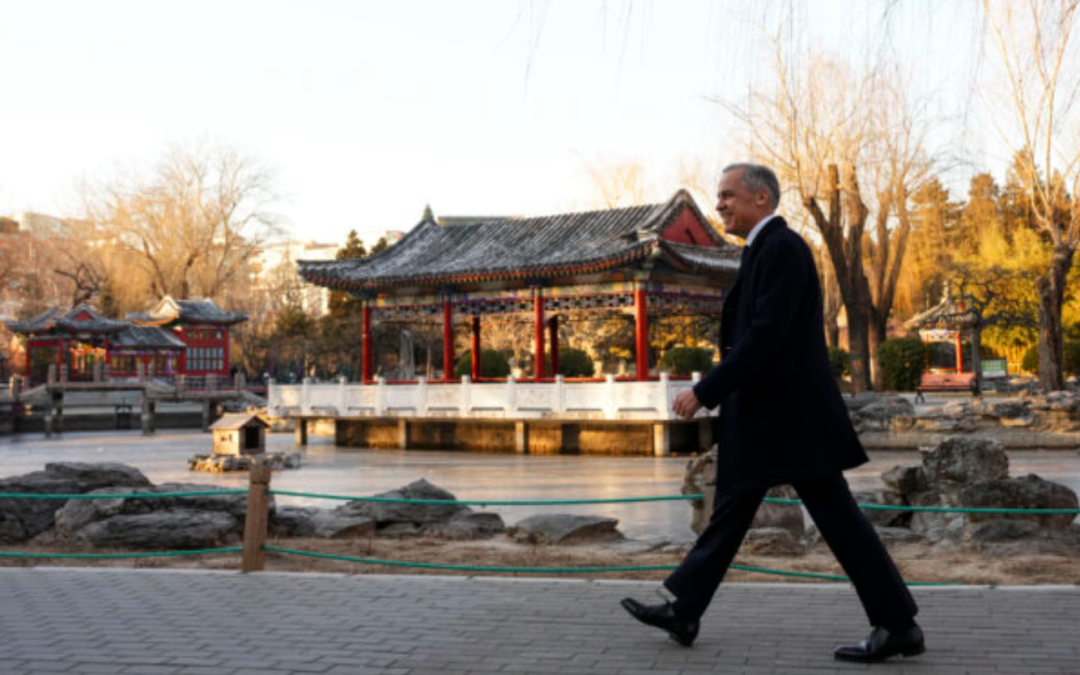
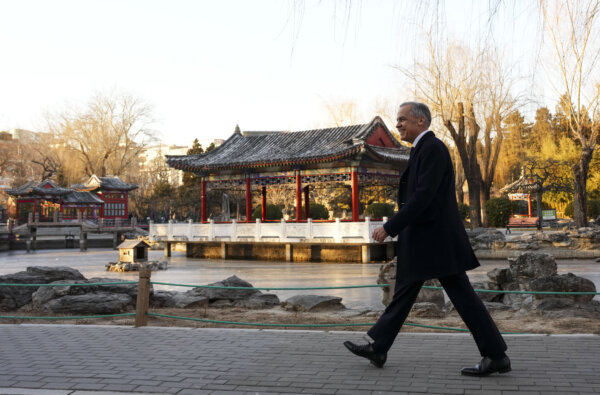
Carney unveiled a provisional commercial pact that allows the import of 49,000 Chinese electric vehicles (EVs) at a most-favored-nation rate of 6.1 percent in exchange for Beijing slashing its tariffs on Canadian canola from nearly 85 percent to roughly 15 percent by March “until at least the end of this year,” according to Carney’s office.
The two sides further discussed boosting bilateral investment in energy, technology, agri-food, and wood products.
‘Not Afraid to Discipline’
Stephen Nagy, a professor at the Department of Politics and International Studies at International Christian University in Japan, warned that while reduced tariffs and new investment offers might provide Canada with short-term economic relief, the deal gives Beijing the power to suddenly cut off those benefits whenever political relations turn sour.
“China’s market access is politically contingent, meaning benefits can be withdrawn rapidly if relations deteriorate. Chinese EVs and clean‑energy investment also raise concerns about subsidized competition, technology transfer, and long‑term strategic dependence,“ Nagy told The Epoch Times.
Nagy said that if Ottawa lacks strict safeguards, this diversification risks becoming a new form of vulnerability.
“I worry about China doing what it does best, oscillating between Confucian benevolence and its hardcore realist bones that are not afraid to discipline counterparts,” he said.
Echoing Nagy’s concern, Tony Liu Tai-ting, an assistant professor at the Graduate Institute of International Politics at Taiwan’s National Chung Hsing University, cautioned that the temporary economic windfall of bilateral cooperation hides serious risks to Canada’s security.
“If Ottawa prioritizes job creation and economic stimulus by welcoming Chinese EV production, it invites data security issues that will only intensify if cooperation expands into other sensitive technologies,” Liu told The Epoch Times.
Liu added that by the time Ottawa realizes it is politically at odds with Beijing, its economic dependence may leave it with little room to maneuver.
Canada–Taiwan Relations
Just ahead of Carney’s trip to China, two Canadian members of Parliament from the governing Liberal Party abruptly cut short their trip to Taiwan, a self-governed democracy that Beijing has not ruled out annexing by force.
When asked about the abrupt departure, a constituency manager forwarded a joint statement explaining that the lawmakers were advised by the government to return home to “avoid confusion” given the overlap with the prime minister’s engagement in Beijing.
Simon Chen Shih-min, an associate professor at the Department of Political Science at National Taiwan University, characterized the incident as a “political misstep” by Ottawa that allowed Beijing to leverage the visit, though he noted it does not necessarily signal a fundamental shift in Canada’s stance on Taiwan.
“We cannot deny that this was a concession to Chinese political pressure, yet the Liberal Party of Canada still values democracy, and I believe Carney understands the authoritarian threat Taiwan faces and will not reduce his support for us,” Chen told The Epoch Times.
Offering a starker perspective, Liu, who has tracked Canada–Taiwan relations for years, warned that as economic ties with Beijing tighten, Ottawa will likely impose stricter self-imposed limits on its engagement with Taipei.
“While the government only encouraged MPs to return early this time, I fear they will soon advise against any interaction with Taiwanese officials, likely silencing parliamentary discussions on initiatives like a Canadian version of the Taiwan Relations Act,” Liu said.
Liu further noted that while Canada has historically used forums such as the G7 and the World Health Organization to advocate for Taiwan’s international participation, such vocal support may diminish as Ottawa potentially exercises greater self-censorship.
Discord and Infiltration
Amid the visit, the Chinese state-controlled media outlet Global Times published a report on Jan. 14 claiming Canada’s engagement reflects anxiety over “U.S. unilateralism,” a narrative widely interpreted as an attempt to drive a wedge between Ottawa and Washington.
Chen dismissed such claims, arguing that Beijing’s divisive tactics are unlikely to succeed given that Canada’s top priority remains its steadfast alliance with the United States.
“Basically, the Carney administration only hopes to strengthen economic interactions with China, but on political or security matters, Canada will stand firmly with the U.S. and the West to defend democratic and free values,” Chen said.
In a similar vein, Nagy viewed Canada’s security, intelligence, and economic integration with the U.S. as “deep and structural,” while Beijing’s alignment with Russia, North Korea, and Iran clearly undermines its claim to be a “stabilizing force.”
“As a result, China’s influence will remain limited and transactional rather than transformative. We should watch out for wedge issues moving forward and how the U.S. will respond,” Nagy said.
Still, Chen predicted that Beijing will likely resort to its usual underhanded schemes to erode Canada’s democratic institutions from within.
“Beijing may exploit the Chinese diaspora to infiltrate Canadian society or even attempt to buy off MPs to influence foreign policy, a pattern of interference seen across the West that requires high vigilance as China will not easily abandon these methods,” Chen said.