
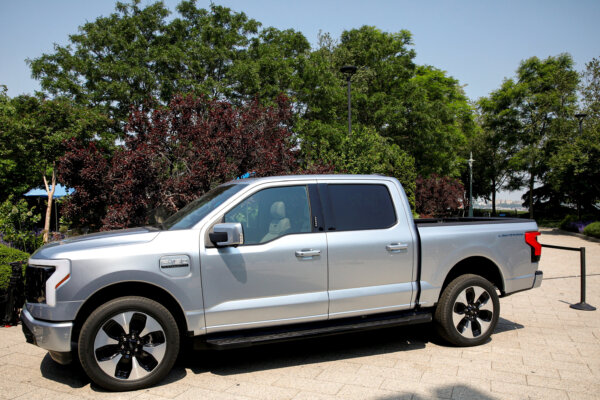
 Ford Motor Co. revealed Monday that it would take a $19.5 billion writedown after choosing to discontinue several electric vehicle models.
The Michigan-based company intends to replace its all-electric F-150 Lightning pickups with an extended-range version that uses a gasoline engine for battery recharging. Ford is also stopping production on a forthcoming electric truck, called T3 in international markets, along with electric vans designed for commercial use.
“When the market really changed over the last couple of months, that was really the impetus for us to make the call,” Ford CEO Jim Farley told Reuters in an interview.
Ford intends to focus on gasoline and hybrid options, anticipating adding thousands of employees over time, though some positions will be eliminated in the short term at a Kentucky battery facility of which it is a co-owner. The company foresees hybrids, extended-range electrics, and full EVs as comprising half of its worldwide sales by 2030, up from 17 percent at present.
The charges will be distributed mostly over the fourth quarter, extending into the next year and 2027, according to Ford. Approximately $8.5 billion comes from stopping planned EV projects, $6 billion from exiting a battery partnership with South Korea’s SK On, and $5 billion for related program costs.
Ford also increased its 2025 forecast for adjusted pretax earnings to about $7 billion, from a prior conjecture of $6 billion to $6.5 billion.
U.S. electric vehicle purchases fell about 40 percent in November after the Sept. 30 end of a longstanding $7,500 buyer tax credit aimed at boosting demand. Trump’s team also stopped penalties for fuel-efficiency violations in a July tax and spending package known as the One Big Beautiful Bill Act.
The F-150 Lightning first hit the market in 2022 with the help of some promotion by comedian Jimmy Fallon. Ford prepared for 200,000 initial reservations, but demand did not meet expectations. As of November, sales were at 25,583 units, down 10 percent year-over-year.
The T3, meant as the Lightning’s successor, was due to be built at a new Tennessee site as a key second-wave EV. Ford now plans to produce gasoline trucks at the facility starting in 2029.
Monday’s change in strategy essentially means Ford will not produce second-generation EVs.
“Rather than spending billions more on large EVs that now have no path to profitability, we are allocating that money into higher-returning areas,” said Andrew Frick, head of Ford’s gas and electric-vehicle operations. Ford anticipates about $5 billion in EV losses this year, same as last year’s number.