Submitted by Thomas Kolbe
Friedrich Merz finally has a positive headline. In December, industrial orders surged. But behind the costly statistical recovery lies nothing more than the buildup of a debt-financed defense sector.
It took some lead time, but the Chancellor now finally has a success story. For December 2025, Germany’s Federal Statistics Office reported a 7.6% month-on-month jump in industrial orders. November had already provided a first boost with a rise of over 5%—right in the midst of a severe economic crisis.
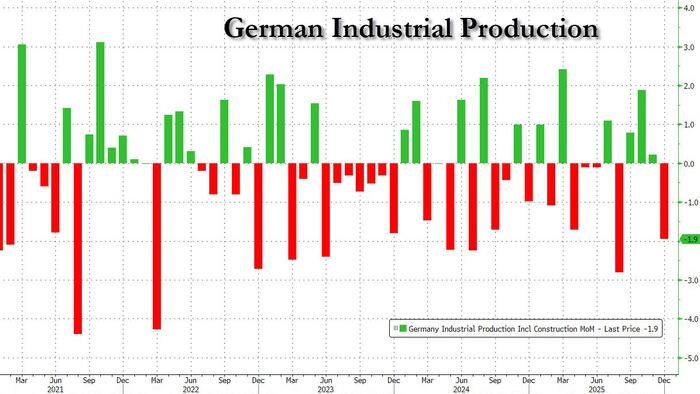
Industrial production, meanwhile, fell 1.9% in December, sliding back into negative territory—a fact largely lost in the media’s cheerleading. That the once-proud German automotive industry saw a 6.3% drop in orders also barely registered amid the general sigh of relief.
But once you dissect the data and strip out large orders, a very different picture emerges. The apparent surge in orders shrinks to a mere 0.9%.
What happened? Experience shows that this comes from “Other Vehicle Manufacturing,” which jumped roughly 9.5%. This category is dominated by defense equipment. In short: the federal government’s debt-financed special fund has found its way into German military production.
Or put differently: the government can now take a public victory lap after plunging citizens into massive debt to generate a short-term statistical effect in the super-election year 2026. Nobody wants to appear a total failure.
What is celebrated as an economic turnaround is in reality a statistical masking of the transition from market-based order to a debt-fueled administrative economy.
The military buildup is basically the last gasp of a policy that, in stubborn Keynesian mode, keeps trying to replace the gaps in Germany’s industrial economy with a “managed economy.” This strategy ties up resources and personnel, diverting exactly the capital needed for real investment under better conditions.
Goods are produced that no one demands on the market. A few pockets get richer. It’s classic client politics in the Berlin–Brussels style. Nothing new in the West, really.
The Real Situation
The real state of the German economy is shown in construction. The HCOB Germany Construction PMI, a monthly leading indicator, fell in January to 44.7 points. Values below 50 signal contraction.
After a brief uptick in December to 50.3, mostly due to energy network investments, the German construction sector plunged back into recession in January—mirroring the entire Eurozone.
For four years now, this central economic sector has been essentially frozen. Investments are held back; new projects, especially commercial ones, are nowhere to be found. The sector remains in prolonged stagnation.
Excessive energy costs, Kafkaesque regulation from Brussels and Berlin, and stifling interventions like rent caps are the recipe for a recession set in stone.
Expect billion-euro programs for subsidized public housing soon, purely to create a statistical illusion of recovery.
System-Compatible Criticism
The federal government can finally breathe. Expensive for taxpayers, but apparently worth it politically. Applying Keynesianism to the defense industry is among the dumbest of political moves. Driving a nation deeper into debt to produce goods that either rust or are used destructively is maximal political nihilism—bordering on madness.
The fact that the state-friendly media celebrates this “recovery” implies two things: complete media submission to government goals, and statistical validation to continue reshaping German society into a green, militarized command economy.
Silence from German business leadership confirms that politics has morally inoculated this strategy. The perpetuated narrative of an imminent Russian invasion now legitimizes the defense buildup.
Similarly, under the Green Deal, years of effort have embedded the fairy tale of saving the world via CO₂ reduction deep in public consciousness, with most voters still supporting the course. Criticism now appears climate-hostile, irresponsible, and anti-scientific.
Compliance is no longer enforced through coercion, but through reshaping business rationality. Every new regulation or CO₂ levy creates companies that survive only within the state’s subsidy architecture.
Result: media-friendly, calibrated language dominates discussions of “bureaucracy relief.” It is system-compatible fine-tuning, subtly orchestrated by Brussels. No one risks reputational loss in this highly repressive media environment.
Business has learned to couch criticism to avoid upsetting the Kaiser while remaining eligible for support. We see conditioned obsequiousness leading us steadily toward a new socialism.
* * *
About the author: Thomas Kolbe, a German graduate economist, has worked for over 25 years as a journalist and media producer for clients from various industries and business associations. As a publicist, he focuses on economic processes and observes geopolitical events from the perspective of the capital markets. His publications follow a philosophy that focuses on the individual and their right to self-determination.
Loading recommendations…