
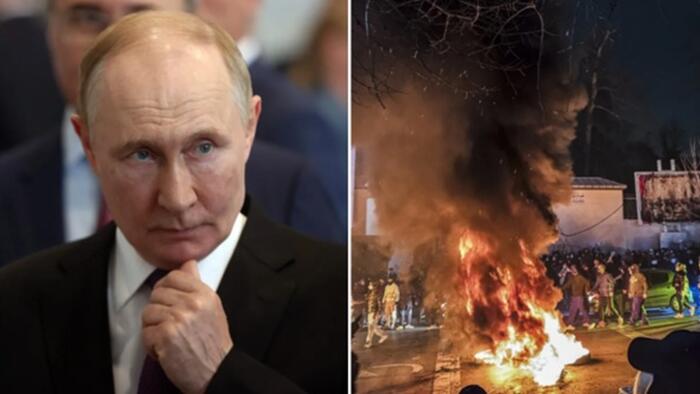
There may have been some back-channel dealmaking and a ‘mutual understanding’ reached between Iran and Israel far behind the scenes as protests unfolded on Iran’s streets, and as President Trump began to make threats about striking Tehran.
At a moment Trump seems to have climbed down (at least for now) from the threatened drive to intervene militarily, The Washington Post has issued a Wednesday report saying Israel and Iran have been in indirect diplomatic contact via Russia as a mediator.
“Days before protests erupted in Iran in late December, Israeli officials notified the Iranian leadership via Russia that they would not launch strikes against Iran if Israel were not attacked first,” WaPo writes. “Iran responded through the Russian channel that it would also refrain from a preemptive attack, diplomats and regional officials with knowledge of the exchange said.”
Could this be because of the Iranian missiles that rained down on Tel Aviv back in June? If so, it seems the Islamic Republic has finally established deterrence.
The timeline of what was communicated when remains unclear. But this backchannel had already been revealed in Middle East media reports, for example in the following prior reporting:
Israel and Iran have recently exchanged secret, indirect messages through Russia in the midst of heightened regional tensions, according to a new report by Amwaj.media today. The exchanges were described as an effort to prevent further military escalation rather than to establish any form of ceasefire or diplomatic framework.
According to the report, the messages were conveyed through Russian President Vladimir Putin after Israel sought to pass along a signal that it was not interested in escalating military conflict at this stage. Iranian officials acknowledged the message but emphasized that their reply carried no commitment, no coordination, and no obligation on Iran’s part. An Iranian political source quoted in the report said bluntly that “there is no commitment, no coordination, and no ceasefire agreement.” The source emphasized that the contact should not be interpreted as a step toward broader understandings between the two countries, which remain bitter adversaries with no direct diplomatic ties.
The exchanges were reportedly limited in scope and intent. No guarantees were offered, no timelines were discussed, and no monitoring or enforcement mechanisms were established. One source described the communication as “a mutual announcement to a mutual friend on no new strikes,” meaning that the goal was simply to manage tensions at a specific moment rather than to lock in any lasting arrangement.
A senior Iranian political source confirmed that indirect communication with Israel had indeed taken place, identifying Russia, and specifically Putin, as the intermediary. The source reiterated that there was “no ceasefire agreement” and that the messages amounted only to parallel notifications of intent, rather than a shared understanding or deal.
The report says the Iranian side of the exchanges was handled not by the foreign ministry but by Ali Larijani, secretary of Iran’s Supreme National Security Council.
It’s possible that this served as important background to Trump’s apparent decision to not strike Iran at this point. Israel is usually the country yelling loudest to hit Iran, but this time the Netanyahu government was somewhat muted.
Sorry to be a hater, but this is not “breaking news”. It was reported over two weeks ago: https://t.co/SjEJKtgAT6 https://t.co/jDExKOZVND
— Mohammad Ali Shabani (@mashabani) January 14, 2026
By all accounts, Iran’s streets have pretty much gone quiet by now, after a crescendo of violence this week left hundreds dead, including many police and security personnel.
Loading recommendations…