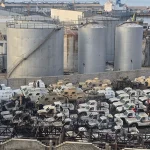
 A plume of smoke rises after a strike on the Iranian capital Tehran, on March 3, 2026. The United States and Israel launched strikes against Iran on Feb. 28, with the killing of Iran’s supreme leader and the Islamic republic retaliated with barrages of missiles at Gulf states and Israel. Atta Kenare/AFP via Getty Images
As the United States and Israel continue their attacks against the Iranian regime—decapitating its leadership and destroying its nuclear and missile ambitions—what remains of the Iranian leadership must be wondering why China hasn’t come to their aid.
Where’s the Value of China’s ‘Strategic Partnership’?
But how well is being a “comprehensive strategic partner” of China serving Iran and Venezuela now?
So far, in light of U.S. military action going unchallenged by Beijing, the answer is “not well.”
2026: A Year of the US Confronting Extremists
The Trump 2.0 presidency has been defined by an aggressive foreign policy, both in the Western Hemisphere and in the Middle East.
U.S. President Donald Trump began this year by first warning then-Venezuelan dictator Nicolás Maduro to cease his drug smuggling into the United States. Then U.S. forces attacked Venezuelan drug boats, but the smuggling activity continued. Trump then acted upon his threat to come after Maduro and removed him from Venezuela.
U.S. threats and actions against Venezuela, and the subsequent capture of Maduro, should have been a clear message of Trump’s new policies. So, too, should have the U.S. attack on Iran’s nuclear facilities at Fordow, Natanz, and Isfahan in June 2025. Both events should have served as a clear warning about the administration’s intentions.
A similar narrative continued throughout Washington’s appeals to Tehran. Prior to launching the war, Trump warned Tehran to abandon its nuclear and long-range missile programs and to stop attacking Israel via missile launches and its many proxies in the region. The administration has also been adamant that Tehran cease its processing of weapons-grade nuclear materials.
Beijing’s Delicate Balancing Act
In practical terms, Beijing’s relatively mild reactions to the U.S. actions in Venezuela and Tehran are understandable. Yes, Tehran is a strategic partner, but Beijing has deeper economic relationships with other Gulf states. For example, in 2024, China’s trade with Iran was about $13 billion. In comparison, trade with Saudi Arabia exceeded $107 billion, trade with the United Arab Emirates was more than $100 billion, and trade with Qatar was about $24 billion.

What’s more, Tehran didn’t help its case with Beijing when it fired missiles at those same Gulf allies. Clearly, Beijing’s decision to sit back and defer action against the United States is carefully considered.
But that decision comes with consequences. For instance, China’s reputation in the world is less than it was before the war. The reasoning for that is simple but powerful. China’s minimal-to-non-response to the United States and its relatively low level of assistance to Tehran have revealed that Beijing is a strategic partner to no one but itself.
Put another way, China’s relationship with its “allies” isn’t driven by ideological alignment as much as it is by economic interests. Beijing’s partnerships with Caracas and Tehran have been shown to be mainly transactional in nature.
Brazil Doubles Down on China–and the US
Like other regions, political alliances in Latin America are complex. Brazil is China’s most important ally in the Americas and a strategic partner. With more than $171 billion in trade in 2025, including record levels of oil shipments, Brazil is a key partner in Beijing’s long-term Latin America economic strategy. And of course, Brazil participates actively in BRICS initiatives to reduce dollar dependence and is a major critic of U.S. Latin America policy.
Asia Reassess Beijing’s Ability to Lead
The war in Iran has exposed a weakness that Beijing has spent years concealing. Despite massive economic investments and deep political ties, when its allies come under fire, China is unable or unwilling to come to their aid. For Asia’s major powers, that failure is a fact they cannot ignore.
The prevailing sentiment echoing across social media is that China is perfectly willing to reap economic benefits through resource extraction and debt-trap diplomacy but is unwilling or unable to project hard power to defend its allies.
The consequences are already rippling across the region. East Asian powers import roughly 60 percent of their oil from the Middle East, and risks to global energy supply chains are rising significantly as the war escalates. India, which had deepened ties with Beijing through BRICS and the Shanghai Cooperation Organization, is now navigating the crisis largely through its U.S. partnership, deploying naval destroyers to protect its own tankers in the Arabian Sea.
Japan is accelerating missile defense upgrades, including new advanced surface combatants designed to rival China’s principal warships and improve its capacity to combat Chinese military dominance in the Western Pacific.
Beijing’s Real Priorities
The upshot is that even though China may have the world’s second-largest defense budget, Beijing’s immediate security priorities are focused on its objectives within Asia and, therefore, are much closer to home. They consist mainly of “reunification” with Taiwan, winning its border dispute with India, and exercising uncontested influence throughout the East and South China seas.
At this point, it seems unlikely that Beijing would be willing to engage the United States militarily if it thinks it can win in the long run.