OAN Staff Brooke Mallory
7:50 PM – Friday, March 6, 2026
The aging “pillars” of the Democrat establishment descended upon the “House of Hope” on Friday to bid farewell to the Rev. Jesse Jackson Sr., turning a “Celebration of Hope” into a high-profile reunion of political figures who have defined the party for the last thirty years.
However, the former politicians frequently appeared to center their remarks on themselves and their own experiences rather than keeping the focus on civil rights leader Jesse Jackson, who died on February 17th at age 84.
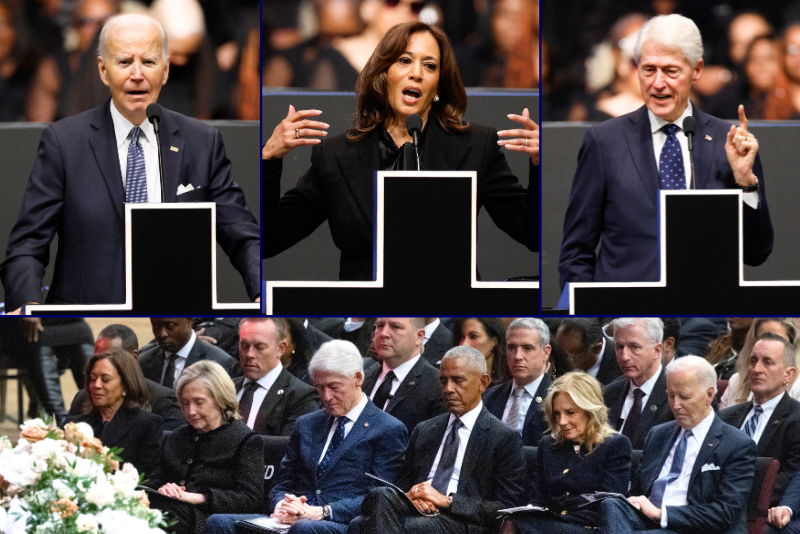
Former Presidents Barack Obama, Bill Clinton, and Joe Biden — accompanied by former Vice President Kamala Harris — took center stage at the arena. Notably absent from the row of former first ladies was Michelle Obama, whose seat remained empty while Hillary Clinton and Jill Biden flanked their husbands in the front row.
Location
The nicknamed “House of Hope” is a massive 10,000-seat megachurch and arena located on Chicago’s Far South Side. While it serves as the sanctuary for Salem Baptist Church of Chicago, it was built from the ground up to function as a full-scale arena.
Departing from the architecture of a traditional church, the venue swaps wooden pews for 10,000 stadium-style seats tiered in a dramatic “bowl” configuration that centers every eye on the massive stage. The sanctuary boasts full-scale broadcast facilities for global reach and an expansive footprint that includes three regulation-size basketball courts.
Barack Obama
While the service was billed as a “homegoing” for the deceased civil rights figure, the rhetoric often veered into current politics, with Obama delivering a eulogy that struck a notably pessimistic tone.
“We are living in a time when it can be hard to hope,” Obama told the crowd, lamenting what he suggested was daily assaults on “democratic institutions” and “common decency.” While he also credited Jackson with “paving the path” for his own presidency, Obama’s remarks served as an obvious critique of the current administration under Donald Trump.
Obama also used a familiar refrain, describing himself as the “22-year-old child of a single mother with a funny name.” Since he has used similar phrasing in numerous speeches since 2004, some commentators on social media joked that he was “playing the hits” a bit too hard. Online users expressed that it felt a little “scripted” for such a personal occasion.
There was also a fair amount of gossip regarding the fact that Michelle Obama did not attend the service with him, which has become a more common occurrence ever since Biden left office.
Nonetheless, political commentators argued that Barack was still seen as one of the only “adults” in the room in comparison to his former president colleagues.
Joe Biden
Biden, now a former president himself, sat alongside Harris, whose political future remains a subject of speculation following the 2024 election.
Biden began his speech by looking at a clock on the podium and quipping, “I think that clock is broken. I’ll try to keep this under two minutes.” Nonetheless, Biden ended up speaking for approximately 22 minutes.
Biden referenced his own lifelong struggle with a stutter.
He noted, “If I told you all earlier, when I was a kid, I had a cleft palate or club foot, none of you would have laughed, but it’s okay to laugh at stuttering.” This was seen as a callback to how he has been mocked throughout his political tenure.
“It’s the one place where people think you’re stupid. Oh, really? I’m a hell of a lot smarter than most of you,” Biden declared, prompting uncomfortable chuckles in the crowd.
Furthermore, since Biden was speaking at a televised funeral at the time, critics felt the “smarter than you” remark came off as defensive and arrogant rather than illustrative of his point about disabilities.
While discussing global demographics and Jackson’s international influence, Biden became much more animated, telling the crowd to “Watch, man, watch” as he predicted Africa would be the most populous continent by 2050.
Black Americans and others on social media highlighted how awkward the moment felt, noting that Biden appeared to scan the room for people of color (POC) while delivering the line, which only amplified the discomfort for many viewers.
As Biden attempted to recount the legislative milestones of the 1960s and 70s, his delivery accelerated significantly, causing the names of former senators to blur together into an indiscernible slur. This cadence produced a strained, “gargling” vocal quality, making it sound as though he were struggling to clear his throat or navigate a mouthful of water while speaking.
Notably, cameramen also cut away from the crowd at one point during Biden’s speech, prompting speculation that the move may have been intended to avoid showing any audience reactions, including possible laughter or mockery of the former president. What made it even more obvious was that as soon as the next speaker took the stage, the camera angle pointed back up to the crowd.
Kamala Harris
Similar to Obama, Harris began her remarks with a comment about the current political climate under the Trump administration that many found either jarring or tacky.
“I’m not into saying ‘I told you so,’ but we did see it coming. What I did not predict is that we would not have Jesse Jackson with us right now to help us get through this,” Harris said.
This “I told you so” framing was later criticized for being too self-referential. Detractors argued that instead of centering the eulogy on Jackson’s life, she made the opening about her own loss in the 2024 election.
At another point, Kamala also shared stories of her own collection of Jackson’s 1980s campaign memorabilia, attempting to link her own trajectory to the Rainbow Coalition Jackson founded decades ago.
Critics on social media mocked this as coming off both “cringey” and “performative,” suggesting she was trying too hard to “claim” Jackson’s legacy as her own. The nickname “Kooky Kamala” began trending online among detractors who felt her delivery — which included several of her trademark mid-sentence laughs — was tonally mismatched for a funeral.
Bill Clinton
Bill Clinton’s appearance at the memorial was much more subdued than Biden’s or Harris’s, but in true “Bubba” fashion, his peculiar moments were mostly centered on his personal reputation and the long, complicated history he shares with those in the room.
Just days before the funeral, Governor JB Pritzker (D-Ill.), who was also a speaker, had to answer questions from the media regarding Clinton naming him in newly unsealed Epstein-related depositions.
When Clinton took the stage right after Pritzker, the “vibe” in the room — and certainly on the live stream — was described by some commentators as incredibly tense. Seeing them share a stage while those headlines were fresh made for a very uncomfortable visual.
Clinton’s speech was notably short and humble, which some felt was a tactical move to stay under the radar.
“I’m here more as a friend than a former president… He was my friend when I needed him,” Clinton said of the late Jackson.
While it sounded sentimental, critics of the 1990s-era “New Democrats” pointed out that Clinton and Jackson had a notoriously rocky relationship, most notably during the 1992 campaign. Some felt Clinton’s attempt to paint them as “best friends” was a bit of a historical rewrite to soften his own image.
The relationship between Clinton and Jackson was a decades-long “frenemy” saga defined by a constant struggle for the soul of the Democrat Party.
It reached a breaking point during the 1992 campaign with the famous “Sister Souljah moment,” where Clinton used a speech at a Rainbow Coalition event to criticize the rapper — a move Jackson blasted as a cynical ploy to appeal to moderate White voters by “playing the race card.”
For years, the two clashed as Clinton’s centrist “New Democrat” platform stood in direct opposition to Jackson’s unapologetically progressive grassroots activism. Ironically, the rift reportedly only healed during the Monica Lewinsky scandal, when Jackson stepped up as Clinton’s spiritual advisor and public defender during impeachment.
By the time of the funeral today, the rockiness had smoothed into mutual respect, though the imagery of Clinton eulogizing Jackson still carries the weight of their complicated history of betrayal and redemption.
Attendance
The scene at the House of Hope served as a testament to Jackson’s legacy. Despite the biting Chicago winds, thousands of mourners began forming lines hours before the doors opened at 9:00 AM in the morning, stretching for blocks around the 10,000-seat arena.
The atmosphere in the queue was described as both somber and celebratory. Large television screens were positioned along the sidewalks, playing loops of Jackson’s most iconic speeches to keep the “spirit of the movement” alive for those waiting.
According to many who waited in line, speaking to the media, the hours-long wait was just a small price to pay to honor a man who spent over sixty years on the front lines of civil rights. Attendees ranged from elderly activists who marched with him in the 1960s to young students inspired by his mantras.
An estimated 10,000 people attended.
Other Speakers
Analysts say that the inclusion of Rev. Al Sharpton, Governor J.B. Pritzker (D-Ill.), and Mayor Brandon Johnson (D-Ill.) in Friday’s program highlighted “an intersection of faith, local pride, and political mobilization.”
Sharpton, who describes himself as a longtime protégé and “spiritual son” to Jackson, delivered a eulogy that functioned as both a tribute and a mandate for the future. However, he also took the opportunity to criticize both President Donald Trump and the upcoming 250th anniversary of the United States of America.
“They getting ready to celebrate the 250th anniversary of the country, but we were not free in 1776! It is not our celebration. We got here in 1619 … We come this far by faith.”
He blended scripture with a call to action, declaring that while Jackson was a “giant,” his true work was in the streets and at the ballot box.
Sharpton’s refrain, “We won’t go back,” echoed through the House, symbolically “passing the torch” of civil rights leadership to a new generation while urging mourners to honor Jackson’s memory by organizing and registering voters for the upcoming elections.
From a civic perspective, Pritzker and Johnson spoke to Jackson’s identity as a quintessential Chicagoan whose influence reshaped the city’s political landscape. Pritzker described Jackson as an ambassador of hope for the world who remained, at his core, a neighbor and a friend to the people of Illinois.
Meanwhile, Mayor Johnson offered a more personal and unguarded reflection, sharing anecdotes about Jackson’s competitive nature — including lighthearted debates over football and NFL MVPs — that further “humanized” Jackson.
Entertainment
The musical tributes by Jennifer Hudson and BeBe Winans during today’s four-hour “Homegoing” service provided a emotional moment, transforming the House of Hope from a political assembly into a space of deep reflection.
Chicago’s own Jennifer Hudson, the singer and actress who starred in the 2006 film “Dreamgirls,” delivered a stirring rendition of Sam Cooke’s classic tune “A Change Is Gonna Come,” a performance that many in attendance described as the emotional peak of the program.
Her powerhouse vocals, rooted in the same Chicago gospel tradition that Jackson championed, served as a bridge between the civil rights struggles of the 1960s and the modern era.
Complementing this, gospel legend BeBe Winans took to the stage to perform his classic anthem “Stand.”
As he sang the lyrics, the audience, including the row of former presidents, rose in a standing ovation. Both performances ultimately functioned as musical eulogies that aimed to capture the resilience of Jackson’s civil rights history.
Stay informed! Receive breaking news blasts directly to your inbox for free. Subscribe here. https://www.oann.com/alerts
What do YOU think? Click here to jump to the comments!
Sponsored Content Below